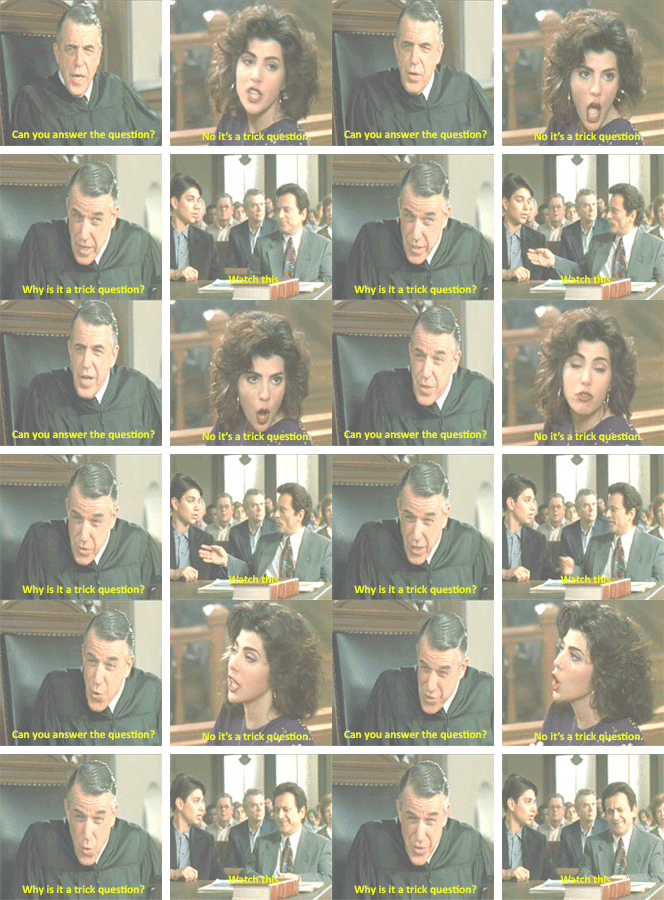
joreth: (feminism)
I watch a lot of '70s and '80s sitcom re-runs with feminist characters. Most of the time, that's why I like them.  But that was the era of 2nd Wave feminism, which is notoriously sex-negative.  So I occasionally have imaginary conversations with these fictional characters defending sex-positivity. This bit popped into my head today after an episode including a porn actress:
We all agree that we should have the right to say "no" and have that respected.  But what good is that "right" to say no if we're not allowed to say "yes"?

That "no" is just as restrictive as anything else the patriarchy imposes on us.  That "no" doesn't give us any freedom at all.  We are still being judged by patriarchal values of sexual objectification.  Required to have sex, required to be chaste - it's two sides of the same coin.

I will say "no" when I mean "no" and "yes" when I want to say "yes".   And if I want to say "yes" more often than someone else, or less often than someone else, as a warrior for the right of women to own their own bodies, the right to say "yes" should be just as important as the right to say "no".

To be judged as "lesser" than other women because one says "yes" is to buy right into those same patriarchal values that led us to fight for the right to say "no" in the first place.  You are still judging me for my sexuality, you are still defining my own boundaries for my body for me, you are still taking away my freedom, my choices, my agency.

You don't have to say "yes" if you don't want to.  But I shouldn't have to say "no" if I don't want to.  Consent is meaningless if you can't say "no", but the right to withhold consent is meaningless if you can't say "yes".

"But self-respect, blah blah blah."

I respect myself by listening to what my body wants and honoring it, not by allowing men to place their own narrow filter over me, telling me when I am worthy of respect by them (and myself) and what makes me not worthy of respect.

I respect myself when I have sex because I want to, and I respect myself when I don't have sex when I don't want to.  I even respect myself when I trade sex for money, at least as much as I respect myself when I trade literally any other labor or experience for money.

It's not the act of sex in exchange for money that makes it disrespectful, it's the commodifying of labor and service to trade for survival that's disrespectful.  

I am worthy of respect from myself and others because I exist, and no other reason is necessary.  My self-respect is not subject to the whims of other people's values.  That wouldn't be SELF respect, then.  Certainly, allowing other people to decide what to do with my body against my own desires and interests would not be respecting myself.
joreth: (polyamory)
www.morethantwo.com/polyprisonersdilemma.html

I wrote a rant a while back about my observation of a gender-based set of tendencies in the poly community. This is basically what I was talking about - People socialized as men have a higher tendency to start out defensively while people socialized as women have a higher tendency to start out cooperatively. But I don't mean that in the emotional sense, because often there is no clear gender line between people who feel *emotionally* cooperative and people who feel *emotionally* defensive.

So, let me expand a bit on what I mean there.
"I tend to see a lot of people in poly relationships who are very uncomfortable with the idea of meeting a lover’s other lovers. This is one of the most common sources of angst I’ve noticed for people who are polyamorous, especially if they’re fairly new to polyamory.

Meeting a lover’s other lover presents a host of opportunity for cooperation or defection. You can reach out to the other person and try to make that person feel welcome; you can be closed up and defensive to that person; you can even be actively hostile to that person. And, of course, your lover’s lover has similar choices."
When it comes to people who think about the idea of metamours, and who feel uncomfortable with the idea of meeting the metamours, I, personally, have not noticed any gender differences. Newbies, generally speaking, feel all kinds of anxiety about meeting metamours - should they or shouldn't they? How should they meet? When? Under what circumstances? Etc.

But when it comes to *actually* meeting, I've observed that, in heteronormative relationships (regardless of the gender or orientation of the participants, these are relationships that fall into heteronormative traits, habits, patterns, can take advantage of hetero privileges, etc.), it usually falls to the women to making it happen. Women are the ones encouraging the men to meet each other, and women are the ones voluntarily reaching out to other women to meet (or ask in the forums how to go about doing so).

Not without trepidation, not without playing dominance games, not without anxiety. But actually *doing* the emotional labor in poly relationships, I see more women doing more of the work.

In my observations, men have a tendency to just wait around until their women partners instigate or organize some kind of event that will bring the men into proximity with each other. Where they might bother to chat, if they happen to be near enough to hear each other, but unless they find some kind of common interest that sparks curiosity and enthusiasm, men have a tendency to just leave it at that and not put forth much effort to go uphill trying to build connection that takes some effort and doesn't happen spontaneously and easily. And if the men are the pivot points, they just sit back and let the women meet or not meet.

But women as the pivots have a tendency, in my observation, to keep talking and prodding their men partners to meet. They're the ones who schedule the dinner date, or host a party, or set up Skype for the men to meet each other. And if the women are the metamours, they are less likely to wait for their pivot man to insist on meeting and they'll send an email to their women metamours, introducing themselves and arranging a coffee date, or whatever.

These observations are not related to how each person *feels* about meeting metamours and not related to the *strategies* each person employs in meeting the metamours. I've seen people of all genders play out dominance games or pull rank or be passive aggressive, and I've seen people of all genders have excellent communication skills and get along well with metamours.

It's the *labor* that's involved that I had noticed often falls along gender lines and that's what I was ranting about in that post. And it has been my observation and experience that, when the women do all this early emotional labor involved in reaching out and establishing contact, then shit gets done because the groundwork has been laid.

Sometimes the "shit" that's getting done is productive. The women build friendships and a level of trust that enables them to weather turbulence in relationships because they built a foundation to have faith that trouble will eventually be worked out. That foundation gives them a sense of resiliency that makes the metamour relationships more likely to be successful and closer-knit.

And sometimes the "shit" that's getting done is not productive, including hierarchical primaries laying foundations for rank-pulling and place-setting and generally undermining the relationship between their partner and metamour. This is when the traps for hierarchy are set for future snapping shut on the poor secondaries and when cuckoos get the eggs in place to push out of the nest.

My point was that "shit gets done" because they start the work early.

But when men, generally speaking, just kind of passively allow their women partners to take the lead, they end up not having these sorts of foundations with their metamours. And then if a conflict ends up happening (which it doesn't always, but if it does), then the men don't have that connection, that trust that they will find a solution together through collaboration. They see themselves as on an island with their woman partner, who sometimes sails over to another island and stuff just kinda happens over there, and then she comes back. They don't see themselves as really *part* of their metamours.

And when men passively allow their women partners to do all the emotional labor in facilitating their own metamour relationships, that adds to the anxiety and stress and *effort* of the women maintaining those metamour relationships. Regardless of whether they all start out cooperating or not, the women metamours in this scenario are doing it all on their own while the men pivots just sit back and let them hash things out. The women carry the burden of maintaining both their romantic relationships and the metamour networks.

I generally have good metamour relationships. Not without their bumps, but pretty healthy and collaborative. But I'm an introvert and managing a lot of emotional relationships is fucking *exhausting*. It would be nice to have a little help facilitating, especially in the beginning when I don't know my metamour very well and we haven't yet found our common paths.

Add to that, the effort I have to put in to maintain *other people's* metamour relationships, because without me poking and prodding, none of my men partners have ever reached out on their own to meet each other.

I take that back - Sterling often reached out without me prodding him. He would often ask me if it was OK to contact one of my other partners and he would reach out to them. But he's the most social extrovert I've ever dated and has none of the social anxiety or concern that people might find his reaching out to be intrusive.

I've dated other extroverts before (and, in fact, I prefer to date extroverts to compensate for my own introversion), but they were either too concerned with pushing themselves on people, they gave up after a lack of reciprocation, or they were simply too passive and content to spend their energy on their own friends and partners.

And I see this *all the time* in other people's relationships too. Once I started seeing the gender split, I couldn't unsee it and it makes me very frustrated at how poor men's communication and collaboration skills are, especially initiating.

But all of that is a side-step to the point of this link. This link is focusing more on the things that people actually *do* to or for their metamours, not the more abstract application of, basically, using the cooperation / defection as a filter through which I see emotional labor.
"In a very literal sense, you make the social environment you live in. People take their cues from you. Even in a world of people who adopt a hostile, defecting strategy, it is possible to do well. On your first move, cooperate. Open yourself. Invite this other person into your life. Only if it is not reciprocated—only then do you become defensive, and stay that way only for as long as the other person is defensive."

"It turns out that even in complex situations, the simplest strategies tend to work the best. In fact, consistently, the programs that were most successful were nice, meaning they never defected before the opponent; retaliating, meaning they would defect if the opponent did, but only to the extent that the opponent did; forgiving, meaning they cooperated and forgave if the opposing program stopped defecting; and non-envious, meaning they did not attempt to score greater gains than the other program."
The bottom line is to start out being nice to someone, start out hopeful and optimistic and see your metamour as an opportunity instead of a threat. If you do that, they are more likely to do it in return. Couples keep asking how to get their potential "thirds" and "secondaries" to "respect" the primary relationship? The only way to do that is to start out by respecting your secondary and their other relationships.

You *have* to give first. But unicorn hunters never want to hear that answer. They *think* that they *are* respecting their secondaries, but the very act of wondering how to *make* someone "respect" a preexisting relationship is an act of disrespecting the other person. You get respect for giving it.

And then, you have to let them fuck up at least once first. That's the Tit For Two Tats strategy that this link mentions at the end. Start out being nice. Then, when they fuck up, assume good intentions and continue being nice. Only after they show a pattern of operating in bad faith do you start reacting defensively, not before.

Intimate relationships are not a medieval war game. If you try to put up battlements first to "protect the primary relationship" from this interloper that you're hoping will "respect" you, you will lose.

War strategies are basically methods for how powerful people fight each other to stalemates - both sides shore up their own walls first and then warily eye each other over the spikes in the walls and promise to cooperate as little as they can possibly get away with before the opposing side decides to retaliate. It's a game of how much can you optimize your own wins before you lose them in a battle when your opponent gets pissed off at your optimization.

Intimate relationships are the opposite. It's a trust fall. You have to open yourself up to vulnerability and you have to be willing to be hurt for the potential greater payoff in the future. Because you WILL be hurt. Your partners and your metamours will fuck up and your tender side will be exposed. That's the nature of the relationship.

But the goal here isn't to optimize our own gains *in spite* of an opposing force. The goal here is to build a cooperative structure where sometimes one side loses a little but sometimes the other side looses a little too and it all balances out in the end where both sides come out further ahead together than they would have alone. This takes them out of opposing sides and puts everyone on the same side.

The goal is to get out of the Prisoner's Dilemma entirely and build up systems where cooperation is always in everyone's best interest, and voluntarily taking turns conceding is in everyone's best interest because it'll payoff in the next round, and everyone is on the same team.
joreth: (feminism)
https://qz.com/991030/your-single-coworkers-and-employees-arent-there-to-pick-up-the-slack-for-married-people/

Not poly but an example of couple privilege, which is so deeply embedded in our culture that we bring these kinds of values with us into poly relationships unless we are consciously fighting against it.

How many unicorn hunters argue that their mythical "third" should be the one to move in with them because they have the family so it would be more of a hardship for them to move? How often do we see excuses for ignoring or dismissing or mistreating secondaries because they're "single" but the couple has a "family" to protect. How often do solo polys bear the brunt of the emotional labor, the financial strain, and various "responsibilities" because the "family" is a priority and needs to remain as such?

#RhetoricalQuestions #CouplePrivilege #IHaveMyOwnResponsibilitiesThatNeedPriorityButNoOneToHelpMeLikeThat

"In fact, single people do more to maintain their relationships with their friends, neighbors, siblings, and parents than married people. They are better at staying in touch with them, and helping and encouraging them. It is different for couples who move in together or get married. They tend to become more insular, even if they don’t have children. When aging parents need help, they get it disproportionately from their grown children who are single."

"Single people are rooted in their communities and towns in significant ways. They participate in public events more often, and take more music and art classes. They volunteer more than married people do for a wide variety of organizations."

"Ideally, only in special circumstances should employees be asked to justify their requests to take time off. Otherwise, in a culture that still celebrates married people and their families... single people may be treated unfairly. For example, employers may be tempted to take more seriously a request to take time off to care for an ailing spouse than an ailing sibling or close friend."

"When single people are caring for their parents and others who need their help, they do so at greater economic risk than married people are. If they put in fewer hours at work, or step away from their jobs, they do not have a spouse to pick up the financial slack—or keep them on their employer-sponsored health insurance. Similarly, when single people get laid off or lose their jobs, they are particularly vulnerable for the same reasons."

"Even more significantly, single people are excluded from more than 1,000 federal laws that benefit and protect only people who are legally married. ... When lifelong single people die, they cannot leave their benefits to anyone else—they go back into the system—and no one else can leave their benefits to a single person either."

"Financial disadvantages in taxation, Social Security, health spending, and housing expenses add up. By one estimate, single women, relative to married women, lose out on somewhere between a half million and a million dollars over the course of their adult lives."
joreth: (feminism)
www.newyorker.com/tech/annals-of-technology/duck-sex-and-the-patriarchy
"Freedom of choice, in other words, matters to animals; even if they lack the capacity to conceptualize it, there is an evolutionary difference between having what they want and not having it. Unfortunately for female ducks, though, evolving complex vaginal structures doesn’t solve the scourge of sexual violence; it exacerbates it. Each advance results in males with longer, spikier penises, and the coevolutionary arms race continues."

"Contemporary anti-feminists often portray men as victims of the coercive social control of women, even as they actively organize to diminish women’s sexual autonomy by impeding their access to health care, contraception, and abortion. But this view is a grotesque distortion. Like convoluted duck vaginas, feminism is about autonomy, not power over men. Although one is genetic and the other is cultural, the asymmetry in ducks between the male push for power and the female push for choice is mirrored in the ideologies of patriarchy and feminism."

" By evolving to regard violent, antisocial maleness as unsexy, females may have instigated the evolution of many elements critical to our biology, including big brains, language, and even our capacity for self-awareness and reflection."

"When sexism becomes unacceptably antisocial and hopelessly unsexy, then patriarchy may finally give up its remaining weapons."
joreth: (being wise)

Misanthropic humanism (n): When you know ppl suck but still get pissed when they're mistreated, exploited, oppressed, & deceived. #Atheism ~ @TheGodlessMama


"Wishing everyone on the road would die in a fire and also have affordable health care and the right to use any toilet they want." ~ Rachel Primeaux Jordan

Finally found my philosophical worldview label.
joreth: (feminism)
Every time some man asks why I'm wearing my iPod (or now my phone) on my arm, I cock my head to the side and say in a blatant "this should be obvious, why are you even asking?" tone:

"No pockets," or "pockets are too small."

It's my way of constantly reminding people of casual and everyday sexism.

Women never ask me why I'm wearing it on my arm.  They sometimes ask me if it's a health monitor (as do some men), but they always say what a good idea it is if they bother to say anything at all (except my mother, who sometimes wishes I wouldn't wear it when I'm dressed up, which is exactly the time I need it most because - no pockets!)

To be fair, about half of the men also think it's a good idea, but every comment about my armband has to be prefaced with a question about why I'm wearing it in the first place.  These men simply can't come up with the answer on their own.  Women know why I wear it on my arm.  That men don't is a symptom of how habitual it is for men to not consider what it's like to exist as someone other than them.

Who asks me about my armband is literally privilege in action.  That's what privilege is like - small, everyday, relatively unimportant stuff that some people never have to think about and others of us have to spend time, energy, or money to compensate for.  In order to ask about my armband, specifically why I'm wearing it, one has to be able to look at me, recognize my attire enough to identify the armband, and never have had the necessity to try and find a place to carry one's phone because a convenient phone-carrying place was built in to literally every possible outfit that one has ever purchased (which itself is often purchased without much thought other than price and approximate fit).

Imagine going through life never once needing to consider how you might need to carry the 3 most important things to carry around on a daily basis - keys, wallet, phone.  And never realizing that only some people never have that consideration.

It should be obvious why I wear my device on my arm - because I fucking want to and it's more convenient or comfortable or useful than alternatives, otherwise I would wear it somewhere else.  This shouldn't ever have to be asked.
joreth: (feminism)
"Geez, what's the big deal?  So what if he wants to open your door or pay for dinner?  It's such a minor thing to be making a fuss over, just let him do it!"

You're right, this one instance *is* a minor thing.  So YOU shouldn't be making it into a big thing if she insists on not doing it.  If it's just a "little thing", then don't get all pissy when she doesn't want you to do it for her.  It's just a "minor" thing, right?  So it shouldn't bother you at all if she doesn't want it.

Oh, right, because it's not a fucking "minor" thing, it's a big fucking deal to both of you.  That's why there's an argument in the first place.  It's a symptom of much, MUCH bigger things, only we're the only ones willing to admit that these things mean more than they seem on the surface.

You're in denial. If it's not a "big deal", then shut up and let her get her own damn door or pay for her own damn meal.  It should be no skin off your nose to let her have her way if she cares more about this "minor thing" than you do.   Or can't your fragile ego handle her "minor" difference of opinion?


"Ladies first!"

That's right, taking point is the most dangerous position that requires the keenest senses for detecting threats and protecting everyone behind them.  I shall scan the room to determine it's safety and security so that you can feel safe before you enter an unknown area.  Thank you for acknowledging that you need a woman to lead and protect you.

#OrMaybeItCanJustBeWhomeverIsMostConvenientToEnterFirstBasedOnDoorMechanics #LetsNotPretendThisIsReallyChivalryBecauseYouClearlyHaveNotThoughtThisOut #ThisIsPureBlindAdherenceToSocialProgrammingOnYourPart
joreth: (feminism)
Found a couple of new identity words that I like, but I don't think they feel right on me. (All words written in the feminized form because the post is referencing a feminist movement regarding the labels).

I posted back on Cinco de Mayo the differences between certain labels for people of Mexican descent, and how I preferred "chicana" over "Latina", as a reclaimed, formerly derogatory word that emphasizes the dual nature of being of mixed ethnicity and living in the US as well as the association with activism.

A few years ago I learned about "chingona" and "maldita". As far as I can tell, "chingona" derives from the verb "chingar", which is "to fuck" and is considered vulgar - a swear word. But more than just "a fucker", a "chingona" is colloquial for basically "a fucking badass" and is also a derogatory slur that some are attempting to reclaim, particularly the feminine version that I'm referencing in this post.

A "maldita" is a step beyond "fucking badass", somehow. The literal translation is "damned" or "cursed" or "accursed", but the colloquial use as an identity label is like a chingona on steroids? They are kinda like Spanish words for "thug", with similar classist and racist undertones and a similar embracing of the term by some.

These are words that I would have vehemently rejected when I was a teen, back when I also rejected "chicana" because of the class implications of "gangbanger", "thug", "good for nothing", "low class", etc. I wasn't one of *those* Mexican-Americans. I spoke proper English and I had a proper education and I lived in the suburbs and I eschewed gang violence and tattoos (and used words like "eschewed").

I live very far from the gang violence I grew up on the peripheries of back in the '80s today. Now I live in poverty, often in a house that would have fit right in with the ghettos I turned my nose up at. I still eschew gang violence and I still speak with a "blank" American accent (slipping into a Southern drawl every now and then).

But many people have been blurring the lines between "thug" and "activist", and many of them have been reclaiming words that are normally used to condemn and dismiss them. Like "chicana". I feel that my temporal distance from the California gangs of the '80s and my observations of how civil unrest is sometimes deliberately masked by oppressors to resemble general "thuggery" has given me a new perspective and newfound respect for the title "chicana".

With my memories of the gangs and my distance from my Spanish-speaking culture, I don't feel that I can claim "maldita" and "chingona" for myself, nor that I fully understand all the subtle cultural nuances of the terms. But I like that I learned about them and I like that they exist. I think they'll be rolling around in the back of my mind for a while.

https://web.archive.org/web/20170417034346/https://soyxingona.com/about-me/what-is-a-xingona// - "A Xingona is a woman who is on her game. Basically she has skills that no one else has strived for only by first hand experience. Xingonas aren’t brought down by bias, machismo, prides, and over-rated ego. She gets shit done because she can and she will."

https://alvaradofrazier.com/2012/07/14/frida-kahlo-chingona-artist - "The term 'Chingona' is a Spanglish term, slang, for a bad ass, wise woman, powerful, individualist, self-activated, a woman who lives a life for their own approval, self-empowered, a strong woman..."

https://www.huffpost.com/entry/how-i-define-my-chingona-fire_b_5887de69e4b0a53ed60c6a35 - "Chingona: noun. 1. a Spanish slang term meaning 'bad ass woman'. Although the word 'chingona' is a Spanish term, it is not limited to Latinas. A chingona is any woman who chooses to live life on her own terms. PERIOD. She is the scholar AND the hoe. At the same damn time. OR she is neither. The point is: she gets to choose. And whatever choice she makes, is the right one."
joreth: (anger)
I tell ya, I'm really irritated at men who think they don't act emotionally.

I recall once where I was complaining about someone who emailed me to say that they weren't going to buy anything from my t-shirt shop until I included this one gender combination on my shirts that I had left out when I had come up with like a dozen different combinations, and I said that I was going to refuse to add that combination just because he demanded it and if he wanted that combination he would have to request a custom shirt to purchase like anyone else who wanted something that wasn't already in my shop.  My partner to whom I was whining pointed out that I was reacting emotionally, and I said "yup! I am feeling petty so I'm just not gonna" or something to that effect.

I had another relationship once where the entire fucking relationship could be summed up as "he doesn't believe that he reacts according to his emotions and thinks everything he does is perfectly logical and reasonable".  OTG he was like the most irrational, illogical, emotion-based person I've ever known, he was just really good at *justification*.

Like the time that he got all freaked out when I started dating someone new.  He refused to acknowledge it, but he had been hurt really badly in his first serious relationship (and now that I know more about culturally enforced, misogyny-based abuse, I can see now how he did it to himself, but that's another tale).  So every relationship he had after that point was arranged to prevent him from feeling that hurt ever again.

So he refused to tell me that I couldn't date this other guy, which is a good thing.  And he refused to *ask* me if I would not date this other guy, which is also a good thing.  But he couldn't admit that he was *bothered* by me dating this other guy.  Instead, one week, before I and the other guy even decided that we wanted to date, my then-partner counted hours.

So, here's the thing... there was a special, one-time showing of an indie film happening in the new guy's town, which was 2 hours away from me and my then-partner.  He organized a group of mutual friends to go and invited me along.  My then-boyfriend wanted to go too, which I thought was weird because he never expressed interest in that type of movie before or in that group of friends, but whatever, it was a group outing.

So we get to the movie and the new potential moves into the row of seats.   My boyfriend cuts me off to get into the row before me and sits next to the potential, so that I couldn't sit next to him.  So I stood there, looking at him oddly until he got up and let me sit between them.

After the movie, everybody hugs everyone goodbye as is common in that group of friends and my potential gives me a kiss on the cheek, which is new for us.  The rest of the way home was stony silence until I pushed him into an argument.  He got all pissed off at me for inviting him along on this "date", why didn't I just tell him to stay home so that he didn't have to watch his girlfriend making out with another dude?

Keep in mind that this guy was a poly *veteran* and I had 2 other boyfriends at the time, one of whom he has watched flog me and make out with me at parties before.

So no amount of explaining or clarifying that this wasn't a "date", that I didn't "invite" the boyfriend, he invited himself, that we didn't "make out", and that I had already told him that the new potential was a potential and we were dancing around the idea of dating.  The argument ended, but never got resolved.

But I tell that story not because of the content of the event, but because the 4-hour round trip car trip that I took *with my then-boyfriend* and the 2 hours spent at the theater *in a group not talking to each other* was "counted" among the hours I had spent with the new potential.  Which is bad enough on its own, but then he also *deducted* an entire 24-hour period that I had spent with him that week, which was not scheduled and which cut into my crafting time even though I had a con deadline coming up, but that I offered to spend with him anyway because I could tell he was feeling anxious and left out and I wanted to reassure him.

So, if you add up the 6 hours for the movie and take away the 24 hour spontaneous date, that makes 6 hours for new guy and 4 hours for existing guy, so clearly new guy wins and I'm obviously more interested in him than existing guy and planning to dump him soon.  Those are numbers!  They're objective fact!  There are no emotions here!  6 is clearly bigger than 4!  You can't argue against that!!!  He's not being irrational or lashing out because of his emotions, he's just plainly stating facts.  And facts are facts.

I mean, except for the part that his numbers were completely pulled out of his ass, the point is that he couldn't admit to reacting out of his emotions, which don't necessarily reflect reality.  No, he had to retreat into "logic" and "reason", which were anything but logical or reasonable.  But to him, he had to have an *argument*, a *case* to win.  There was no sharing together, no collaboration, no acknowledgement whatsoever that feelings ARE FUCKING REAL THINGS and affect the way we perceive the world and the way in which we see ourselves.

His problems were way deeper than this example, btw, but I don't want to spend any more time on talking about him because it's not just him.  One of the reasons why I always identified more as masculine is because I have such little patience in dealing with emotional conflict.  Almost every relationship I've ever been in has ended in *his* tears because he has such overwhelming emotions that he doesn't know what to do with them.  But, at the same time, these guys just. refuse. to admit. that they're feeling feelz.  So I get stuck in HOURS-long debates, day after day, as they try to "reason" with me about whatever the fuck has them feeling insecure.  So after a few years, I just threw my hands up and said "fuck, you guys are so fucking emotional!" and stuck with casual sex for a while because I was so damn tired of managing other people's emotions.

Then, I started getting into poly relationships with guys who supposedly are better at communication and not so attached to toxic masculine standards.  Nope, same bullshit.  Emotion fucking everywhere, but long "debates" to hide them behind.   And Cthulu forbid you point out to them that they're having a fucking feeling!  Well, anger is OK to feel, and frustration.  But being afraid?  Feeling not worthy?  Feeling small?  Feeling unloved?  Shit, even the good emotions - happiness is OK (not to my fucked up ex above, though), but tenderness?  Vulnerability?  Even elation and non-sexual passion is touchy because if you feel *too much*, that's also not manly.  Or something.

But feelings are what give us the motivation to act.  They're how we prioritize what we want to act on and how we're going to act.  We literally cannot make decisions without feelings.   And when some guys get it in their heads to do something that ends up hurting someone else, they get really entrenched in the idea that they've logically, rationally, thought everything through and decided this was the best course of action, when in reality, they *felt* something and reacted and then post hoc logicked up their justifications, which they now are invested in maintaining because to do otherwise would reveal the illusion that they are reacting in emotion.

I'm even willing to concede some things if they say "I want it done this way because I'm feeling emotions" instead of trying to logic me into agreeing with them.  I had a freakout with a partner a while back, and I asked him to do something for me that, honestly, is a little unreasonable.  But I owned it.  I knew when I asked him that it was unreasonable, and I admitted it and I admitted that I asked it of him because I was feeling.

So I also said that it was OK for him to say no, and I had to really mean that.  Before even asking, I got comfortable with the possibility that he would say no, and I resigned myself to just dealing with the feelings.  If this is how men approached it with me, I might be a little more willing to bend on some things.  I might actually be willing to do the unreasonable thing, because this kind of self-awareness and ownership is a good sign that they really will work through the feelings and the unreasonable thing won't be a permanent setting or a pattern of the future.

But, in my experience, that's not what guys do.  They have an emotion, they react, and they instantly come up with all kinds of "logical" reasons for taking action.  We know that people do this all the time, about, like, everything.   There are even studies for it.   See?  Logic & reason & science, so there!  So when I get mad about it, we have to fucking *debate* every goddamn detail like it's a fucking courtroom case that can be won or get thrown out for a technicality, and all of it misses the main point - that he's feeling something.

There are 2 other examples here, both from one guy.  In one, he refused to admit that he was afraid and that his fear was clouding his judgement.  In the other, he owned up to the fear, but then made his partners responsible for it.

The first example: he was absolutely terrified of HSV.  Y'know, the "std" that is the most common and least harmful of all of them?  The one you can get from your fucking grandma?  But not just from fucking your grandma, just to be clear.  So, through a long chain of network metamours, he "discovered" (because he forgot that it was disclosed it to him when he became connected to the relevant part of the network) that some metametamour had HSV, but that all the people between him and that person consistently test non-reactive for it.

So he threw a fucking fit over it and the idea that one of his partners was fluid-bonded to someone who was connected to this other metametamour.  He didn't want his partner and her other partner to be fluid-bonded because of his phobia, so he bombarded them with "studies" about how latex barriers reduce the risk of transmission.  He retreated into "logic" and "studies" and "science" because he couldn't admit that he was terrified of something that actually posed no threat to him (and I mean that literally, he later tested reactive for HSV himself and had it the whole time, he just didn't know about it because he was asymptomatic).  It would be like a big manly man admitting a phobia of mice or something.  Instead, he had to scour the internet looking for studies on rabies in mice and people who got sick from exposure to housepets.  There's even more outrageousness to the story, but this post is already long.

The other example, he was absolutely terrified of his partners having other partners.  And by "terrified", I mean that he described his feelings in terms of someone going through a PTSD trigger episode and he used that to justify the use of PTSD therapy techniques to deal with it.

What I mean is that he admitted that he was having a totally irrational emotional meltdown at the very idea of his wife having a male partner.  He owned up to that.  But then he *used* that to justify controlling his wife's behaviour.   He ranked various sex acts from kissing to PIV, even breaking down different *positions* for sex as their own separate item.  Then his wife was not allowed to do each act until he went through a "desensitization" process that included first thinking about them doing the act, then talking about them doing the act, then them doing the act in front of him, and then finally doing the act without him present but her describing it afterwards.  Each time resulted in shaking and a literal catatonic state, and only when he could do that stage without shaking and going catatonic could the wife and her boyfriend move to the next stage.

However, as the wife racked up individual sex acts that she was allowed to do with her boyfriend, this guy used that as "proof" that he was "getting over it".  See?  This is how PTSD is treated!  There are papers on it!  He's following an approved psychological method!  It's science!  How can it be wrong?

As I read through Why Does He Do That, on the section on how individual psychotherapy and marriage counseling actually enables abusers because it doesn't attack the root issue and instead solidifies the attention back on the abuser (which is what he wants), this is so clearly what's happening here.  He's going through the motions of being a "sensitive" man, of acknowledging his "feelings", but then he pawns off the responsibility for dealing with those feelings onto his female partners and backs up his actions with "logic" and "science" and "reason".  And he never reached a point at which he had to stop "desensitizing" himself to things, he just got "desensitized" to specific actions.  He still "needed" this massively invasive controlling behaviour because he never stopped feeling his feelings.   He just moved various activities in and out of the "trigger" category by making his partner responsible for "triggering" him.

He, like so many others, can't just say that he's having strong feelings and those feelings are making him act like an asshole because it's hard not to act like an asshole when you're feeling strong feels.  Just, will guys just fucking start owning up to lashing out in feelings for a change?  Maybe then we can start moving onto what to do about those feelings so that you don't act like an asshole in response to them, but right now I'd settle for guys who just own it first.

And you?  You right there?  The guy who is shaking his head in amazement at all the assholes I've known and feeling just a little bit smug that you don't do this (or you stopped doing this)?  Yeah, you probably still do.

joreth: (feminism)
Country music has a bad reputation for being pretty misogynistic.  The current crop of pop country is especially bad about that, sparking an epidemic of songs about girls in tight shorts who do nothing but sit in the cabs of pickup trucks.  But like most genres, country is actually pretty diverse and has a prestigious lineage of feminist music.  I've been building a playlist of "feminist" country music and I'm up to more than 50 songs so far.

Unlike Hollywood, however, this list is nuanced and shaded.  The movies would have us believe that there are only 2 kinds of feminist representations - the badass Strong Female Character who can kick ass (except when she needs to be rescued by the leading man, of course) and has no other personality, and the man-hating harpy.

But this playlist shows many sides to the "strong woman".  It's not all about women beating up their abusive men in retribution, although those songs exist too.  In many places, it intersects with classism (although, to be fair, it's still predominantly white, as is the larger country genre, but there is one song in there about interracial relationships at a time when they were still taboo), where sometimes some ideals have to be sacrificed for the more immediate need of survival. Sometimes it's not about triumphing at all, but about existing in a misogynistic society.

There are tales of revenge, of liberation, of parenthood, of singlehood, of being caged, of sexual freedom, of running out of choices, of standing up to authority, of making the system work in her favor, of rejecting her circumstances, of accepting her circumstances and making the best of them, of birth control and abortion and sex, of career options and motherhood choices, of sorrow and pride and love and heartache and loneliness and optimism.

They are all stories of being a woman. This is what feminism looks like.

joreth: (Default)
www.buzzfeed.com/andyneuenschwander/which-female-mythological-monster-are-you

Accurate

You got: Harionago

The Harionago from Japan often appears as a woman with long, beautiful, flowing hair...that has sharp barbs or talons at the ends. As the legend goes, the Harionago laughs at men who pass by on the street, and if the men laugh back, she stabs them with her hair. In short, the Harionago takes no bullshit, and neither do you.
joreth: (feminism)
www.racked.com/2017/1/18/14112366/dressing-like-an-adult-sophistication

This is interesting. I thought it was going to rely on slut-shaming in order to make its point, that dressing "sexy" was bad so, ladies, cover it up! But that's not the take that I got. I also thought it was going to blast millennials by comparing youth to age in this specific time. But it didn't do that either. If anything, it picked on Baby Boomers.

I'm letting my hair go grey on its own. When I visited my mother before the pandemic, I had more grey than she did because shes not ready to let the world see her age (although she finally leaned into grey hair with the social trend that came about during lockdowns of more "natural" hair styles). I have nothing against people who color their hair because they like the color. But I'm not going to color mine because I *fear* my color.

This article wasn't about shaming people for their arbitrary fashion choices of today. It wasn't yet another "kids today don't know what's good for them!" It was a more subtle look at the way our culture dismisses older women (with a nod to the effects older men get too) and an appreciative look at the experience and complexity that can come with age, as seen through fashion.
"Before, girls aspired to wear the sexy draped dresses only deemed appropriate for over-30 women who could handle the consequences of showing off their cleavage. Today, if you were to read some women’s magazines at face value, we’re left with nothing to look forward to past the minimum age of renting a car.

The culprit? The baby boomers and the 1960s Youthquake. "

"“By the age of thirty, most women were married, held jobs, or both,” writes Przybyszewski. “And they were presumed able to handle the eroticism embodied in the draped designs that made for the most sophisticated styles.” Draping gathers excess fabric into unique waves that draw attention to the wearer’s womanly curves and the tug of gravity. “It offers a more subtle eroticism than our usual bare fashion,” she writes. "

"The only acceptable way to present old age in public is to completely efface it. "

"But what if we accented our age on purpose to show off our hard-earned sagacity?"

"You could either get botox or celebrate the raw power of gathering decades of knowledge of yourself and the world. I say, let’s assemble a squad of matronly motherfuckers."
joreth: (feminism)
https://theestablishment.co/special-snowflake-my-ass-why-identity-labels-matter-3b976b1899a4/

I've been arguing against the "I don't need no stinking labels!" crowd since I first encountered them. Not "needing" a label is a form of privilege. That's wonderful that you, personally, can move through life without ever having your personhood challenged or needing to do work in order to find people who are similar to you or who accept you.

The rest of us use our biologically advanced tool of language to communicate abstract concepts with each other like who we are and how we work to be "seen" by others and to find each other because we're not as visible or as numerous as some people are and we live in worlds that are hostile to differences.
"Labels are crucial for anyone whose experience isn’t positioned as the default in our society."

"That’s what labels do — they empower marginalized people. Through our identities, we build communities, we learn about ourselves, we tell our own stories, we celebrate ourselves in a society that often tells us we shouldn’t, and we come together to stand up to oppressive systems.
Our identity labels hold power."

"Remember those Earth-like planets NASA recently discovered? Well, they’re currently in the process of naming them — because that’s what often happens when you discover something that you didn’t realize existed. Notice I said “you didn’t realize existed,” not “new.” Many of these identities aren’t new — it’s just that people are only now starting to learn about them and name them."

"On a daily basis, people are discriminated against for being something other than white, thin, neurotypical, cisgender, heteroromantic, heterosexual, and whatever else is perceived as “normal” in our society. If you fit into any of these categories, then you experience privilege. Some of your identities are more accepted, or at least more widely known. You don’t have to explain yourself everywhere you go. You don’t have to worry about facing discrimination throughout your day.

That’s privilege."
joreth: (feminism)
https://nypost.com/2017/03/20/why-your-schlubby-hubbys-aging-worse-than-you/

Here's a *classic* case of the sheer wrongness of "reverse sexism" in action.

Imagine that - you pressure women to obsess about their appearance for their whole lives, they end up spending 40 years researching and trying out all kinds of different things in an effort to slow the clock, but give guys a "free pass" in looks and 40 years later they have absolutely no skills in taking care of themselves.

Poor babies. All those decades of women "nagging" their husbands to eat better, to exercise, and to finally give up and attempt dieting and working out on their own since their husbands won't deign to participate in "women's stuff" somehow managed to make 2 entire generations of men "surprised" when their aging catches up with them and their wives are still working their asses off (literally in some cases) to maintain their youthful appearance so as to not lose their jobs or social capital.

When I was a kid, my mom was forever on a diet. She tried aerobics, she tried Weight Watchers, she tried just about everything. But not my dad. No, that's what "women" did. It wasn't any kind of overt, malicious sexism, just that dieting, exercising, and looking youthful was for women. Dad only put on sunscreen when mom nagged him to. Dad only ate healthy when mom cooked (they both worked full time so they shared in the cooking). And then, all that healthy cooking was negated by the GIANT bowl of ice cream every night. Dad did absolutely nothing physical other than simply moving his body to the places where the body needed to be.

Ignoring the extreme end, where men and women are both health and appearance conscious - the average, everyday sort of people still have a strong gender divide where women are expected to care about their appearance and men are not. It is considered "sexy" for a man to be "rugged" and to have a weather-worn appearance and way less of a big deal for men to have a pot belly and sagging jeans than women. But after a few decades, that rugged, weather-worn skin looks a lot different from skin that was taken care of for the same decades.

Women are expected to wake up an hour (or two or three!) earlier than men to "put on their face". Then they have to carve out time in the evening to take off that face and care for the skin underneath all that makeup. Throughout the day, they have to reapply their face, plan and create healthy meals, and exercise. Once or more a week they have to find time to do certain other rituals that might not need to happen daily, like facial scrubs, manicures, etc. From the article itself, "[she] gets massages twice a week, regularly practices yoga and undergoes microdermabrasion, vampire facials, injections, IPL therapy and other skin-care treatments".

In addition to the time investment, this all cost a shit-ton of money. I do none of these things because I just. can't. afford it. So it's really *expensive* to be a woman in this culture.

But this article is framed as though women are somehow *fortunate* to have been "taught" all this diet and exercise and skin-care shit. Like we didn't get brutally teased or bullied for not living up to the expectation, or we don't literally get less sleep to keep up appearances, or we don't spend a small fortune of our smaller paychecks to maintain an appearance that could seriously, legitimately, harm our ability to hold down a job if we didn't.

"Robert" actually thinks it's a "luxury" that women he knows don't work as much as men do and can take the time to workout every day! Yeah, because not having your own independent income is SUCH a luxury! Women who lack their own income stream are NEVER tied to their male partners' income in this way and often trapped in relationships or situations because they can't afford to leave! We're just so FORTUNATE to be dependent on people who think everything we do is silly and meaningless ... until they need that information for themselves.

Like the poor dermatology patients, nobody told them to wear sunscreen! Like, in the last 30 years when the sunscreen market exploded with a million different SPF levels and headline-making "news" reports about the damages of sun and skin cancer rates and probably his wife pestering him for a little while to wear sunscreen until he shut her down for "worrying too much" so she just gave up and only applied it to herself, nobody told them to wear sunscreen! Ever!

And not a one of them had parents who got shriveled and shrunken and leathery and who developed diabetes and arthritis and a slowing of the reflexes and mental acuity! Not one of them had a parent that they watched age to teach them that they probably should do some preemptive work on themselves!

This is not a "side benefit" to sexism - ladies, hate your culture making you feel like shit for how you look? Well, at least you will look better than your husbands when you're 60 and they're struggling to sift through all the diet pamphlets they're bringing home from the doctor! You've spent your entire LIFE reading book after website and trying fad after fad! Aren't you so lucky that you didn't have to wait until you were a senior citizen to start that?!

Guys, diet and exercise are not "women's things". They are important topics for your health. If you wait until you already look and feel like shit, it's too late and the best you can hope for is to slow your already rapid demise. But the fact that women are required by society to study and apply this shit from an early age is not an example of "women's privilege".

This is an example of the Patriarchy backfiring on itself. Women are oppressed by social beauty standards so they start much younger on learning about health and appearance. The fact that men don't figure out the importance of health and appearance until their bodies start falling apart is not a *privilege* of being a woman, it's an unintended consequence of a system that oppresses women via the appearance route while letting men off the hook for the same thing.

Stop pissing on women for the amount of time it takes them to get ready, for wearing makeup (or "too much" or the "wrong" style), for being concerned about things like sun damage, their weight, their appearance, their future. 1) Women need to not be pressured to be changing their appearance to suit someone else; 2) Men need to start caring about their own health, of which appearance is an indicator of some things.

Maybe if sunblock came in a steel container that you had to open by pounding a hole in the top with an awl and hammer, and was named something like MANLY GUN OIL BUT FOR YOUR FACE IN THE SUN, guys would wear it instead of waving it away when their wives offer it to them and then show up at the dermatologist's office 30 years later asking "why didn't anyone tell me I needed sunblock?!"

Sunblock - it's so manly and rugged, it can even withstand THE SUN!

Sunblock - it's like waxing your Camero or your Hummer with weather protectant, but instead of your MANLY CAR, it's your own skin!

Sunblock - It's fucking ARMOR, dude!

Exercise regularly and eat everything in moderation and a variety of things, mostly leafy greens. Stay out of the sun and wear sunblock when you can't. Moisturize. No wonder men have a lower lifespan than women - y'all don't take care of yourselves and then blame it on everyone else for not "telling" you about it until later, when women have been talking about health and appearance the whole time but you just didn't want to hear it because that's "women's stuff".

Boo fucking hoo.
joreth: (dance)
www.quora.com/What-is-the-most-inappropriate-interaction-you-have-had-at-a-club/answer/Joreth-Innkeeper

Q. What is the most inappropriate interaction you have had at a club?

A. I've had 2 that I can come up with off the top of my head and they happened on the same night.

I was at a regular nightclub with some swing dancers, and towards the end of the night, everyone had left except for 2 guys I know.  They were off dancing with some non-dancers they had met.  I was approached by a guy who is not a dancer, but who was clearly drunk.  He asked me to dance.  He said that he saw me dancing earlier and knew that I was with a group of actual dancers, not your typical drunk club girl.

Now, partner dance etiquette is to accept dance requests, dance one song, thank your partner for the dance, and return to your place to dance with someone else.  You can dance with them again later, but you don't dance multiple songs in a row because you don't want to monopolize anyone's time.  I get that non-dancers are not aware of this, but I still do this even at nightclubs.

We danced one song and he was terrible.  He was sloppy drunk and unable to tell that his clumsy manhandling of me was wrenching my shoulder.  So I thanked him for the dance as soon as the song ended and I turned and went back to my spot.  He followed me, demanding to know why I had left him on the dance floor.  I told him about proper dance etiquette, and that he got his dance with me, now I was done.  He backed me into a corner to prevent me from leaving and started arguing with me about dancing more with him.

Right about when I was getting ready to pull out my knife to get him to back off, one of my 2 dancer friends left saw what was happening and rushed over to grab my hand and pull me on the floor.  The asshole shouted after me something about being a bitch for going to dance with someone else.

A couple of songs later, I got asked to dance by some other drunk guy.  I accepted, and he attempted to hold me like he had seen the real dancers holding me, but as usual, he had no clue how to do it right.  He held me way too close and his hands were way too low on my back.  I started leaning away from him and he started holding me tighter.  He tried to spin me in a clumsy spin, and when I came back from the spin, he grabbed me in a full-body embrace and kissed my neck.

I pushed him away and walked off the floor.  He grabbed my arm to pull me back, but the other dance guy who was still there saw me and dove between us, putting me into a proper dance hold and whisked me away.

This second asshole tried to cut in, but my dance friend yelled back at him that I was "his" and he wasn't letting me go again.  He quietly asked me how "friendly" he could be to make his point, and I gave him permission to be *very* friendly.  So he put his hands on my butt and kissed me.  Finally the asshole left.

I hate displays of possession, but the behaviour of these two jerks left us only 2 options - allow someone else to "claim" me so that they would respect my rejection, or escalate to violence.  I chose the non-violent response first, and fortunately I did not have to fall back on the violent one.
joreth: (being wise)
This post was originally commentary I attached to a link to some other article that has since been removed and I don't remember enough of the article to search for an alternate copy of it or a wayback machine archive of it. But I've used this commentary in other discussions since, so I'm archiving it here. If I find a relevant article to attach to this commentary, I will amend this post. I think it might have been the story of the real-life "Lord of the Flies" where a group of boys was shipwrecked but they formed a cooperative culture until they were rescued? But I'm not sure.


I got into this argument with a former metamour once. Apparently she had read some well-written book about the Stanford experiment and waxed philosophical about the terrifying nature of people, and I criticized the experiment for its many flaws which means that we can't draw the conclusion that people are fundamentally evil and corruptible, but that *privileged white boys who want to impress their authority figure who removed their accountability in the first place* are the only ones we can draw that tentative conclusion about.

She also really did not like me saying that.
  • When people are raised at or near the top of the privilege ladder;

  • When they are given absolute authority with no accountability and no personal history of education or exposure to the responsibility of authority;

  • When their own authority figure involves himself personally in the experiment instead of recusing himself;

  • When *someone believes their victim is consenting* (because the victim is a volunteer who, presumably, can "opt out" at any time, and they don't understand what happens to a victim's ability to consent *even when they originally volunteered*);

  • When they believe the whole thing is play-acting and *are told to take on a particular role*;

  • When they come from a society that says one class of people is subhuman and then they are told to play a character in charge of said sub-human who is also supposed to be a "character";
When all these things happen, as they are far more likely to do when someone is raised white, male, and middle-class than in any other demographic, THEN you get this outcome.

When someone is raised with empathy as one of their highest values, and are taught throughout their life about the responsibility that comes along with authority, and that other people are real people too, and that consent can be revoked at any time but certain times are really difficult to retract consent from, and that rehabilitation is both more effective and more humane (and that it's admirable to be humane) than punitive justice systems - you don't get this outcome.

As we know, because we've seen how other cultures handle their justice system. And not everyone devolves like this.
joreth: (boxed in)
There have been a lot of rumblings in my various communities about the lack of accessibility for basically everyone other than straight white educated cismen. One popular option that a lot of people are choosing to take these days (and I wholeheartedly support them) is to look at the speaker lineup, and if they are the only POC or woman or disabled person or whatever on the lineup, then to decline the invitation to speak.

Another option is to do the same thing as a guest. A third / fourth option is to do the same thing *as* straight, white, cismen and to do it publicly as a way to give up your seat for someone who is not (especially if your "seat" is on a panel or podium discussing accessibility issues).

As I said, I support this choice completely. However, the consequence of all POC and women and disabled people et. al. refusing to participate is that these events *remain* white, straight, male, and able-bodied.

So, if we are a member of an underrepresented demographic, and we get invited (or accepted) to speak at an event where the speaker lineup has less diversity than we'd like, and we have the spoons or the matches or the hit points for it, and our lecture topics work this way, I'd like to propose doing more of this in addition to our boycotts.

Give our lectures and workshops and panels in ways that absolutely do not benefit the people who are not us but that do benefit the people we are trying to make these events more accessible for.

This will not be applicable to everyone who speaks. It's most easily demonstrated with something like hearing loss because accommodating people with hearing difficulties tends to be *inconvenient* for people who can hear, whereas many other forms of accommodation benefit everyone or most people even those who do not *need* the accommodation.

One of the things that I do is, in my Simple Steps workshop, where we take dancing exercises and learn how to apply them as actual communication tools, we deliberately arrange this hands-on workshop so that men have to touch other men.  Everyone other than straight cismen is socialized to allow some form of physical contact (often whether it's wanted or not), but straight cismen get to indulge in their homophobia because of the homophobic culture.

So we do not accommodate them.  They are forced out of their comfort zone in our workshop.

Obviously, this has limitations.  People who have mental health issues regarding physical contact will find our workshop difficult for them. We made a choice to focus on this one issue, and the nature of the workshop is to be hands-on and interactive.  But the same goes for the ASL speaker in the original meme here - people who have eyesight problems would have had difficulty in his lecture too.

Another thing that I do is I make many of the events I host to be either child-friendly or low-cost / free (or both) because poverty is one of my pet SJ issues.  I am not a fan of children.  But I make as many of my events child-friendly because I know how expensive child-care is and how difficult it can be to participate in a community when everything costs money and time and there are children at home.  Children running around an event is inconvenient to many adults.  But without childcare options, poor people (and mostly women) are left out. 

I will be considering some of my more popular lectures and workshops to see if I can adapt them to make them less convenient for various target audiences, to illustrate this point.  If there is a way to make your lectures more accommodating to the people you are representing while simultaneously making it less accommodating to the non-representative audience, please consider this act of civil rebellion in lieu of just not participating at all.

If we want separate spaces, that's one thing, but if we're asking for more inclusivity, some of us have to be the ones to barge through the door. Otherwise, the room will remain monochrome because we've all decided that forcing the door open is too much effort.

No photo description available.

Event Organizer: We're sorry, there won't be interpreters at the event where you are presenting about Deaf things, sign language, and interpreting.
 
Me: No problem, I'll present in ASL without interpretation. Hearing people will have to get by.

EO: Ummm ...

I presented for 25 minutes, and opened with a couple of slides in written English that explained the situation. Told them to stay, so that they could "learn a lesson they didn't come here for." They all did.
joreth: (feminism)
www.quora.com/What-can-I-do-if-my-wife-teaches-my-daughter-piano-but-I-want-her-to-do-gymnastics/answer/Joreth-Innkeeper

Q. What can I do if my wife teaches my daughter piano but I want her to do gymnastics?

A.
What does your daughter want?

She’s a human being.  Her desires for her body, time, emotions, etc. are the only ones that matter here.  If you’re funding her activities, you can technically be allowed to place limitations on them based on what you're willing to pay for, but as for encouraging her what TO do (as opposed to what not to do)? That’s all her.

Your interest in your daughter pursuing gymnastics is completely irrelevant.  So is your wife’s interest in teaching her piano.

Find out what YOUR DAUGHTER wants to do and stop treating her like an extension of yourself that you get to force into doing whatever it is you’d rather be doing but, for whatever reason, aren’t doing yourself.

If she wants to learn piano, then that’s what she should learn.  If she wants to do gymnastics, then that’s what she should do.  If she wants to do both, then find a way to allow her to do both If she wants to do neither, then suck it up and treat her like the human person she is, and encourage her in her endeavors like a responsible, loving parent.

She is not your doll, to dress up in the profession and hobby you want her to do.  She is a person.  She gets to make the decisions about how she spends her time and what she puts her body through.

Honestly, these parents who think their children are extensions of themselves instead of human beings in their own right!  This is how you get adult children who stop talking to their parents.

Respect her autonomy.  She’ll be a much more loving daughter if you respect her.
joreth: (feminism)
People don't seem to understand that everyone has a right to life just not at the expense of someone else's right to choose to not support that life with their own body. We get it when it comes to organ donation, but for some reason not full-body donation.

www.quora.com/Would-you-opt-for-an-abortion-or-put-your-kid-up-for-adoption/answer/Joreth-Innkeeper

Q. What are the reasons you would chose to abort a child rather than carry it to term and put it up for adoption?

A.
I don’t want to be pregnant. As said elsewhere, there shouldn’t need to be any further explanation. I do not want to donate my body to the incubation of another.

Lots of people don’t want to be organ donors either, but nobody is lining up to take away their right to bodily autonomy and force them to donate organs without their consent, even though it would save someone’s life.  Even though it would *kill someone* to refuse to donate.  An actual human person with history and loved ones and memories and plans, unlike a fetus.

I do not want to be pregnant. My reasons for why I don’t want to be pregnant are not necessary for anyone else to know. I want to have the same rights to bodily autonomy that you have as a corpse, where even in death, nobody can make you use your body to give life to another if you don’t want to, regardless of your reasons why.

I don’t want to be pregnant and it’s my fucking body. That’s enough of a reason.
joreth: (polyamory)
www.quora.com/What-is-the-safest-most-discreet-way-to-find-a-suitable-man-for-my-wife-to-have-sex-with-We-are-new-to-this-type-of-open-relationship/answer/Joreth-Innkeeper

Q. What is the safest, most discreet way to find a suitable man for my wife to have sex with? We are new to this type of open relationship.

A.
For the love of whatever you find holy, don't "find a suitable man for [your] wife". She is an adult woman. She has her own preferences, desires, opinions, needs, wants, and boundaries. And since it's her body and her experiences that'll be involved here, none of those things have anything at all to do with you.

I know, I know, "but she's my wife! What happens to her affects me!" Sorry, but in this case, it has nothing to do with you. She is the sole arbiter of her. Only she should have any say at all in what she does with her body, mind, emotions, and time. If she loves you, she'll take into consideration how her actions with another affect you, but ultimately, this is something that is happening *to her*. It's something that *she* is experiencing, not you. You are not relevant in this equation.

Therefore, you should not insert yourself into this experience for her - not to "find a suitable man" for her, not to control or dictate the encounter, not for anything. This is all about her, not you. Stay the fuck out of it.

As for "safe" and "discreet", several online dating apps are adequate for people looking for hookups. Your wife (and her alone) can create a profile sharing what she (and only she) is looking for, and she can be a grown up and do her own homework on vetting potential partners.
She chose you, didn't she? Either she is capable of finding her own partners that are good enough for her, or she isn't. If she isn't, that says something about you. If she is, then let her go about her business and trust that she loves you enough to take care of her relationship with you.

Relevant:

Related:
joreth: (boxed in)
www.quora.com/Wives-would-you-be-upset-if-you-are-overseas-and-your-husband-hangs-out-with-a-gold-digging-female-friend/answer/Joreth-Innkeeper

Q. Wives, would you be upset if you are overseas and your husband hangs out with a gold digging female friend?

A.
  1. I am not overseas but I am literally about as far away from my spouse as I can possibly get without crossing an ocean or international borders. We live on opposite coasts and also on opposite north/south borders.

  2. I do not police who my spouse hangs out with. He's a grownup, he can manage his own friendships. Nobody can do anything to him that he doesn't permit (short of actual robbery or violence). I have nothing to fear from any other person. Should my spouse do something with another person that makes me upset, that would be his fault, not hers, because he is responsible for his own actions.

  3. I do not make assumptions about the motivations of other people. This question implies the assumption that said "female friend" is not just interested in securing economic stability, but that she is planning on doing so at the expense of my spouse. That's a whole lot of unspoken assumptions right there.

  4. Should any woman attempt to manipulate my spouse into some kind of con for the purpose of getting his money, I probably wouldn't do anything about it but laugh at her. My spouse is broke. Of the two of us, I'm the one with the money, and even I live below the poverty line. Plus, we have a pre-nup and our finances are separate and we maintain separate households. He might get swindled, but my finances won't be touched. And then he might learn a lesson about being too trusting too soon.

  5. I do not throw other women under the bus. Other women are not my enemy. The term "gold digger" was deliberately and consciously subverted by a wealthy patriarchal class who was offended at the idea of women achieving any socioeconomic power of their own: https://nationalpost.com/life/relationships/in-defence-of-the-gold-digger-and-the-fight-for-class-economic-and-gender-equality & http://skepchick.org/2013/10/in-defense-of-the-gold-digger/
tl;dr - No I would not be upset if my spouse was hanging around with anyone, let alone a woman who prioritizes her economic stability. Good partner selection solves an awful lot of problems before they ever come up, and treating people as individual agents rather than children, dependents, servants, or things solve most of the other problems.
joreth: (feminism)
www.harpersbazaar.com/culture/politics/a19598317/men-cant-get-a-date-because-of-feminism-metoo-movement/
"But if you are a man who can't get a date with someone who actually likes you, it's not because of feminism. It's because you are someone people do not want to date. Possibly because you spend a lot of time whining about how women having rights has made dating impossible for you."

"Basically, this means that men have to be someone who people want to date. They can not simply exist, as a man."

"This is one of the first eras where men have to bring something to the dating and flirting table beyond the very fact of their being a male who is willing to date a women. Which means that they have to actually respond to women's cues. They have to learn how to read women."

"Women have accepted, from birth, the notion that dating is about bringing qualities to the table. ...Maybe it's about time men started doing the same."
And no, men, "bringing home the bacon", "being a provider", and "doesn't beat her" are not sufficient qualities you can bring to the table. For some women they might be *necessary* qualities, but they're not sufficient.

Like being "nice", it's a *baseline*. It's the bare minimum required for us to not automatically disqualify you, but it's not enough to put you in the running. You still have to be an interesting person and you still have to pay attention to your partner.
joreth: (BDSM)
www.quora.com/Are-older-women-dominant-or-submissive/answer/Joreth-Innkeeper

Q. Are older women dominant or submissive?

A.
Hmm, let me check the handbook…

According to the owner’s manual, the models of women tend to go by decades. So, women born between 1945 and 1954 have a dominant version of their OS (they were teenagers in the ’60s - you didn’t think the sexual revolution happened by accident did you?), and then 1955–1964 had the submissive OS installed (swingers in the ’70s = more docile females), then we went back to the dominant OS for those born 1965–1974 (think of the powerful Business Woman in the ‘80s), etc.

So whether or not “older” women are dominant or submissive depends on relative oldness to whom?

And then there are jailbreak hacks that those skilled enough with technology can install to switch the default operating system in a given woman to make her more or less dominant, depending on whatever default OS she came with. Because, unlike women who were all designed to be identical in their respective cohorts, men are actually individual, autonomous beings, and some of them had different preferences for their women, so they figured out how to hack the models they ended up with to get something a little more personalized to their tastes and preferences.

Oh, and then you also have to take into account the regional formatting! Different cultures tended to prefer one variation of the OS over others, so not everyone switched back and forth like the US did. China, for instance, seems to keep all their women models in the submissive OS all the time and they strictly regulate them to keep them from exerting any individuality whatsoever.

That’s why a lot of US men seem to prefer to obtain their women from Asia - they can be guaranteed to get the same model no matter what, unlike US versions which tend to have more variation in the features offered, thanks to unfettered competition that comes with capitalism.

So, make sure you check the born-on date and the region of the woman you are considering purchasing, to make sure she has the OS you really want. You wouldn’t want to accidentally end up with a model that has a dominant OS, for example, when you thought you were purchasing one with a submissive OS.

You also don’t want to mistakenly treat a woman like an individual human being, who has thoughts and preferences of her own and has a complex, nuanced, rich personality with a completely unique history.  Now THAT would be absurd!


[EDIT: In case this isn't clear, this entire post is sarcasm, intending to point out the fallaciousness of the generalization and the general tendency of too many people to not see women as individual human beings, but rather as one collective group for whom, if you can just find the right formula, you can "figure out", but without that magical Unified Theory Of Women, remain this mysterious species who do random and unpredictable things for unknowable reasons.

"Older women" are not all of anything, except "older" (although, older than *what* is unclear since the questioner did not specify).  Even trying to do a legitimate cohort study on "older" women, we couldn't make any generalizations because this doesn't specify or take into account ethnicity, country of origin, religious background, political affiliation, personality type, economic status, or even account for the generational differences of everyone who is "older" (for instance, Gen X and Boomers and the Silent Generation are all older than Millennials and each of those 3 cohorts have their own trends that make them different from each other, as I tried to point out in my sarcastic response).

And on top of all of this bad generalization of lumping all women into a single class, the criteria being studied is all lumped together into a false dichotomy as well, completely ignoring the complexity of BDSM trends and preferences in individuals.

So I am being sarcastic, women, even "older" women, are not either/or of anything, and trying to treat this question with any degree of seriousness like discussing studies of women and kink completely miss the point of the sarcasm, which is that the question is flawed from so many different angles that a real discussion on women and kink can't even begin to address the underlying premises and biases going on with the question.


"Can you answer the question?"
"No, it is a trick question."
"WHY is it a trick question?"
"Cause Chevy didn't make a 327 in '55. The 327 didn't come out til '62. And it wasn't offered in the Bellaire with the 4-barrel carburetor til '64. However, in 1964 the correct ignition timing would be 4 degrees before top dead center."]
joreth: (being wise)
www.quora.com/Why-has-it-become-common-for-married-people-not-to-wear-their-wedding-rings/answer/Joreth-Innkeeper

There are an awful lot of assumptions buried in this question.

Q. Why has it become common for married people not to wear their wedding rings?

A.
It was not common in the US for wedding rings to be worn by men until the 20th century, so it had kind of a similar effect as branding livestock - it said that the woman belonged to someone, but the man (because same-sex marriage did not exist at the time) had no such corresponding mark of connection or ownership.

So it was only “common” for some people to wear rings, and it was only common for other people to wear rings for a short span of time in our nation’s history.  Wedding rings being common is a relatively modern practice, however they continue to be common today.  While it may be more noticeable now that some people do not wear their rings, and there may indeed be an increase in that number from previous generations, it is still more common for married people to wear a wedding ring than not.

But reasons why someone would not wear a wedding ring can include:
  1. Historically, the wedding ring was connected to the exchange of valuables at the moment of the wedding rather than a symbol of eternal love and devotion.   Wedding rings are an archaic tradition used to mark humans as being “taken” or “owned” by someone else through this exchange of wealth.  Some people choose not to be marked as such or to engage in archaic practices that are not relevant to their modern lives.
     
  2. The modern version of wedding and engagement rings were a deliberate propaganda campaign by the jewelry industry to sell more products, said jewelry industry contributing to war and slavery in their goal to obtain more product to sell, and some people are conscientious objectors.
     
  3. Jewelry is often inconvenient or even dangerous in certain lives.
     
  4. Jewelry is a very personal expression of the self and a wedding ring may not match the aesthetic that a person is going for.
     
  5. Some people just don’t like things on their hands.
     
  6. Some religions discourage the display of wealth and jewelry.  Methodist teaching says that people should not be "adorned with gold, or pearls, or costly apparel" (John Wesley, “The General Rules of the Methodist Church”).  Mennonites do not wear jewelry, including wedding rings, as part of their practice of “plain dress”.  Certain branches of Quakers have a “testimony of simplicity” and therefore do not wear jewelry and keep to “plain dress”.
I don’t wear my wedding ring because jewelry is dangerous in my job (#3).  I work with heavy machinery and anything that can’t easily tear away, such as metal around fingers, necks, and through ears and noses, could get caught in something and rip said body parts off.  My cousin’s fiance lost his ring finger a week out from the wedding (no idea why he was wearing his ring early) and had to go through the ceremony with a bandage on his hand and she put the ring on his right hand instead of his left.  I play piano.  I’d prefer to keep all my fingers, thank you.

As such, I have not worn rings in many, many years, so when I do put on a ring for an aesthetic look for dressing up or for a costume, it feels uncomfortable and gets in my way, much like long fingernails feel on people who do not wear their nails long normally (#5).

I object to the diamond industry, which is wrapped up in the jewelry industry in general, so I do not participate in displays of wealth and jewelry with materials associated with the diamond slave trade, the various gold rushes, or with the De Beers corporation and their capitalistic campaign to artificially create a market for themselves through their manipulation of the market (#2) with deceptive advertising.  Diamonds and gold are symbolic of that campaign and the horrific atrocities committed to obtain precious stones and materials for jewelry for rich people.  This could technically leave other materials and stones available to me for use as wedding rings or other jewelry, but I have other reasons for eschewing them in general.

I do not like being treated like someone’s wife (#1).  I prefer to be treated like an individual human being.  I have noticed that the way that strangers treat me changes based what they think my jewelry says about me.  As a teenager and young woman, I used to wear a wedding ring deliberately to avoid getting hit on in public spaces.

As an older adult, even though I am still getting hit on, I find that not being hit on just because I have signaled that I belong to someone else is more offensive.  My “no” should be more impactful than “there is a man out there somewhere who owns me and would not approve of you making moves on his woman”, so I would rather reject advances on my own than let the implication of some other man’s disapproval do the rejecting for me.

Aside from advances, I am treated more respectfully and with more deference when people find out that I am married (or when they think I am, such as when I used to wear a ring and was not married).  Again, I would prefer to earn that respect just because I am a person and deserve respect, than because I have met the social obligation of tying my fate to someone else.

So a side effect of not wearing a ring due to danger, comfort, and personal aesthetic (the actual reasons why I do not wear a ring) is that I get to challenge people’s assumptions and demand respect based on who I am, not my connection to someone else.  Some days I don’t want to put forth the effort of dealing with that challenge, so I might wear the ring to avoid it.  But mostly I see this as an opportunity for change rather than a drawback.  I consider it a feature, not a bug.
joreth: (being wise)

While it's not usually a good idea to hijack a thread talking about oppression of one class for another, this one explicitly asked the question if another class experienced anything similar.  Since oppression is about one group of people benefiting off other classes, the tools of oppression are often similar from one class to another.  A lot of what is done to women to keep us "in our place" is also done to people of color to keep them in "their place".  And intersectionality is when several axis of oppression cross and the tools are used doubly or triply to keep people in "their place" because they belong to multiple classes that all get held down.

Don't tell people to smile (unless you're a photographer and it's your job to get happy pictures).  Nobody exists to look pleasantly at you.  Nobody needs to gain your approval for existing in public or in the space they occupy (unless it's legitimately your personal, private space).

Y'all think you can read emotions on people, but you can't.  There are some great studies out there that show we are absolutely terrible at reading other people's emotions.  Not smiling does not equal "angry" or "sad".  Not smiling is merely an absence of emoting happiness, it is not the *opposite* of happiness.  You need other cues for emoting non-happiness emotions.

But, as atheists have been trying to explain forever, the absence of a thing does not mean the presence of the opposite thing.
 
And even if it did, it's none of your fucking business anyway.
joreth: (feminism)
Speaking of masculinity, one of the things that really gets me going is someone who presents as very masculine in body shape, clothing, movement, etc. who is secure enough in himself to also allow himself to be vulnerable and express emotions other than anger.

I had a customer come to my framing counter one day. He was a soldier, and built like one. My absolute ideal body type that I like to drool over is the dancer or swimmer's body, which is triangular but long and narrow. He was more like a wrestler, with a massive upper body and blocky frame. Still attractive, though.

His grandfather was in a previous war, and he took the flag that was flown in his grandfather's plane with him when he deployed to Afghanistan and had it flown where he was stationed. Then, when he was sent home, he had it framed, along with some kind of certificate, some pins, some patches - it was kind of a complicated shadowbox frame.

Well, when he had it shipped back home, it got damaged. The glass was broken, the frame corners were pulling apart, the patches came off. So he wanted to see about getting it repaired or re-framed. When I told him what kind of pricing we were looking at to do something that complicated, his face fell. Custom framing is expensive anyway, but to do the kind of job he wanted, it's a pretty hefty price tag.

Suddenly, everything just came crashing down on him - the loss of his grandfather, the damage, the fact that he didn't have the money to replace the memorial he had built - and he started crying. I'm not very good with displays of emotion. I don't know how to react because I don't want to embarrass people. So I kind of stood there awkwardly and let him cry for a few moments. When it looked like he was trying to stop the tears and move on, I started speaking to him as if I hadn't noticed anything.

But he clearly wasn't done yet. That's when he said he couldn't afford what we had to offer and that's how I knew what he was going through - that overwhelmed feeling that just hit him as I described above. So I asked him if he wanted a moment, and then quickly tacked on "or a hug?", in a lighthearted sort of way to indicate that he could take my suggestion as a joke and brush it off if he wanted to.

But he looked at me with tears in his eyes and said "I would love a hug, thank you."

So we embraced. It was a very quick but strong hug, and he immediately backed up and was able to gather himself together. We went on with our discussion of frame options.

I came away from this encounter with the following thoughts:
  • I am not good with the touchy feely stuff and I don't intuitively know what to do when people behave emotionally in front of me. But I've been observing people who seem to be good at this naturally, so I offered the hug because it seemed to me like the sort of thing that a touchy feely person would do. And it turned out to be the right thing to do, and I'm glad I did it. I feel proud of myself for thinking of it.
  • Some of those touchy feely types forget about consent when faced with these kinds of situations, and they just immediately move in to hug people. Because I'm actively trying to work on being more emotive and more comfortable with other people's emotions, I have done this in the past too, but mostly with friends with whom I have already established a level of comfort with casual touching. But even those kinds of relationships still need to observe consent, so that's another layer I have to work on.

    And this time, I did.

    It occurred to me that I ought to hug him as someone who is better with dealing with other people's emotions would do. But since I did not know him, I refrained. But then I thought that I could still make the offer, even though he was a stranger. So I considered it, and I decided to do the "say it lightly and with a wry smile to indicate a joke that can be dismissed without being taken as a rejection" thing as the least creepy way to make the offer.

    I asked for his consent, and he clearly communicated his acceptance. It was all very simple and quick and direct, just as any issue of consent in a social setting ought to be. I'm pleased to have modeled a good example of asking for consent, even if nobody else witnessed it.
  • I realized that I had found him mildly attractive when I first saw him, but as I was in my work environment, I don't tend to consider the people around me in a personal way because, well, there are lots of problems with doing that. But when he cried, I not only found him mildly attractive, I also found myself attracted TO him.

    Which was a wildly inappropriate time to be attracted to a stranger, btw. And since he is married and a customer, I did not change my behaviour in any way to indicate any kind of attraction. Just as I've posted several times about having unrequited crushes, I have learned how to just feel my feelings, enjoy feeling them, and then let them go.

    So, instead of turning this into a really weird and creepy scenario where this obviously distraught (married) man is seeking my professional services and I hit on him, I chose to acknowledge my feelings in the moment and then shelve them for later.

    Now being later, when I could get a little introspective and look at what I felt and why. And it turns out that a masculine man who is also able to feel his feelings and express them without shame, even in public, twiggs the "masculine" category in my head even harder, which then makes him attractive to me.

    Stoic men who don't emote or express emotions are considered "masculine", but not something I like. I've had enough experiences with men like this to know that they typically don't understand their own emotional landscape and therefore act on their emotions without really understanding what they're doing, and then retroactively justify their actions as "logical". This is extremely frustrating.

    Men who do express their emotions tend to be considered not masculine, but that's mainly because the media tends to portray men as expressing emotions in overly dramatic yet feminized ways. Think Nathan Lane as Albert in The Birdcage.

    gifbase -#thebirdcage#albert#fall#dramatic#horrified

    Since I don't believe that emotions, or the expression thereof, are either masculine or feminine, I believe that there are ways to express them that do not conflict with even "traditionally" masculine presentations. As I keep saying about my own gender identity: it's not that the gender assigned to me is wrong, it's that the definition for my gender is wrong.

    Masculinity can be preserved even during the expression of emotion. Even during the expression of so-called "feminine" emotions, such as crying.

    What I witnessed that day tripped whatever categorizing algorithm I have in my head that labels things as "masculine". When he cried, my brain said "now he's even MORE masculine! We like masculine!!!!" and suddenly I found myself attracted to him.

    If I ever had an "ideal man" in my head, the fantasy man that I hold up as the Gold Standard is Johnny Castle from Dirty Dancing. He had that same mix of toughness and tenderness. He had the body type, the working class background, the roughness, the strength, and also the compassion, the caring, the willingness to be vulnerable, the desire to be loved, the nurturing protectiveness, and strength of character to be all of those things at once and in front of other people.


    I found this stranger's expression of deep feeling, and his willingness to be vulnerable and feel his feelings unashamedly and openly, and his acceptance of my offer of sympathy and condolence, to fall under the umbrella of the range of things labeled as "masculine".
I felt we had a deep, connective moment that was made all the more precious for its fleetingness. I will likely never see him again, and I could not help him with the problem he came to me for.

But I hope I provided a similar kind of connection for him that I felt from him - a brief point in time where two strangers could touch each other emotionally and feel that thing that we social animals seem to so desperately need - connection, bonding, to be seen and acknowledged, witnessed and accepted.

Wherever you are, I hope you find a solution for your grandfather's memorial frame, and even though I could not provide the solution you were looking for, I hope I was able to provide a moment of solace for you on your search.
joreth: (Bad Computer!)

No photo description available.
Well, while trying to prove a point to my kids, we’ve just surpassed the 48hr mark of the “who will pick up the random piece of trash that they KNOW isn’t supposed to be there” challenge... Between the kids AND the husband, and MULTIPLE trips in and out of the bathroom, this little piece of heaven may just be in it for the long haul! 😂🤦🏽‍♀️
#easymoney #justdotherightthing #decorativefeature #stopthemadness

I wonder if this might have changed the course of my triad relationship.

But, then again, someone would have had to actually pick something up in order to discover the money, which would lead to a change in behaviour "just in case" money was on the bottom of everything.  The main reason, I think, that women still do the majority of the domestic labor in relationships, or if not the labor, then the Household Management labor, is because we are conditioned to both believe that things will not get done unless we do it and then conditioned to be "bothered" by things before everyone else.

As long as we really are "bothered" by the mess sooner, then the people we live with never have to learn how to be "bothered" by it themselves.  It will always get done.  We have to really learn how to not do shit until either the consequences for not doing it get bad enough or the reward for doing it is high enough that people will learn how to be "bothered" themselves.   That's how we were conditioned, after all.

In the last days before my triad imploded, the house was a fucking disaster.  You see, we had an unequal distribution of income, so we redistributed the other parts of the household to compensate.  The person who made the most money was responsible for the highest financial contribution and that was it.  The sole household "job" she had was to write on the shopping list what she wanted from the store because I am not a mind reader.

(incidentally, she refused to put anything on the shopping list, because she didn't want to "bother" me by requesting things even though that was the point of the shopping list.  So I outright refused to buy her groceries, even those few that I did happen to remember she wanted or liked.  She ended up paying more than her share simply because she also had to buy her own food in the house.)

The person who made the least amount of money had no financial contribution other than donating his food stamps to the household groceries.  Instead, he was responsible for all the household chores.  Since his most recent job *was as a personal house cleaner*, this should not have been difficult for him.  

My job was to make up the difference in the finances, to manage the finances, and eventually to manage our houseboy because he wasn't doing any chores at all by the end.

We were so poor, that one time I took a 6-week contract job that took me out of the house for a month and a half.   The amount of money I made for that job should have paid for my share of the bills and given me a cushion for the next month.  While I was gone, he was responsible for managing himself and she became responsible for managing the finances, including paying the bills on time and doing the shopping.

I came home to find the electricity and gas shut off, no food in the house, and an overflowing litter box.  She had forgotten to pay for 2 months in a row and he didn't clean anything.  So all my "cushion" went towards reconnect fees.

By the end, I had given up.  I had previously put a trash can in literally every room of the house, so that nobody even had to get up to throw something away.  And yet, trash would pile up on tables, furniture arms, any available surface, including the floor.

A few weeks before I moved out, I spotted some trash sitting on the floor next to the trash can in the living room.  One of them had thrown it towards the trash can from the sofa and missed and then left it there.  The bin happened to be in the path between the living room / kitchen and the hallway that led to their bedrooms and the only bathroom.

Which means that you literally had to step over that trash to get to anywhere in the house except *my room* which was an add-on on the other side of the house.   Anyone using the bathroom had to step over it.   Anyone going to his or her bedrooms had to step over it.   Anyone coming from their bedrooms or the bathroom into the living room had to step over it.   Anyone going into the kitchen had to step over it.

That bit of trash was still on the floor when I moved out about 5 months later.  Since all the furniture was mine, I cleaned out the entire house in all the rooms except their own bedrooms (and I did go through their rooms too, looking for my things - he had a habit of leaving his dirty dishes piled up behind his computer desk and they were all my dishes).

But I left that fucking piece of trash right there on the floor of the empty house.

If I had had the money at the time, I wonder if this would have worked?  I did use my father's tactic of taking anything they left in the common area that shouldn't be there and putting it out on the curb (Dad has OCD and would accidentally throw away my homework if I left it out on the table, just because "it shouldn't be here" got expressed in his brain as "I will throw it away then").

But all that did was teach them not to leave things they wanted to keep in the common rooms.  It didn't stop them from from leaving *trash* around, and if I had picked up their trash for them, that would only have reinforced the problem.  I wonder if I could have retrained them with positive reinforcement instead, since they clearly weren't bothered *enough* by the mess to fix it themselves.  But someone would have had to pick up that first piece to find the positive reinforcement in order for that to work.

So I applaud this person for attempting such a creative solution to this pervasive problem.  My cynical brain, however, is not at all surprised that it doesn't seem to be working.

Men: PUT ON YOUR BIG BOY PANTS AND START MANAGING YOUR OWN FUCKING HOMES.  Don't wait for the women in your life to tell you what needs to be done, just fucking do it.   And start getting on your friends' backs about them doing it too.
joreth: (feminism)
https://www.quora.com/My-wife-has-changed-since-marrying-me-She-isnt-as-laid-back-and-free-spirited-as-she-used-to-be-The-same-thing-happened-with-my-ex-wife-too-which-led-to-our-divorce-Why-do-they-get-bitter-after-marriage/answer/Joreth-Innkeeper

Q.   My wife has changed since marrying her.  she isn't as laid back and free spirited as she used to be.  The same thing happened with my ex-wife too which lead to our divorce.  Why do they get bitter after marriage?

A.
  As they say, “if all of your exes are crazy, the thing they have in common is you”.  Lots of other commenters are pointing this out.

First, losing one’s free-spiritedness is not “bitter”.  As someone else said, the opposite of laid back is not bitter.  So one does not follow from the other.  If they’re both “bitter”, then something serious is going on.  But if they’re just not as fun as they used to be, then it’s probably your problem for expecting them to perform their personalities for your entertainment.

Either way, the problem points to something you’re doing that results in your partners ending up unhappy, which is point number two.

Third, women, in general, are still expected to be the Household Managers, even when their hetero relationships are more or less “equal” in other respects.  When a man gets home from work, he might have to take out the trash or wash the dishes after dinner, but his job is essentially over when he clocks out.  When women get home from work, they start their second job.

Even when *chores* are split evenly, women are still expected to be the manager.  Men “help out around the house”.  Men often say “if you want me to do something, just ask”.  We shouldn’t have to ask.  As an adult living in the house, you ought to know that the trash needs taking out and the dishes need washing and the kids need to be fed and the floor needs vacuuming and, and, and.

Project Management is a full time, highly paid job.  But a lot of women are expected to do it for free, and without notice, when they get home while a lot of men are given all the credit for “helping out”.  So a lot of women who, as single women with only themselves to care for, get married and have children and end up losing their “laid back” and “free-spirited” natures because shit has to get done and nobody else will do it unless they take the reins and make them do it.  The household needs to be managed.  It’s really difficult to be “laid back” and “free spirited” when there is shit that need to get done, especially when the people you’re responsible for overseeing don’t realize that you have a legitimate job as the overseer.

I’m a freelancer in an industry where crews are hired to perform job duties for a particular contract, and when the contract ends, we go on to find other contracts.  Many of us who have been working in the industry for a while know each other and we often find ourselves on crews of the same people over and over again.  Between regular contact and our industry’s traditions of networking for gigs, many of us are friends outside of work.

Because of this, we can often find ourselves working on a crew one day where our friend Joe was hired as the crew chief.  And perhaps the next week, Emily got hired as the crew chief for this other gig and Joe has to work under Emily’s supervision when Emily was working for Joe just a week ago.

Some people who are new to the industry find it difficult sometimes to work for their friends.  They go from being buddies who drink and smoke pot together, to now their buddy is “in charge” and making demands of them and they can’t respond to their buddy like he’s their buddy. Yesterday, he was their buddy.  Tomorrow, he’ll be their buddy again.  But today, he’s the boss.

When people get married, and someone ends up taking on the Project Manager role for the Household Manager, they are no longer that carefree, laid-back, free-spirit you went on dates with.  Now they’re in a managerial role, and possibly a role they didn’t ask for and might not even want.  And here you are wondering where your date buddy went, now that she’s been promoted to Project Manager and there is shit that needs to get done.

You will probably find that your wives are better able to act more laid-back and free-spirited if they had a little less management responsibilities on their plate.  I know that I’m usually too tired for a spontaneous decision to get dressed up and go out dancing all night when I’ve put in 12 hours at work only to come home and find the house a mess and someone waiting for me to ask them to make dinner.

And I find that a lot of my last-minute “let’s just get in the car and drive and see where we end up and spend the weekend there!” plans to explore and adventure get scrapped when I have a grown-up job and a mortgage to pay and kids with homework that need to be done and dentist visits to schedule and swim meets to attend.

The ability to be “laid back” and “free-spirited” is directly negatively correlated with how many responsibilities need one’s attention and how many other people require attention to those responsibilities for their survival.

If you want your wife to feel more “laid back” and “free spirited”, then you could start by taking some of the responsibilities off her plate.

The Invisible Workload That Drags Women Down - “To truly be free, we need to free women’s minds. Of course, someone will always have to remember to buy toilet paper, but if that work were shared, women’s extra burdens would be lifted. Only then will women have as much lightness of mind as men.

Women Aren't Nags—We're Just Fed Up - “that I was the manager of the household, and that being manager was a lot of thankless work. Delegating work to other people, i.e. telling him to do something he should instinctively know to do, is exhausting. … Even having a conversation about the imbalance of emotional labor becomes emotional labor.

Why I Don't "Help" My Wife - “When you make a mess, you shouldn't expect your wife to clean it up. It's your job to clean up your own messes. You both live there, you're not “helping” her with anything because it's your home.
joreth: (anger)
www.quora.com/Can-you-choose-to-be-LGBT-Why/answer/Joreth-Innkeeper/comment/85632057

In a quora question about whether we could "choose" to be LGBTQ, I responded that I *wish* it was a choice because men basically suck and I'd love to not be attracted to them anymore, but I just am and I'm simply not attracted to not-men.

So some douchenozzle comes out and mansplains to me in a reply about me being fed up with the shit that men do.

Because of course he does.  Because #LewisLaw

Apparently I just have to learn how to find people with common interests.  Because that's NEVER FUCKING OCCURRED TO ME EVER IN MY LIFE (says the person who literally gives that answer to everyone asking how to find other polys) AND I'M NOT ACTUALLY TALKING ABOUT A BIGGER ISSUE.

Ernie Dunbar:  It's worth noting that everyone has this problem.

The problem is finding someone who's compatible with you.  It's no wonder that everyone thinks there's only one person in the whole world that fits just right, because when dating, we never narrow it down beyond “singles” before starting the search.

Personally, I've found a great deal of success by hanging out with people who have common interests.  So long as there's a sufficient number of people open to a relationship in that group, you'll find what you're looking for just by narrowing the field down a bit first.

Joreth Innkeeper:   Are you serious?  You think my big problem is that I can’t find anyone who shares my *hobbies*?!  And that I’m *alone* because of it?

I’m married.  I’m polyamorous.  I’m a community organizer.  My own relationship network is about 50 people.  I already know how to make friends and “hang out with people who have common interests”.

I’m not talking about compatibility.  I’m talking about gender issues, sexism, misogyny, and feminism.  And mansplaining like this is part of why I’m fed up with men and wish I could just chuck the lot of you out the airlock.

Here’s a newsflash for you … men who share my interests CAN ALSO BE ASSHOLES.   It’s fucking easy to find people with common interests.  It’s not easy to find men who aren’t mansplaining, privilege-denying, entitled jerkoffs and I’m too fucking tired to keep doing the emotional labor, the Relationship Maintenance labor, the Household Management labor and All The Intersectional SJ Educational labor every time I meet a guy who happens to share my interests in movies and music.
joreth: (feminism)
https://www.quora.com/Do-you-think-feminist-women-are-gold-diggers/answer/Joreth-Innkeeper

Q.   Do you think feminist women are gold diggers?

A.
   Feminists are people who believe that everyone should have equal power and freedom and opportunity in a society where women currently are disempowered, and the goal is to empower them to full autonomy.  Under a capitalist system, that means that women have their own economic security.

A “gold digger” is a patriarchal term where society sets up women to be economically disadvantaged, offers them only one way to improve or secure their economic status and that’s through romantic relationships, and then socially punishes women for pursuing the only avenue available to them for privilege, empowerment, security, or simply survival by calling them names for doing the one thing they are supposed to be doing.

So, by definition, feminists want to dismantle the entire system that puts women into the position of needing to pursue romantic partnerships with men for economic security.

Which would make them the opposite of “gold diggers”.

The way to remove the trend of women using their romantic relationships to improve or stabilize their economic status is to provide more opportunity for women to improve or stabilize their economic status in ways that do not involve romantic partnerships - i.e. equal pay, equal job opportunities, social services for drains on finances like childcare, healthcare, housing, food, etc.  Separate the means of survival and economic status improvement from relationship status, and you remove the problem of women pursuing men for economic reasons.
joreth: (anger)
https://www.quora.com/For-straight-women-would-you-rather-have-a-man-be-too-nice-or-too-agressive-when-approaching-you-for-a-date/answer/Joreth-Innkeeper

Q. For straight women, would you rather have a man be too nice or too agressive when approaching you for a date?

A.
There is no such thing as “too nice”.  There is genuinely, sincerely nice, there is not nice, and there is passive-aggressively not nice masquerading as “too nice”.
  • Someone who is genuinely, sincerely, kind and compassionate and caring is “nice”.
  • Someone who is a doormat is not nice, they lack boundaries.
  • Someone who relies on gender-based behaviour revolving around a misconception of “courtesy” from an era in which women were chattel but somehow using the same behaviour on women hundreds of years later isn’t demeaning or treating them as chattel, is not nice, it’s misogynistic virtue signaling.
  • Someone who is “too aggressive” is actually violating boundaries and consent, not just the opposite of “too nice”.
I want someone who treats me like a human fucking being. I want someone who recognizes my humanity, who respects my agency, and who gets to know me as a person first so that they can treat me the way I want to be treated, not according to some rule book that says “all women want / like / should be treated…”.

That’s not “too nice”, that’s the absolute bare minimum, the bottom line, the lowest bar for “decent human being”.  You can’t go overboard on recognizing one’s humanity and respecting one’s agency and treating one as an individual.  You can’t be “too” of that.

Being a doormat, being passive-aggressively meek in order to curry favor, and being “aggressive” and ignoring boundaries are all just different ways of not doing enough of all that.
joreth: (feminism)
https://jezebel.com/rewriting-the-fairy-tale-adoption-narrative-1831433433

Adoption is not the "abortion alternative".  It's an industry (yes, I use that term deliberately) fraught with corruption, racism, and capitalism.

I had a pretty good adoptive experience.  But growing up, everyone else I heard about did not.  My own sister spent her entire life feeling abandoned, grieving for her bio-parents, and turning to drugs and sex-too-young to fill the void.  My uncle met my aunt when she was pregnant.  She gave up that child and later was found by the child.  The adult-child's story was pretty bad - neglectful adoptive parents, drug use, abuse ... They've tried to maintain a friendly relationship over the years but it's always been rocky.

I say that I was better off for my bio-mom not parenting me.   It's one of my main arguments in favor of allowing people to opt-out of parenting.  But the adoption system is not conducive to stories like mine.  Far too many people are not "better off" for the parents they ended up with.  Or, possibly they still are, but they still didn't get a good deal out of the arrangement.

Adoption is its own reproductive rights fight.  The system is terribly flawed and desperately needs an overhaul.  It is not a safe "third option" to avoid the issue of abortion.

I am glad I had an abortion.  I am more relieved by it every passing year.  It was absolutely the right choice for me.  Adoption was not.  I didn't want to avoid parenting, I needed to avoid *pregnancy*.

And the bullshit "gotcha" thought-questions about "what if we had transporters that could take the fetus out of your body and put it into someone else's, would you support that over abortion?" DO NOT SOLVE THE PROBLEM.   Or, rather, they might possibly remove one objection, but they introduce a whole bunch of other problems.

Look, I had signed up to be an egg donor at one point.  So I *also* get it from the standpoint of "my genetic offspring will be out there, somewhere, being raised by someone else".  Clearly, I'm OK with that possibility.  But the irony of people, particularly white men, who insist that they want to have "a child of their own", posing this gotcha question and suggesting that women give up "their own" child for someone else to raise, is thick.

Adoption is not an "abortion alternative".  Adoption is its own issue and the adoption system is fucked up.   If you really want to reduce abortions, support preventative care and post-natal care.

Oh, but that would be "socialism"!

Yeah, well, you care so much about all those little "babies", then fucking pay for their parents to care for them or to better avoid having them in the first place.
joreth: (sex)
https://www.quora.com/Some-women-say-they-dont-want-a-guy-to-ask-for-permission-to-kiss-them-They-say-Just-do-it-But-the-MeToo-movement-and-current-culture-seem-to-make-it-risky-for-a-man-to-take-any-actions-without-getting-consent-How/answer/Franklin-Veaux

Consent is so difficult for some people to grasp!

So, I have a non-consent fetish. I really like rough, violent sex. I like it when it feels like my partner is so overcome with lust for me that he just takes me without regard to my feelings on the matter. My interest in violent sex waxes and wanes depending on other variables in my life. Sometimes I really don't want any violence at all and I'm totally into the whole sappy romance-with-candlelight-and-soft-focus-filter thing. But when I'm in a depressive state, my interest in violent sex is particularly strong.

I happen to be in one of those depressive states right now, while simultaneously actively looking for new partners. Which means that dating is particularly frustrating for me, because I really want that whole swept-away, passionate, lustful experience but men are just awful and I can't stand them right now because politics and depression. When some of the people on the dating apps that I'm using start right out with the kind of aggressiveness that I could have been into, I get pissed off at them. So, things are complicated for me right now.

But if I was out with someone, and there was some chemistry between us, and he did this to me ... I'd probably drop trou right there. Aggression, control, and still consent.
"lean in and whisper in someone’s ear, “You’re very attractive and I would love to kiss you, but I’m not going to unless you tell me you want it.”"
What if something like that happened at each stage?
  • "I want so bad to touch you right now, but I will not unless you tell me you want it."
  • "Tell me how much you want to stroke me, and then do it."
  • "I want to feel your heat, your wetness, I can tell you want me to, but you have to ask me for it first."
  • "You smell so good, I want to taste you. As soon as you tell me you want me to."
  • "I'm right here, about to penetrate you, but I'm not going to, unless you tell me you want it."
joreth: (feminism)
I'm listening to the song Hole In The Bucket. The way I've always heard the song performed, it seems to imply that the guy is basically lazy and expects his wife to troubleshoot everything for him.

It's like, guys who can't find their keys or socks or something, and take one glance around the room and then shout to their wife in the other room "where is it?" and the wife, who is up to her elbows in soap suds with screaming kids running around her ankles and food burning on the stove has to also mentally remember the details of every room in the house and all her husband's activities since he came home the night before to find whatever it is he lost because he can't be arsed to actually look for the thing.

The song is always sung with irritation at the guy who can't manage very simple domestic tasks and expects his wife to tell him each step along the way.

But today, I had a different perception.

If the genders were reversed, and I was playing "Henry", this song now sounds to me like being mansplained at.

Henry isn't doing a thing. Liza tells him to do a thing. Henry gives a reason for why he's not doing a thing, so Liza tells him to fix it. Every step Liza suggests, Henry asks Liza how he's supposed to accomplish that step, until we come right back to the beginning where he can't do the first step because of the original problem he mentioned at the beginning.

This reminds me of the argument I got into with my parents' friend about why I don't have health insurance. "Just save money!" How am I supposed to do that if my bills are higher than my income? "Get a better job!" How do I do that if the economy is in a recession and there aren't enough jobs? "Go to school for a better education!" How do I afford school if I don't have any money? "Save better!" With what income?

And 'round and 'round it goes.

It felt, to me, this time listening to this song, that Henry already knew there was a problem, but Liza thought she knew better, and Henry had to walk her through it, step by step, to reach the conclusion he had already reached. And, as a woman, I find this "well how would you suggest I solve this problem then?" questioning method to be very familiar, as a lot of men really don't like it when I simply make statements.

"OK, that sounds reasonable. Oh, wait a minute, but then how would I do this part if this thing is happening?" Constantly catering to the person offering "advice" and doing emotional labor to manage their own feelings so that they don't get "hurt" that their advice isn't warranted. Spending all this time walking them through the decision tree until they finally get to the conclusion I have already reached and doing so gently so they don't get their feelings hurt when I was the one who was dismissed, as though I couldn't have figured all this out on my own.

Up until the very last verse of the song, where we come to the first verse again, with the genders as-is, this song is still very much a "women are the Household Managers and have to do all the Domestic Labor even when the men 'help out'" situation.

But when we come full circle, then I suddenly switch to the other side and hear the lines as not Domestic Labor Management but as Unhelpful Fixer Offering Not Applicable Suggestions.

So that was an interesting perspective shift.


joreth: (::headdesk::)
www.quora.com/Can-you-please-reply-with-a-good-white-magic-spell-to-get-hot-sex/answer/Joreth-Innkeeper

Q. What is a good white magic spell to do to get sex?

A. Even if magic did exist (which it doesn’t), using it “to get sex” would be violating another person’s agency.

Which is rape.

There is nothing “good” or “white” about making someone have sex against their will, regardless of the tool or method.

Learn how to actually talk to people and find people who might want to have sex with you. It might be a slower process, but it’s the only one that will work and the only one that doesn’t make you a creepy rapey creeper.
joreth: (feminism)
So, I was actually challenged by someone on my stance on abortion.  They seemed to try and catch me in a "gotcha".  My position is that I do not want to be pregnant, and as its my body, I am the only one who gets to have a say in whether or not I am pregnant.  The opposing position was the usual tripe about how men "deserve" the right to be fathers and it's not fair that women can unilaterally decide on behalf of men that they will become fathers or not be allowed to be fathers, just because women are the ones who carry the fetuses.

The question was what I would do if I could transfer the pregnancy to the father, in some hypothetical magical medical machine that would transfer the fetus with absolutely no side effects or permanent changes or damage to my own body.  The unstated implication in the question was that he expected me to still choose the abortion, for ... some reason.

Instead, I said "I don't fucking care how the fetus gets out of my body, as long as it gets out of my body without damaging it and I don't have any financial ties to it."  If the fathers really want to take on sole responsibility the way women have been forced to forever, that's their choice, but I suspect very few will really understand what it is they're taking on as single, solely responsible parents.

He didn't actually know how to take that response.  Apparently it didn't occur to him that anyone would actually accept that as a viable option.  Except I'm not pro-abortion because I'm pro-killing-fetuses.  I'm pro-abortion because I legitimately do not want to be pregnant nor can I afford to raise a child.  Whatever method results in that solution, I'm willing to entertain.

As an adopted child, and as someone who was once so poor that I signed up to be an egg donor, I have absolutely no qualms about someone else raising "my" child.  I believe children should be raised by parents who want them, and I don't want them.

But I'm quite sure most men don't really want them either.  At least not the way they *think* they want them.  And being forced to carry a fetus will reveal that.  Could you imagine the outcry if this magical machine was available to anyone carrying a fetus and the default option was to implant it in the other genetic-contributing parent with OR WITHOUT their agreement? 

Like, we as a society don't like abortion, so this magic machine is created as a solution to abortion, which means that if the pregnant person wants it out, the fetus has to go SOMEWHERE, and the other genetic donor was obligated to take over the responsibility in the way that the current fetus-carrier is currently obligated by increasingly aggressive lack of abortion options?  Passing it onto someone who is not genetically related would require both a consent form and a medical exam to make sure they could biologically carry it to term (like current surrogates), but if one parent doesn't want the fetus, the other has to take it, since getting rid of it wouldn't be allowed.

I'm not actually proposing that we have a solution that merely passes on the violation of bodily autonomy.  I'm just saying that if the gender that has never really known what it means to live a life under the threat of no autonomy was suddenly faced with it, the arguments would change right quick.
joreth: (Bad Computer!)
https://www.quora.com/If-someone-asks-you-to-use-a-pronoun-for-them-other-than-the-normal-ones-what-is-your-response/answer/Joreth-Innkeeper

Q.  If someone asks you to use a pronoun for them other than the normal ones, what is your response?
 
A.  I use them.

Just as I use whatever name they tell me is their name.  I don’t ask to check anyone’s driver’s licenses or birth certificates to make sure that the name they’re asking me to use matches whatever name somebody official said was theirs.

I just call people what they want to be called.  Because it’s fucking polite.
joreth: (being wise)
It kind of amazes me to what lengths people will go to justify liking problematic media.  "No, it's not really problematic!  Listen to all these excuses that, if you squint really hard and stand on your head and also totally invent a different backstory, it's actually very progressive!"

Look, almost all our media is problematic because it was created and it exists in our very problematic culture.  Like what you like.

Just don't try to make it less problematic than it is, especially when people are upset about it.  Acknowledge that it's problematic and that other people are hurt by its themes or messages and enjoy it anyway.  And let those people be upset about it, don't try to justify yourself to them or get them to be less upset.

I've given up some forms of entertainment because I just can't divorce myself from the context (like anything made since I discovered the problems with Tom Cruise or Johnny Depp).  Other things I just say "yep, it's awful, but I love it anyway".  I mean, I listen to pop-country music.

If you can't still like it knowing that other people don't for very valid reasons, then maybe you shouldn't be enjoying it.
joreth: (feminism)
There is one good thing that seems to come out of most of my bad breakups.

If I have made any kind of connection with some of the women in my exes' lives, and those women aren't also total assholes (or haven't internalized the abuse he has subjected them to, causing them to side with their abuser and turn on his victims), then when the ex turns into a jerk during the breakup, sometimes the women reach out to me and I discover that I wasn't alone in being mistreated, and I end up building some pretty amazing friendships out of the wreckage.

My best friend is a metafore (metamour from before who still feels close enough that we don't want to give up the metamour connection even though we're technically not metamours anymore) whom we both broke up with our mutual partner for the same reason - his mishandling of all our various relationships.

I have another metafore who was smarter than I was and dumped his ass when he started to treat her the same way he treated me right before he dumped me.  Neither of us speak to him anymore, but I still consider her a good friend.

I also know a few other women who were friends with various exes of mine who have shitty breakup skills (or, at least, they did with me) who I felt that we got closer after talking about the breakup because they also went through some shit, but as a not-girlfriend while I was a girlfriend, maybe didn't have anyone else to talk to about our similar experiences until I was also not a girlfriend and they extended some compassion over the guy who introduced us.

I have quite a few former metamours with whom I am on good terms with, but whatever breakup that happened to separate us as metamours didn't fall into my "bad breakup" category for me, so it's not a surprise that we're still on good terms.

But there's something that seems to happen among women (probably our socially-required emotional labor skills that facilitate our relationship building even among extended acquaintances like metamours and partner's friend) when the dudes in our lives do shitty dude things and we reach out to each other for understanding, compassion, and healing.

Something that polyamory in particular has brought to my life as a huge bonus is a connection with women.  I was a classic Chill Girl, having exclusively male friends and all-male social circles, until I started having poly relationships.  Then, dating straight men, I was introduced to some amazing women through my male partners who I would not have gotten to know if we hadn't had that male partner bringing us together, since I didn't seek out women as friends.

Before I was poly, my experience with monogamous culture was that my male partners would tend to separate "girlfriends" from their women friends because monogamy, jealousy, possessiveness, etc.  So it had to wait until I started dating people who fundamentally did not compartmentalize or separate out the women in their lives and who had women in their lives that did not compete with each other.  Polyamory was the catalyst for me in finding these sorts of people.

Even when those women weren't poly themselves and they were platonic friends or family, it wasn't until I started dating polyamorously that I had the sorts of situations that fostered sisterhood bonds and taught me the value of relationships with women and non-cismen.

So, one thing that I can take away from even bad breakups, is that sometimes I get to build closer connections with women whom I would not otherwise have met if I hadn't dated a man they knew, and those closer connections came out of commiserating and expressing compassion and sympathy for said mutual man behaving poorly.  This doesn't give men an excuse to behave poorly, of course, but it does at least give me something to take away from a bad situation that will bring value to my future.

Thank you, "women" in my life, for all your emotional labor and Relationship Management skills.  Even though it's ridiculously unfair that we share the brunt of all that work, at least some of us recognize and acknowledge the value of that work and I am grateful for it.
joreth: (feminism)
I had an abortion several years ago.  When I was a teenager, Plan B wasn't a thing, so even though I had heard of it before I got pregnant, it just wasn't in my memory and I somehow managed to forget all about it the one time I needed it.

I was dating someone who was planning on getting a vasectomy, but hadn't yet scheduled it (ironically, he did schedule it after I got pregnant but before we knew).  I had been very reliably using the Mucous Method up until that point.  One day, we started out having sex, and before there was penetration, I told him that I was too close to my ovulation cycle, so he would need to either wear a condom or pull out.

I guess he forgot.

So I got pregnant and I didn't remember that Plan B was a thing, and a month later I started having the worst morning sickness ever.  As I missed my period, I took a pregnancy test, and my fears were confirmed.

Neither of us wanted to ever have kids.  I had been thinking about this since I was a teenager.  I had decided when I was 14 that if I ever got pregnant when I was not in a position to raise a child, I would abort.  I revisited that decision many times over the years and always reached the same decision.

Now I had taken on the identity label "childfree-by-choice" and was dating a man who felt the same.  So I looked at that decision one more time and, yep, still no change.

So I had an abortion.  He helped pay for it and he took care of me while I recovered.  Some things that they don't always tell you about abortion is that it may have a very long recovery period.  I had to be put on light duty for weeks afterwards - no heavy lifting (and remember, I do manual labor, so that put a crimp in my income).

I told my employers that I had just had surgery, so please put me on operator gigs only.  2 days after my abortion, I could barely stand upright.  But I had a camera gig, which they swore up and down that I would only have to operate, and not do any labor.  After the hefty price tag for the "surgery", I needed the work.

When I got there, they put me on the hand-held camera.  After I reminded them of my light duty restriction and asked to be put on the long lens, they said that I was the only one qualified to run a hand-held, plus it was corporate hand-held, which means I should be able to run it on sticks (on a mobile tripod) for the whole show, and not actually do for-real-hand-held.  So I agreed to stay where I was.

And then the director insisted I go handheld.

I nearly passed out from the pain of lifting a 30 lb camera on my shoulder and physically running around the stage.  I definitely had to run to the bathroom at least once to vomit from the pain.  I was dizzy and light-headed and felt like my insides were trying to spill outside, and this went on for 3 days.

My abortion was not a decision that I made lightly.  I spent many years considering the question to reach my conclusion.  My abortion was also not something without consequences.  It was a miserable experience and one that I hope never to have to go through again.  But I don't regret it even a single bit and I am horrified (and I use that term deliberately, to the full extent of its definition and context) at the thought that I may not have the option in my future.

Of all the bad situations I've gotten myself into, of all the choices I've had to make where no option was really a "good" option and some of them were merely less-bad than the others, that's the one decision I have absolutely no regrets for, that I still, to this day, feel nothing but relief and gratitude for.

That man and I broke up not too much longer afterwards.  Not because of the abortion, but because we were really just not compatible.  It was a breakup in my top 3 Worst Breakups Of All Time.  It is one of the few relationships I have actual regrets for getting into and I might actually choose to erase from history if I had a time machine and I could go back in time and stop myself from dating him.

Not only were we not compatible in the long run, but over the years I've kept a sort of passive eye on him, just to see how things have turned out for him, and boy have we diverged!  I got more and more liberal and progressive and feminist and he got more and more ... let's just say he went in the other direction.

Each time something comes up to remind me of his existence, I am more grateful than the last time that we did not have to become co-parents.  I am hard pressed to think of other exes who I would have hated having to make parenting decisions with as much as him.

Not to mention the fact that my income has remained the same over the years while my cost of living has increased.  So I am, if it's at all possible, even poorer now than I was when we were dating (although he has plenty of money, so I suppose at least the kid would have been cared for).

I can't even express the full extent of my relief at not having had children, at never having been pregnant, and at having had that abortion all those years ago.  I was at the time fully cognizant of just how privileged I was for the opportunity.

So that relief is in direct proportion to the amount of horror I feel now, contemplating the very likeliness of losing Roe vs. Wade.

All the terror and disgust and fear that I felt when I realized I was hosting a parasitic life that would tie me to that man for 2 decades is magnified and amplified by the number of souls from the future, crying out for their lost choice, the number of women dying in living rooms and hospital emergency rooms from illicit attempts to save themselves from the chains of their pregnancies.

For all the problems that are legitimate concerns of abortive procedures (not the least of which is lack of proper counseling to help people who are less resolute than I was), losing these procedures will only make things worse.

It's only by having affordable, accessible, and culturally acceptable medical treatment for people who do not want to conceive or who are unwilling or unable to carry to term that we can even hope to fix the problems with the system and create those processes that would solve the legitimate problems.

I had an abortion.  I do not regret it even a minuscule, subconscious bit.  My relief and gratitude for the option only increases as time passes.  It was a terrible experience that I hope to never experience again, but I am so happy that I had the option when I needed it.

I do not have "mixed feelings".  It was not a difficult decision for me to make (although I did put a lot of effort into making that decision and making sure it was the right one).  I do not mourn some lost baby that could have been.  I am not suffering from any long-term medical side-effects from the procedure.  I am not afraid of "missing my chance".  I am not saddened at never having had children and quickly approaching an age where I can't "fix" that decision.

While I would have preferred to have made better decisions that would have prevented me from needing an abortion in the first place (*hint hint* - better education and access to Plan B would have solved that problem), and the procedure itself was deeply uncomfortable, the choice that I made that day was probably the single best decision I have ever made in my life, given my circumstances.

And I can't even imagine the shitshow that my life would have turned into had that choice been taken from me.

#StockUpOnPlanBNow #SaveEnoughForYouAndForOthersWhoCouldNotAffordToStockUp
joreth: (feminism)
By now everyone should know that I believe the book Why Does He Do That? by Lundy Bancroft should be required reading in middle school and that absolutely everyone must go out and get that book and read it if you haven't already (and I can help you get that book if you need help - it's that important to me that everyone reads it).

However, that book focuses on male-on-female cisgender hetero abuse.  Which, to be fair, is a significant enough problem to focus on.  In a patriarchal society, men have power in a multitude of ways that encourage and support their abuse of women partners.  However, patriarchy can backfire on itself in a variety of ways too, including erasing women-on-men abuse due to the faulty premise that women *can't* abuse men because men hold all the power.  Which simply isn't true.

Men and women both abuse their partners using mostly the same tools.  But men are *protected* from the consequences of their abuse because the patriarchy empowers them, and women are *emboldened* from their abuse of men because the patriarchy renders their strength and power invisible and punishes men for being "weaker" than women (which, by the faulty patriarchal logic, would include any man who found himself abused by a woman as "weaker", by definition).

So, women don't have the systemic structural support to their abuse, but their abuse does tend to go unrecognized and insufficiently punished because the system doesn't acknowledge their power.  And men victims don't have much in the way of structural support for the same reason, whereas women victims have tons of support (with varying degrees of effectiveness, given the nature of the society).

Which means that there ought to also be resources out there addressing the specific issues that men face at the hands of abusive women (or, rather, there ought to be resources addressing men abusers, women abusers, men victims, and women victims, because each category has its own unique qualities).  Unfortunately, I do not know what those resources are.  Does anyone know of a seminal book on women-on-men abuse the way that Why Does He Do That is, in my opinion, the seminal book on men-on-women abuse?  I would really like to read it and add it to my library and my recommendation list.

Emotional Blackmail is another great book, I'm told, although I haven't read that one either. But I would recommend it second-hand on the word of some trustworthy sources who have read it.
joreth: (feminism)
It's weird.  When I see arguments about sex work, and people shorten it to "sw", for some reason that makes it easy for my brain to just skip over the term entirely.

So then, if I don't have the word "sex work" being said in my head along with the rest of the words in the sentences, my brain just substitutes "retail job" automatically because all the anti-sex-work arguments apply to my retail job - customers being dangerous, forced into work I don't like just to survive, demeaning, customers who don't value my services, even the false equivalency to sex trafficking (which, again, is not the same thing as "sex work") works for the retail industry because of the sweatshop problems in the production side of retail.

But I have never had anyone tell me that I was immoral for spending literally hours standing on tile (because retail workers in the US are not allowed to sit, even when they're cashiers and don't move from their post), working my body for poverty-wages to make some CEO richer.

I have never had anyone tell me that I was "selling my body" when I perform a dance routine on stage, or climb a truss or load a truck, which is all manual labor using my body in exchange for money, or tell me that I was a bad person for doing so or that I should find some lower-paid job where I didn't have to "sell my body" because that would make me a higher value person / potential wife / mother.

I have never had anyone tell me that they support me but my customers are evil and should not spend money on my services (even though banning all my customers would then put me out of a job).

I've never had anyone shake their head in shame over my being exploited by capitalism (but I've had plenty of people shake their heads at me over requesting a living wage in a capitalistic society).

I've never had anyone tell me that by consenting to work for a retail employer, I am indirectly supporting those aforementioned sweatshops.

Not only have I never had anyone tell me that my job is demeaning, but I have had lots of people try and tell me that it's noble to "earn an honest day's pay for an honest day's work" and to take pride in a job well done no matter what kind of job it is.  The harder the job (and often the lower it pays), the more "noble" it is.  Unless it's making your fast food, I guess.

It's funny how these arguments only apply when the job in question is sex, but it doesn't apply to retail, to cleaning services, to farm workers, to call service employees, or any of the other hundreds of low-paid, high-labor, emotionally and physically draining work.  But Horus forbid a person likes sexyfuntimes enough to want to trade it for money, and someone else has the money to trade it for sexyfuntimes with someone who enjoys the trade.

Literally, replace "sw" in any anti-sex-work argument with "retail" or even with "freelance art / content producer" (such as people who make a living from their Etsy products, or classic artists, or photographers, or musicians) and it applies to my life.

I HATE retail work.  I loathe it with every fiber of my being.  Even though I like the creative process of designing and building custom frames, I hate showing up to my job, I hate my 4-hour shifts that costs me almost as much in gas to get there and back as I make that day, I hate hate HATE our customers, I hate the physical and emotional pain I suffer from walking and standing on that goddamn tile, and I hate my pittance of a wage that I earn in exchange.

I love my freelance work, but I hate the part where I don't work for several months in a row no matter how many clients I call and beg for work, and I hate that I can be fired from a gig for the completely functional clothing that I'm wearing and my employers can pretend that I'm not being "fired" because they can just not call me for more work, but I'm not technically "fired" because this fucking state has no union power for my industry because our union sucks.

Everything that's "bad" about sex work applies to my jobs.  So unless you have a solution to capitalism itself so that *nobody* has to trade *anything* for money, any objection to sex work (as opposed to sex trafficking) or to legalizing and supporting sex work and sex workers is just sex-negative condescending bullshit.

When I see you fighting just as hard to, not just abolish capitalism but replace it with something that doesn't result in me starving to death because I can no longer earn a living, as you do justifying why sex work is bad (or sex work is good but people who use sex services are bad), then maybe I won't block your ass for your deeply embedded misogyny and sex-negativity.

And I better not catch you patronizing a kink club or using sex toys (which were probably manufactured in one of those sweatshops in Asia that more closely resemble your sex trafficking ring that you're so concerned about), or taking pole exercising classes, or wearing lingerie (or regular undergarments, or any clothing that you didn't personally make with your own self-harvested fibers that you wove yourself and then cut into your clothing for that matter) either. You fucking hypocrite.
joreth: (dance)
In dance, we have what's called "back leading". This is where the follow actually guides the lead, on a range of subtle to ham-footed non-verbal cues. See, in a proper partner dance, the person who is the lead (in classical dance, it's the same person throughout the song, in progressive dancing, it can switch back and forth) is the one who initiates and guides the dance.

Dancing is like a conversation. One person does the initiating and that same person does the guiding. It can be structured or loose, like a conversation, but one person invites the other person to it, an then based on how the other person responds, guides the outcome. It can meander all over the place or it can be a focused discussion, depending on how the person leading it wants it to go.

It's also very much like a well-crafted D/s scene, again, where someone is "in charge", but the better Doms don't just rigorously plan the whole event moment by moment, tool by tool, emotional response by emotional response. They set the overall scene for the sub and invite them to play in that scene, guiding the mood but ultimately paying attention to the sub's mood and desires and re-crafting the scene in the moment as a response to the sub's responses to the Dom's efforts.

Also kinda like a DnD game. I don't game, myself, but I keep seeing memes about how a Dungeon Master will create a beautiful, rich, nuanced storyline, and then the players will sit down and, like, spend the next hour torturing a chicken or something. The DM has a bunch of stories and circumstances in their back pocket, to throw at the players no matter what choices they make, and sometimes they have to make something up on the spot because their players threw them a curve that nothing in their back pocket can cover. But ultimately, the DM is "in charge" (for whatever value of "in charge" one can have with a room full of geeks and their own ideas) and is responsible for guiding the outcome of the game.

Dance is like all of that. The follow is responsible for paying attention to the cues that the lead is giving, and working within the framework the lead offers to create a visual and physical work of art (or conversation, or scene, or game). Follows are given a range of freedom in how much input they have on the course of the dance, depending on the style, from almost none to "wait, who is the lead and who is the follow again?"

But sometimes we get a mismatch of experience in a dance pair, and the follow may be more experienced than the lead (or just think they are). And sometimes that follow will attempt to guide the lead into guiding the follow more properly. This is called "back-leading".

Sometimes this is appropriate. When the lead has consented to learning from the follow, the follow may choose to show them what the proper form or invitation feels like, so that they can learn how to do that move on their own. Sometimes, the follow does it out of a sense of compassion or kindness. The follow may find themselves dancing with a lead who doesn't know what they're doing, so the follow tries to "help them out" by guessing at the lead cues and going ahead and doing things anyway, making the lead feel that the dance is going well.

But this is kind of like faking an orgasm - sure, the lead might feel better about themselves in the moment, but they will believe that the execution of the move was done well because of something that they did, and they are likely to be tempted to continue dancing this way in the future, and with other partners. In the moment, in a social dance where it's rude to break into a song to teach someone who has not agreed to be your student, it might feel kinder to just smile and go with what you're pretty sure are their intentions even if they weren't really giving you the proper signals.

Most follows that I know do this. There is a certain threshold that we each have for ourselves before we will become exasperated enough to breach etiquette and correct someone in a social setting (or, if we're never willing to do that, we might just avoid dancing with that partner again).

Someone recently said that she was refusing to back lead anymore, because it was a "politeness" that was ultimately hurting the lead. The lead would never learn that they are not executing the lead signal properly, and if they danced with a partner who was less experienced than this follow, that other follow would not understand and would not do the intended move. The lead would then believe that the follow was at fault, and neither of them would grow from the experience.

But this follow also said that they didn't want to break etiquette by turning a social setting into a lesson when the lead didn't ask for it. I know that *I* hate it when my partner takes it upon himself to start "teaching" me, as opposed to suggesting a new move that I willingly want to learn in the moment (I have a whole other story about this that I'll share in the comments).

So, instead, this follow said that she was just going to not do the move that the lead wanted her to do if she couldn't tell from the actual lead signal what he wanted her to do.

There are some moves that just naturally move from one to the other, and if you are a part of a local community and are familiar with the lessons in that area, you likely know which steps they have been taught based on their experience level. Whenever I go to a new city, I can often tell who are the students who just had a class or who take the same series of classes, from the dancers who have been dancing for a while and just know things (or are visiting from different regions, like me), even if the students are natural dancers or are really good or have that whatever that makes them seem experienced. The students all do the same sets of moves in the same order.

Occasionally, a student will try to stand out from the crowd and do something "different" - throw a move out there in an unexpected place. But this usually feels like the lead is trying to "stump" the follow, trying to trick the follow to see if the follow is paying attention, or to be different for different's sake.

An experienced lead can mix up the order of dance patterns because they understand momentum and they can intuitively feel how one move leads into the next, so they know which moves can follow which other moves and they can mix and match. A student often doesn't have this understanding yet, so they just randomly throw things out there, and the follow's center of gravity might not be in the right place for executing that particular pattern, or they might be on the off-foot.

But I digress.

There are some moves that naturally flow from one to the other, so an experienced follow can often intuit which move the lead wants the follow to do even if the lead didn't give a clear signal (or any noticeable signal at all, for that matter). This follow declared that she was simply not going to intuit or guess what pattern the lead wanted her to do based on her knowledge of how dancing typically goes. If the lead didn't give her a signal that she could read, she would just not do the move and she would just basic in place until he gave her a signal that she could follow.

Things got really interesting for her on the floor when she started doing that.

Suddenly, leads who thought they knew their shit were all "why aren't you doing the move?" and she was like "I couldn't tell from your signal what you wanted me to do" and some of them were getting upset with her for not being able to read them. Many of the leads thought their collective failure to perform this dance was *her* fault, for not being a good enough dancer to know the signals, and when they tried to verbalize with her, would get hurt, shocked, or offended when she said it was their fault.

Especially when it was a partner she had danced with before and she had done that move in the past, so they knew she could do it, but seemed unable to do it now. Kinda like when someone who used to fake orgasms suddenly stops, and the other partner wonders why the technique that always worked before isn't successful now.

Some leads took her refusal to back lead with more grace, asking for advice on how to better lead her. Dance communities, after all, do (in principle) encourage and champion the art of Not Taking Rejection Personally, and there is the mantra that It Is Always The Lead's Fault (which has its own problems, but that's for another time).

But even with the social etiquette dictating a person's outward behaviour, to those of us so used to reading extremely subtle and nuanced non-verbal communication, it was quite obvious that a lot of leads had a hard time after a dance-lifetime of thinking that they were communicating, suddenly being faced with the possibility that they were not communicating well after all. And then simultaneously being expected to correct it and carry the load from that moment on, when they had no tools or experience for how to do that, because they thought they already were and it turns out that they weren't.

It turns out, suddenly refusing to be the Relationship Manager anymore, when one partner is part of an entire group of people who have been raised from birth to not do any relationship managing or maintenance and to not even see it being done because another group was raised to do all of it and to do it invisibly or risk the first group's ire - when one partner suddenly has all that relationship maintenance dumped in their lap with no instruction manual and expected to start managing things, that the expression on their face is a lot like those dance leads when this follow stopped back leading.

Relationship Management is an incredibly huge job description, much like Project Management in the work force. It covers a vast array of duties, big and small, and each Project or Relationship has its own unique mix of those duties. And a lot of those duties are learned "on the job", so we're not always aware that we're doing it, or how to train someone else to do it.

My attachment style is "secure", but just like Personality Types are actually more like spectrums rather than boxes, attachment styles also tend to have gradients and I fall more towards the "avoidant" end of the spectrum. When I'm having more mental health issues, I will jump out of "secure" and into "avoidant" completely, but mostly I fall within the "secure" spectrum, just towards the "avoidant" side in which tools I tend to reach for when it comes to Relationship Management and in my relationship expectations (attachment styles is a whole *other* conversation - Google it if this part doesn't make sense to you).

So, because I'm Secure-to-Avoidant, I tend to think of my relationships as really low-maintenance. I'm pretty flexible in what I find to be an acceptable "relationship". Lives 2,000 miles away? That's OK, we can still make it work. Has a busy life and can only see me once a month? I can work with that too. Prefers to chat online rather than by phone? Sure, we can do that. Needs to live apart? Definitely, we can do that.

But, as it turns out, there is still *some* Relationship Management that happens in my relationships. Whatever goals or expectations we set out for whatever style of relationship we have, those goals and expectations still have to be maintained.

Want to have a long-distance relationship where we only chat online? OK, we still have to make time to chat online. Want to only see each other once a month? OK, that once-a-month date still has to be scheduled. I mean, it doesn't have to be *scheduled* like, on the calendar months in advance, can't change no matter what, scheduled. But, like, at some point somebody has to contact the other person and we have to agree on a time and place that fits into our respective schedules.

Things in a relationship are deliberate. We all make choices about how to spend our time and how to behave around other people. Even when two people live together, there is still Relationship Maintenance to be had. A live-in couple might fall into patterns and habits where they just get used to both being under the same roof for certain hours on certain days, but laundry is getting done by someone, and food is being eaten and that food has to come from somewhere.

For a lot of us, certain aspects of Relationship Maintenance can fall to one or the other by default, without anyone really having a discussion about whose job it is to make sure the dishes get washed or whose job it is to call and ask the other one for a date. And to a certain extent, that's OK. We don't need to have conversations on our first date that go "so, I need you to call me and ask me out every time because I won't call you for a date" and "if we decide to do this relationship thing, it will be your job to choose where we go each time." Things can sort of fall to who has the inclination or the skill to do it, sometimes.

But we do need to be wary of how often certain categories of things fall to certain categories of people, and whether that happens in our relationships with each other because we deliberately take on those roles or because it didn't occur to us to try it differently.

When I get into a relationship, I start out advocating for my own needs. So I'll say that I want to see the other person, and I'll actively engage in the process of making a date with them. Sometimes I'll initiate, sometimes I won't, but the point is that I'm an active participant - looking at my schedule, negotiating the day and time, suggesting or vetoing activities, etc.

After a while, though, I will find myself *always* doing that work. If I don't mention that I'd like to see someone, if I don't point out that I'm free on a particular day, if I don't suggest an activity, those things won't happen.

It goes a little like this:
Me: Hey, we haven't seen each other in a while, we should get together.

Them: We should! I miss you.

Me: OK, so when are you free?

Them: I'm free on this day.

Me: Oh, I'm not.

Them: ...

Me: How about this day then?

Them: That sounds good!

Me: Great! There's this activity that I'd like to do.

Them: Sounds good to me!

Me: OK, it begins at this time. If you pick me up by this other time, we should get there just as this part happens.

Them: Alright, I'll be there then.

Me: Oh, the weather is going to be like this, and the occasion is for this kind of attire, so you might want to consider wearing this appropriate outfit.

Them: Sure!
So, what's wrong with that conversation?  I'm advocating for my wants and they seem pretty agreeable.  Sounds like we both got what we wanted out of the exchange and are happy about it, yes?

Well, yes and no.  There's nothing wrong with that specific exchange.  What's wrong is that this isn't a specific exchange.  What's wrong is when this is *every* exchange.  I'm not just advocating for my wants, I'm Managing The Relationship.  If I didn't initiate this conversation and have it in this way, the relationship wouldn't exist.  That's what's wrong.

Again, this isn't about people taking on complimentary roles and being happy with those roles.  Even in complimentary roles, there is still an equal input of energy and responsibility to that role.

In dancing, the lead is responsible for suggesting the next pattern, but the follow still has to do the pattern of their own initiative.  If the lead has to physically manhandle the follow into place, that's not dancing (tricks like lifts aside - and even then, the follow still has to contribute to the lift, but that's yet a whole other conversation).

When one's role is the Relationship Manager, and one stops doing that role for any reason at any time, the relationship itself stops.  Like when a follow stops back leading and the lead is used to being back led, the dance just stops because the follow is no longer doing anything.  And the mix of emotions from confusion to shock to anger to displacement of blame to expectation from a relationship partner when you stop Managing The Relationship looks just like the mix of emotions from a dance partner when a follow stops back leading.

I've decided to stop back leading.  If the people I'm dancing with (or will dance with) don't figure out how to lead properly, the dance will have to end because I'm just going to sit here and do the basic step until the music stops, and when that music stops, I'll thank you for the dance and walk off the floor.

I am not going to teach you how to lead unless you hire me to teach you (and I have limitations to my skills as a teacher - past a certain point and you will need an expert in this field).  I am not going to intuit for you and do the work in the background.  I am not going to stay here on the dance floor indefinitely, patiently, while you figure out how to make me move.  Eventually the song will run out.  Typically, that's about 3 minutes.

And then I'm going to go sit down and wait for another dance partner who knows how to lead.
joreth: (strong)
Image result for terminator logoAs far as I'm concerned, the Terminator franchise is a trilogy, with T1, T2, and this latest one, T6, finishing it up. If you haven't yet, don't bother seeing any of the others.

Even if you're one of those who needs to "finish a story" or "hear the whole thing", don't bother. It keeps getting retconned and rebooted, so you're really not losing any of the story by not seeing the others.

I would also recommend the TV show the Sarah Connor Chronicles, but I don't think it's necessary either, because this latest film is also a soft reboot that makes that show ... I'm going to say "a different timeline", because the whole franchise is about time travel, so I can rationalize away any incongruities that way.

So, yeah, in my personal headcannon, the story is a trilogy right now with T1, T2, and T6. And I say this as someone who is fine with all 3 sets of trilogies being part of the Star Wars canon, so that ought to tell you something about how little I care about T3-5.

So here's what I think about the Terminator trilogy...

#Irony: The original Terminator movie is about Sarah Connor - a woman who eventually gives birth to the leader of the resistance who is supposed to save the world. It has male action characters, but it's ultimately about Sarah and her relationship with Kyle Reese. It's basically a romance story set in a pre-apocalyptic action film.

The second Terminator movie is about Sarah Connor again, now a fucking badass guerrilla warfare soldier. And, again, it has some male action characters, but it's still about Sarah and her psychological journey from "normal girl" to Mother Of The Saviour And Terrorist. She does her own ass-kicking in this film, keeping up with literally super-human characters in the protection of her son, John.

The rest of the films I won't mention because they're terrible and not the point. The original two films, that set the story and the standard for the Terminator franchise, are a WOMAN'S TALE.

Here's the irony ... people are pissed off because of the strong woman-heavy cast of the latest Terminator film, and accusing it (as they always do of anything that doesn't subjugate minorities in the plot or in the telling of the story) of "pandering" to the new "identity politics" of the feminist cult and younger generations.

It's like people complaining about sci-fi, or Star Trek in particular, getting political. Like, have you ever SEEN the original shit before? That's what IT IS.

Terminator is a chick flick. That's why it's so good. It's a woman's story. It's just that the woman in question, and her story, doesn't involve flowers or wedding dresses. I mean, for fuck's sake, it even includes her getting pregnant and raising a child as an integral part of the plot!

Women have a lot of different stories to tell. Some of them are action stories. Some of them involve fights and fast cars and war and blood and death. When you tell a woman's story, not just what men *think* about women, but her actual story, you get diversity; you get adversity; you get pain; you get pleasure; you get redemption; you get vindication, you get action; you get adventure; you get hardship; you get conflict.

Whether her story takes place in the home or on the battlefield, those are still what you get when you tell women's stories.

Telling these stories isn't "pandering" any more than literally telling *any* story for a commercial enterprise is "pandering" because the producers want to make money from the sale of that story. It's not "identity politics". People want to make money, and they don't make money if they refuse to sell to literally half the population of the planet.

Women have stories to tell.

And in the case of many of these amazing stories finally being told, it's often the same story that they have *been* telling. You just weren't paying attention.

I wrote all of that before seeing the latest film. This was completely my reaction to seeing online criticisms from whiny boys about "too many women" in the new movie. I hadn't seen the movie and I didn't read any reviews, I just saw some complaints about "pandering" and "identity politics" and all the usual bullshit that comes every time women play any kind of role in an action film that isn't the sexy villain, the refrigerator'd girlfriend, or the current love interest.

Now that I've seen the latest Terminator, and realizing that I like it and reflecting on why I like it and the first two but not the rest, I think my claim of this being a woman's story is consistent.

I think one of the main reasons I didn't like the rest of the films (and there are several reasons not to like them) is because they stop being a woman's story, not just because they were poorly told or executed.

The rest of the movies, if I recall correctly because it's been a long time since I've seen them and I only saw them once because they were terrible, unlike the first two - the rest of the movies stop being about Sarah Connor, and start being about man vs. machine, using the term "man" in this context as deliberately gendered and not a shortened form or stand-in term for "humanity".

Linda Hamilton wasn't even in all of the other sequels. Those movies were not about her journey. They became about John Connor, or about Arnold, or about continuing to bleed a franchise. But since the story ultimately is about Sarah, taking her out of the story led to the storytellers losing focus.

Hence reboots and direction changes. They lost sight of what made the story interesting in the first place. I mean, sure, the special effects of both were groundbreaking, so from a technical point of view, T1 & 2 were interesting on production quality alone. But even if we can appreciate a pretty movie, if the story isn't at least as good as the effects, it won't become a classic, iconic, a genre-setting game-changing film (I'm looking at you, Avatar, where even Sigourney Weaver couldn't save that movie).

T1 & 2 were that kind of film because the story telling gave the special effects a purpose. The effects were a *vehicle* to tell the story, not the other way around. T6 brought us back to the story, back to the premise, back to its roots, even with the use of a soft reboot plot device, which, incidentally, basically implies agreement with my assessment that the other 3 movies pretty much don't count.

What makes the Terminator movies interesting is the woman's story. Once you remove that, no amount of action or special effects save the film. Because women's stories are still just people's stories, it *could have been* possible to move on from Sarah and start telling the story of another person in the saga, even if the next person's story was a man. It *could* have been done.

But the next 3 producers / writers / directors didn't treat it as someone's story, they treated it as men's eye candy, and, apparently (by implication), men don't care about the story, they only care about the action.

I mean, I suppose that explains why porn written for het cis men (and a lot of gay cis men) is all "fuck the plot, it doesn't matter why these two people are screwing, as long as we get to the screwing!" People just assume that men don't care about the story, only the action.

But I would propose that the success of the films and TV shows that are successful and/or popular in the last several years suggests that men *do* care about the story too, they'll just take pointless explosions if that's what's available. And if you can marry a good story with a well-produced film in a genre that is favored by men as a group (whether you personally *liked* the story or not), that movie will do very well at the box office, or at least it will do well in popularity over time.

The trick, apparently, is to get enough men to relate to a good story that happens to feature a woman (or several). But that doesn't seem to be a problem with storytelling, that seems to be a problem with the collective male bias and expectations.

Anyway, it's late and I'm rambling. Point is, now that I've seen the latest Terminator in the franchise, realized that I like it, and thought a little about *why* I like it, I think that the reason why I dislike the previous 3 movies is because they stopped being a woman's story.

As I keep pointing out in my Poly-ish Movie Reviews, and to people who keep trying to recommend movies and books to me, I am very character driven. I need to either identify with a character or want to know a character - like, date them or have them in my social circle - in order to enjoy a film or book. If a writer can get me to connect to a character, the story doesn't even have to be all that well-written or produced for me to like it.

When Terminator stopped being a woman's story, it stopped being a people's story. It became fluff. It was all action with no real purpose. I suppose there might have been some themes in some of the sequels somewhere, but really, the story ended with Sarah leaving the focus. Without a focus or a purpose, the story just kept getting lost. And the movies sucked.

So when the saga became once again a woman's story, I enjoyed it, and I think it was a fitting chapter in the longer tale.

And if there's anything I can ever say good about reboots, it's that it gives me the opportunity to pretend that the chapters the reboot scratches over don't exist. I mean, that's also why reboots suck - they overwrite previous chapters, and if you like those previous chapters, then that's a bad thing.

But now I can safely reconcile "Terminator is a trilogy made of T1, T2, and T6 and let's pretend the other 3 don't even exist" in my head, because even the franchise seems to be saying "yep, those other 3 don't exist, here watch this reboot that erases them!"

Those are the 3 that are telling a woman's story and that story is what makes Terminator interesting. The others lose sight of this, and consequently are just not as interesting to those of us who are story-dependent.

Women have stories to tell. And our stories are interesting.

I originally wrote all of this in 3 Facebook posts. In the comments of one of them, somebody asked me how I felt about "the big reveal".

Spoiler alert!!!


Here's the long answer to that question )


My bottom line is that even the reveal, with all its legitimate criticisms, is still part of Sarah's story, which makes it fit into the woman's story trilogy that makes these 3 chapters in the saga such excellent films and the other 3 chapters suck because they are not Sarah's story, not a woman's tale.

T6 is Terminator's redemption film. We are back to telling Sarah's story, and that's why it works. Women have stories to tell. And when you allow us to tell them, the films are engaging, interesting, and they work.


joreth: (polyamory)
I just had a minor epiphany.

I was listening to an interview where the straight white dude in the hetero legal marriage who "opened up" (granted, he had an open relationship, but then they closed up when they got "serious" because that's what you're "supposed to do", figured out that didn't work, and opened up again) decided to lecture the poly community on how we treat unicorn hunters.

As he was talking about how hard it is for the poor newbie unicorn hunters, the thought popped into my head "says the straight het dude who is never the target of these people, telling marginalized people how to react to abuse in their communities!"

After conceding that unicorn hunting is "the wrong way", he started bemoaning how mean it is when we tell them that it's the wrong way, that we need to be nicer to them and hand-hold them gently into learning why what they're doing is wrong, because otherwise these couples are going to leave the community and try to do this all by themselves with no guidance.

So I yelled at my speakers "because it's better to not chase away the toxic abusive unicorn hunters but to instead chase away all the single, bi & pan, female-presenting (or female-assumed) people?!"  Because that's totally what happens. There is NO WAY to explain to unicorn hunters "gently" enough that they're doing it wrong, because they don't want to hear that they're doing it wrong, they want validation that they're doing it right and that they're justified in their approach.

I have this problem with religious debates too.  There is absolutely no way to tell someone "I think your god doesn't exist" without them taking it personally, no matter how "nicely" you say it.  There are no "nice enough" words, because the people who are open to hearing that message are not the problem in the first place.

So any group that tolerates unicorn hunting even a little bit ends up sending all the "hot bi babes" into the Relationship Anarchy groups, even though RA is what polyamory was *always supposed to be* (until the fucking couples with their fucking unicorn hunting found us through Montel Williams and took over - there were always hierarchical couples and unicorn hunters but they were not the majority until we reached mainstream exposure and then hordes of "couples opening up" discovered us en masse).

We get to choose: a community that is tolerant of unicorn hunting with very few hot bi babes and very few advanced, experienced polys (because they all got chased away), or a community of experienced polys and newbies who shut up and listen, all of different configurations and dynamics and orientations who feel safe because of the fostered atmosphere of respect for agency.  Because these two groups are not compatible.

It's like those fucking "coexist" stickers - no, we can't fucking "coexist" because one side is toxic and harmful to the other.  BY DEFINITION, the two camps are fundamentally incompatible with each other.

I've been trying to figure out why this is so fucking difficult for people to get.  Even people who recognize how toxic unicorn hunting is, some of them seem to think that there is room for both sides and get all up on their high horse about how "mean" we are to unicorn hunters and how we should be nicer and softly, gently, quietly lead them into seeing other people as motherfucking human beings, not sex toys.

And it occurred to me that this is basically the same thing as white people telling POC that we need to "understand" the plight of the poor rural white folk who voted for Trump, and men telling women that we need to be less strident when we explain feminism, and gay people to be less in-your-face when we demand equal rights, and atheists need to be less "militant" (funny how most of us are also opposed to violence and the military, but whatevs) when we request space for people of other belief systems.

Because we haven't been absolutely STEEPED in their viewpoint from every angle of society, so being mean to them, obviously we just don't *understand* them!

Here's the epiphany:  People who think we need to be nicer to unicorn hunters (completely ignoring the fact that there is a wide spectrum of people and personality types and argument methods that are actually used in unicorn hunting debates) see the *unicorn hunters* as the "persecuted minority" and the queer, uncoupled femmes (and our supporters) as the oppressive dominant majority.

So when someone who has nearly every axis of privilege stacked against them sees for the umpteenth bajillionth time a mostly het, cis, white couple with legal benefits tearing through their community with their homophobia, transphobia, misogyny, and couple privilege, and decides they've had enough and tells that couple "ur duin it rong", that couple feels like the white man being ganged up on and cries "reverse racism!" because someone was mean to him once.

That's why we are talking past each other.  No matter how many times we explain it, people who defend the "just be nice to unicorn hunters / hierarchical / abusive / misogynistic / racist / homophobic / transphobic people in our community" position, those are people who see the cis het usually white, COUPLE as the persecuted minority.  And there is no "nice enough" way to explain to them that they're not, as long as they think they are.

They're just going to have to go through the trial by fire that all the rest of us did when our own privilege finally came crashing down on our heads and we learned how to see it.  Seeing one's privilege for the first time, particularly after believing that one is *not* privileged, is a painful, shocking lesson. It's like having ice water thrown over your head.

Except the water is actually lukewarm, you're just all fired up with your own blustering ego, so it all feels too cold by comparison.  It won't start to feel comfortable until you cool from the inside first.
joreth: (feminism)
Watching a cop drama. Two of the cops have gotten married and had a baby (and since left the force).

Just saw a scene with a wonderful twist:

The woman leaves the baby with the man to go into the other room to get something for the baby.  We hear a small crash from the other room and the music changes.  He calls out her name and she doesn't respond.  We know something bad has happened.  The father goes into the other room, calling for the mom, and gets distracted by finding the thing for the baby. Suddenly, an armed assailant appears with a shotgun and fires, while the dad's cop instinct takes over and he ducks.

Here's the twist - the dad, unarmed, is the one running through the house and hiding, protecting the baby, eyes wide with fear.  Meanwhile, the mom pops out from around the corner with her gun drawn and has a gunfight with the assailant, scaring him off, while the man huddles in the pantry, shushing the the baby.

It would have been SO easy to have this scene with the characters reversed.  Someone would have had to consciously thought to make this scene play out the way it did.

And it helps that the man's character has been building up as the nurturing, father-figure type.  There have been several scenes in earlier seasons, when he had a baby with another character, that highlight his growth from naive rookie with daddy issues from his gangbanger dad to responsible father who makes very different decisions now that he has children to raise.  So this role reversal isn't out of the blue, it's totally within the character arcs of these characters.

But even still, I was pleasantly surprised to see this scene.
joreth: (being wise)
I'm watching one of my cop dramas (because I have a weakness for them) and this episode has a scene that very clearly illustrates a point.

A lot of people seem really confused on the whole "privacy vs. secrecy vs. transparency" thing. I've written about it before and even have a recent post with that phrase as the title. But some people don't seem to understand how one can be transparent and still maintain privacy.

I think it's really simple.
"But boss!"

"No, I'm asking you to trust me, please. I can't tell you what's going on right now, but I promise I will tell you when I am able to. For now, just drop it."
That's it.

The plot involves a mass conspiracy that's been going on for several seasons, and recently the protagonist did a thing to thwart the agents of the conspiracy, and so needed to do it totally secretly, without the knowledge or assistance of the rest of the cop team, because mass conspiracy.

Now the conspiracy is doing its thing, and others on the team are starting to notice weird things are happening. But in order for the good guy plan to work, the silence needs to be maintained.

So, these are *cops* - detectives, no less. They're trained in the art of investigation. Lying to one's own teammate, especially in the course of the teammate doing their job and trying to solve crimes, is ASKING for crossed plot lines. This is how otherwise Good Guys end up suspicious and accidentally sabotaging the protagonist and furthering the schemes of the conspiracy.

So this character* didn't. This character was honest that there was *something* - yes, teammate, your instincts are correct, so please stop digging because you are right but I am keeping secrets for a reason.

That's all that is needed in romantic relationships too. If you trust them, then you let it go right there. If you don't, well, then you have other issues.

I can be honest with my partners and still respect privacy:
I'm sorry, sweetie, I love you, but that's not my story to tell.

I'm sorry, but I'm going to have to ask you not to pry because this is a personal matter that I don't want to share.

Yes, you are noticing something correctly. I am not telling you everything. There is a reason for that, and I will be able to tell you soon, but not now. Please trust me.

Yes, there is something bothering me but I do not want / cannot go into it right now, please drop the subject. I will let you know when I can talk about it.
You can decide how much trust you want to give to a partner who requests privacy. You can decide that whatever they don't wish to share with you is a deal-breaker. That's your right. But privacy is *their* right.

And as the person trying to maintain privacy, you can decide if this is the privacy you wish to stake your relationship on. But one can be transparent and maintain privacy at the same time. One can be *honest* about maintaining privacy. These are not mutually exclusive goals.

All too often, "honesty" is put in opposition to some other goal, like "kindness" or "privacy", as if you can only have one or the other. Most of the time, you can have both. But it takes trust going both ways in a relationship, and courage to be vulnerable and to stand one's ground, all of which require a foundation of good communication so that both people in the relationship *know* or feel confident about the trust and the safety of their vulnerability and in themselves to stand their ground.

But a good relationship does not require you to sacrifice something else important in order to be honest. If you feel that you are forced into this dichotomy, you are probably not in a healthy relationship.


*It's probably not a coincident that the teammate / boss who chose to be honest and just ask for trust is a female character. Male characters, especially cops, tend to bluster and bluff and let their egos get in the way. The female character relied on her relationship history.  I doubt that was a deliberate feminist critique of emotional labor, but I also don't think it was an accident that this is the dialog chosen for her and had it been one of the male characters or had her character been portrayed by a man, I believe this exchange would have gone differently.
joreth: (boxed in)
Challenge for all cisgender (particularly white) men:

Go for one entire day without making a single, unsolicited comment at someone. If nobody asked you, personally, a direct question, don't respond. Even if someone asked a question generally, such as a social media post or a room full of people, if your opinion, advice, or answer, specifically, was not solicited, then don't give an answer.

Exemption: If a thing is going to happen to you personally, if the subject involves you - your body, your emotions, your time, your possessions, your agency - then you can voice your opinion because then your opinion is relevant and your agency is important. But make sure this actually involves *you*, personally, not just a subject you have emotional feelz about, which makes it *feel* "personal".

If your partner says "let's have pizza for dinner" and you're really not feeling pizza, then give your opinion even though they didn't ask you a direct question. But if someone you know says "I like pineapple pizza", don't tell them your favorite toppings or recommend your favorite pizza parlour.

If you find this challenge difficult, ask yourself why. If you are able to complete this challenge, try doing it for an entire week.

Contemplate how difficult this challenge is for you. How did your social media activity change? How did conversations IRL change? Consider how many other men inserted their unsolicited opinions into the space you left for them that you are now aware of because you held your tongue. How did conversations look when only non-cismen were contributing?

Count the number of times you were about to say something and then remembered not to. Count the number of times you failed. Think about how often you had to actively make a decision about offering an unsolicited opinion. Ask yourself how much effort did it take for you to stop and think about everything you wanted to say, to see if it met this challenge or fell under the exemption? Ask yourself how much effort did you make rationalizing, justifying, excusing, or legitimately categorizing the things that you did end up voicing as an "exemption".

And challenge other cis men.

(challenge idea from Holly Freundlich)
joreth: (polyamory)
Hey, polys, I know that we like to make up our own terminology and stuff, and I actually think that's great.  I think it's both useful and humorous.

BUT WORDS MEAN THINGS!

I mean, sure, living language, words evolve and all that, but poly terminology is LITERALLY LESS THAN A GENERATION OLD.  Most of the people who coined the various words are still alive.

Could we, like, not start making words mean their opposite while the people who coined them are still alive to define them?

We ARE all about "communication, communication, communication", yes?  I know this is a radical concept, but communication is *easier* when everyone in the conversation is using the same fucking definitions for the same words.  Sure, there are no thought police, nobody is going to drag you off to poly jail for using a word differently.  But you're making things more difficult for everyone, yourself included, by just arbitrarily making words mean their opposite.

Can we just agree to use the words as defined at least as long as the person who coined them (or popularized them) is still alive and can confirm its intended definition? Can we make our own vocabulary just last at least as long as that?

Here's something that just occurred to me that I wonder about.

So, the poly "community", the concept, whatever, has been mostly led by women or non-cis men identified persons.  I'm going to stick with the term "women" for right now because the original pioneers and the largest names with the widest reach all used that term.  Point is, women have been at the forefront of the poly "movement" from the beginning.  Literally, both the people tagged with coining the word "polyamory" are women.

Because women have been the bulk of the supporters and champions of polyamory, women have been the coiners of most of our vocabulary.

I get into a *lot* of semantics debates around poly terminology. People insist that words mean their opposites all the time, which is frustrating in general, but in the poly community, the people who coined, popularized, or invented our terms are mostly all still alive and we can *ask* them what the word means.

But people will tell those coiners, *to their faces*, that the words they invented do not mean what they created them to mean.

And because it just occurred to me, as I was thinking over the last 20 years of all the arguments I've had on poly semantics and who came up with which terms, that the vast majority of people I have had to defend as being term-coiners, have been women.

So now I wonder ... if men had developed all these terms, would we still be arguing about their definition?  Would so many people so vociferously declare to the person who invented a word that "language evolves"?  How much of the willingness to tell someone that their own word does not belong to them anymore and we can use it however we like is related to our cultural willingness to dismiss women's ideas, ignore women, 'splain to women, and take credit for women's contributions?

How much of our semantics debates are related to some deeply internalized misogyny?  How often do we arbitrarily change the definitions of terms because we, as a culture and we subconsciously as individuals, do not give women the authority to define and shape our communities?

These are all rhetorical questions.  I am not looking for anyone to answer them because I don't think they can be answered.  I just noticed a pattern, because pattern-recognition is one of the things I'm particularly good at. It might be nothing.

But it might be that, even in a woman-led movement and among women ourselves, we still don't give women the credit that they deserve.
joreth: (feminism)
PSA: Look, all these rules about "no single men" in an effort to weed out the predators is bullshit. Predatory men don't suddenly get not-predatory when they find their prey. A douchebag with a partner is still a douchebag.

In fact, a lot of douchebag, predatory men deliberately cultivate and groom women as partners and friends to be their beards. They know that they look more trustworthy with a woman to vouch for them, so they go out and find women to vouch for them.

Not only that, but the assumption that a douchebag stops being a douchebag once he convinces a woman to date him is basically making women be their man's keeper. It assumes that she will keep him in line. There are even songs about women making men Walk The Line. We have an entire culture built up around insisting that women police their menfolk and keep them in check. Stop making women be the keepers of men. Make them grow the fuck up on their own.

And also, here's a newsflash for you: WOMEN CAN BE PREDATORY TOO. Not having a penis (because all of these kinds of rules pretty much associate genitalia with gender) does not prevent someone from being a predatory douchebag.

Two of the worst manipulative abusers I've ever met are women. But they both get held aloft in the poly community as leaders, invited to speak, their writing passed around as Truth, and asked to organize events. Why? Because they're women, so if they cry "abuse" first, we all have to believe them  automatically, even though crying "victim" is one of the most common tools an abuser uses to isolate their victims from their social support network.

And no one is allowed to name them publicly, one of which because she managed to orchestrate a gag order on her victims, and the other because of the issues with victims going public, so to protect her victims, she remains a Missing Stair that we all have to whisper about in PMs and face-to-face conversations. Hell, even doing that is fraught with danger because someone warning someone else about her, if the person you're warning is a POC, risks you getting accused of making POC do your own emotional labor, or something.

If they were men, in today's political climate, we could name them publicly and there would be backlash. But we can't, so they go on about their merry, abusive ways.

My point is that none of these "no single men" rules actually protect your groups from predatory behaviour. "No single men" only ensures that your predators are harder to spot because they've manipulated the system with a layer of protection behind women champions, and "single men pay a higher price" only ensures that your predatory people have yet another layer of privilege on top of everything else because they are *wealthy* predators who can afford the extra money.

"No predatory behaviour" is what protects your groups from predatory behaviour. If that happens to make the single men demographic a little thin on the ground in your group, then so be it. But then the single men who *do* pass the bar are going to be quality people. And you might be surprised how many partnered men and how many women end up getting weeded out too.

Page Summary

Tags

August 2024

S M T W T F S
    123
45678910
11121314 151617
18192021222324
25262728293031

Syndicate

RSS Atom

Banners