[sticky entry] Sticky: Welcome Visitors!

Feb. 4th, 2009 06:53 pm
joreth: (Default)
 Welcome all visitors and newcomers to the Journal of the InnKeeper.  I thought I'd preface this with a little explanation of what this journal is, what the purpose is, and who I am.

I am Joreth, The InnKeeper, of The InnBetween.  As you can see on the left sidebar, I am an Atheist, I am Polyamorous, I work in the entertainment industry as a Camera Operator, a Stagehand, a Video and Lighting Technician, a Forklift Operator, a Boom Lift Operator, and a Spotlight Operator, and I am sex-positive.  I am opinionated and aggressive and passionate and I care deeply about humanity and my fellow companions on this planet.

This journal started out because I started dating [livejournal.com profile] tacit, who began referring to me in his journal.  So I created a profile here so that he could reference me with a link, instead of just S (the first initial of my real name).  I didn't figure I'd use this for anything since I have my own website where I can post whatever I want.  Mostly, what I wanted to post were pictures, and my website is much better for that purpose.

But then I discovered that my journal was a great way to post those stupid email forwards that everyone wants to send, filled with cute pictures and kitchy sayings or jokes, because I was pretty sure that, here, only people who cared what I had to say would see them.  I wouldn't be sending on unwanted junk email, because if people didn't want to read what I had to say, people wouldn't friend me.  Plus, I could put stuff behind cuts and then visitors would have to do double duty and actually CLICK on the stuff they wanted to see.  So nothing I posted was unsolicited.

But then I discovered the internet's second true purpose (porn being the first one) ... RANTING!

Keeping with my concern of bothering friends and family with unwanted email, I found I could blow off steam and rant here in my journal too, and just like with the email glurge, only people who wanted to read it, would.

Well, over time, it turned out that the things that most frustrated me, the things I ranted about most of all, were things that I (and my followers) felt would be a benefit to society to be heard.  I have always been an educator and a mentor.  I'm not particularly smart, but I do grasp concepts quickly and I can often (not always) find ways to phrase things so that people understand when they might have had trouble before.  At work, bosses routinely tell new guys to just follow me around in order to quickly learn the basics of the business.  I was a mentor, a math tutor, a lighting lab instructor, and a guidance "counselor" at various times.

I have also always been an activist at heart.  A passionate personality and an interest in education tends to pair up to become activist leanings, for whatever causes strike's the activist's heart.  The topics I was most passionate about tended to be the topics that frustrated me the most and ended up as a rant here in my journal.  So my journal took on an educational bent, for some definition of "educational".

I tackle topics that interest me the most, or that I have the most stake in the outcome of changing society.  I cover the most current news in STDs and sexual health, I cover gender issues, I cover netiquette, I cover polyamory, I cover atheism and science and skepticism.  These are topics I feel that people need to be educated about, and I do my best to provide one source of education, to those for whom my style of teaching works.

But, as I've repeatedly said, the topics that tend to get written about HERE, in my LiveJournal, are those that I feel most passionate about, which tends to lead me to feel most frustrated when they're not going the direction I think they should, which leads to most of my entries being rants.

And, to that end, Dear Reader, please understand that, although many of my posts are, in my opinion, educational in nature, they are also written from the perspective of a passionate, frustrated, human, who takes the term "journal" to heart, and treats this like a journal, not a "blog", or a news column, or a classroom.  I hope that people get something of value from my journal, that I can report interesting or relevant news items, and that I can teach people something, and I do offer more classic or traditional styles of education, such as lectures & workshops, but I also come here, specifically, to rant.

Journals are typically places where people can write their private or personal thoughts.  They were traditionally considered safe places to reveal one's innermost thoughts, perhaps even those ideas that could not be spoken aloud.  Well, we have discovered just how valuable revealing certain journals can be to society, usually after that person's death.  And the advent of the internet has created a whole new society whose private thoughts are more public than truly private.  We use the internet to share those personal, innermost thoughts, to reach out to people, to connect with others, when once we might have suffered in silence, in isolation, with our private, paper journals as the sole, compassionate listener to our most intimate selves.

So, here, on the internet, utilizing LiveJournal as a personal journal where I can write my innermost thoughts, perhaps the kinds of things I cannot verbally say in polite society or as a way to organize my thoughts for a more appropriate-for-public version later, you, my Dear Reader, can get a glimpse into the mind of the InnKeeper.

But note that this journal, like any other journal, is only a small slice of who I am.  I use this journal to vent, to rant, to let off steam, and these rantings have shown to have some value to those who follow it.  But this is not the whole of who I am.  This is Ranty Joreth; this is the Joreth who needs to vent; this is the Joreth who needs to blow off steam; this is the Joreth who says anything and everything that may not be allowed to be spoken aloud, in public, or to the intended recipient.

Joreth is ranty and frustrated and passionate.  But Joreth is also compassionate and caring and occasionally a little silly.  Joreth melts at the mere sight of her fluffy kitty and is often late to work because she can't bear the thought of disturbing her cat to remove her hand out from under the cat's head.  Joreth needs hugs and cuddles.  Joreth cries at sappy movies and whenever anyone around her tears up.  Joreth sometimes lets her emotions carry her away.  Joreth gets deeply hurt.  Joreth isn't happy with her physical appearance but is mostly content and accustomed to it.  Joreth secretly craves attention and adoration.  Joreth likes to sing, especially bluesy-country songs and showtunes, but is terrified to have people hear her sing, in spite of being a mezzo-soprano in a choir for 5 years.  Joreth is touched by tears glistening in her father's eyes when he's proud of her.  Joreth has a sweet tooth and can almost always be tempted by sugary desserts.  Joreth is a lot of things, just as everyone else is.  This journal, and the other online aspects of Joreth are not the totality of who Joreth is.  

You get to see a portion of me, and it is truly me, here in this journal, but it is, by far, not the only portion of who I am.  Do not mistake reading a journal, whose very purpose is to be an outlet for a very specific part of my personality, for knowing who I am or anticipating how I will behave or react.  Just as I show only a certain portion of myself at work, and I show only a certain portion of myself with biological family, I show only a certain portion of who I am here.  All versions of me are still me, and there is some cross-over, but they are not complete models of me by themselves.  Just like anyone else, I am a three-dimensional, multi-faceted, complex and dynamic person.  I care, I love, I laugh, I hate, I hurt, I crave, I desire.  Just like everyone else.
joreth: (social events)

I have been meaning to write up a semi-permanent article about Con Hacks for so long that I didn't realize that I hadn't actually done it yet. So here's my first draft:

  1. Remember the 1-2-5 rule: Every single day get 1 shower, 2 full and balanced meals, and a minimum of 5 hours of sleep.

  2. Have a con pack that contains the following:
    • Phone, charging cable, power block, & battery backup if possible
    • ID, room key, & con badge (if not on a lanyard)
    • Painkillers, cough drops, & daily meds
    • You Met Me cards (business cards with appropriate contact info for the convention)
    • Actual pen & paper
    • Sewing kit & makeup touchup kit for costplayers & costumers
    • Safety pins & superglue
    • Snacks & water
    • Paper conference program (if available)
    • Earbuds
    • Earplugs
    • Reading glasses (even if not needed - they make great magnifiers)
    • Travel size tissues
    • Travel size wet wipes
    • Travel size hand sanitizer
    • Mask
    • Non-electric busy-maker like dead-tree book or knitting

  3. Have a spare pair of "comfy shoes" to change into.

  4. Pack or buy con food for the hotel room, some of which is to be eaten in the room and some to pack in above "con pack":
    • Mixed nuts
    • Peanut butter
    • Honey and/or non-refrigerated jam / jelly
    • Tortillas (they travel better than bread)
    • Bananas
    • Canned chicken salad or tuna
    • Fruit leather
    • Honey sticks
    • Cheese in wax (like Babybel)
    • Granola and/or protein bars
    • Dried seaweed
    • 100 calorie or "snack size" bags of chips
    • Individual cups of guac and hummus (if there is a fridge or consistent cooler available)
    • Individual cups of cereal
    • Individual cartons of shelf-stable milk
    • Breakfast pastries
    • Mini candy ("Halloween-size")
    • Bottled water
    • Coffee grounds / tea / roasted cacao grounds, scoop, & tea bags or coffee filters
    • Drink sweetener

  5. Food assuming some method of heat such as room microwave or travel slow cooker:
    • Microwave bags of seasoned rice
    • Canned chicken
    • Canned soup
    • Frozen meals if there is a freezer in the room
    • Hard-boiled eggs if there is a fridge in the room or pre-scrambled eggs in a squeeze bottle if bringing an electric burner/hob
    • Meal-prepped breakfast burritos if there is time to prepare them before con & a freezer in the room

  6. Kitchen gadgets (pick and choose according to needs, finances, & travel restrictions):
    • Electric travel kettle
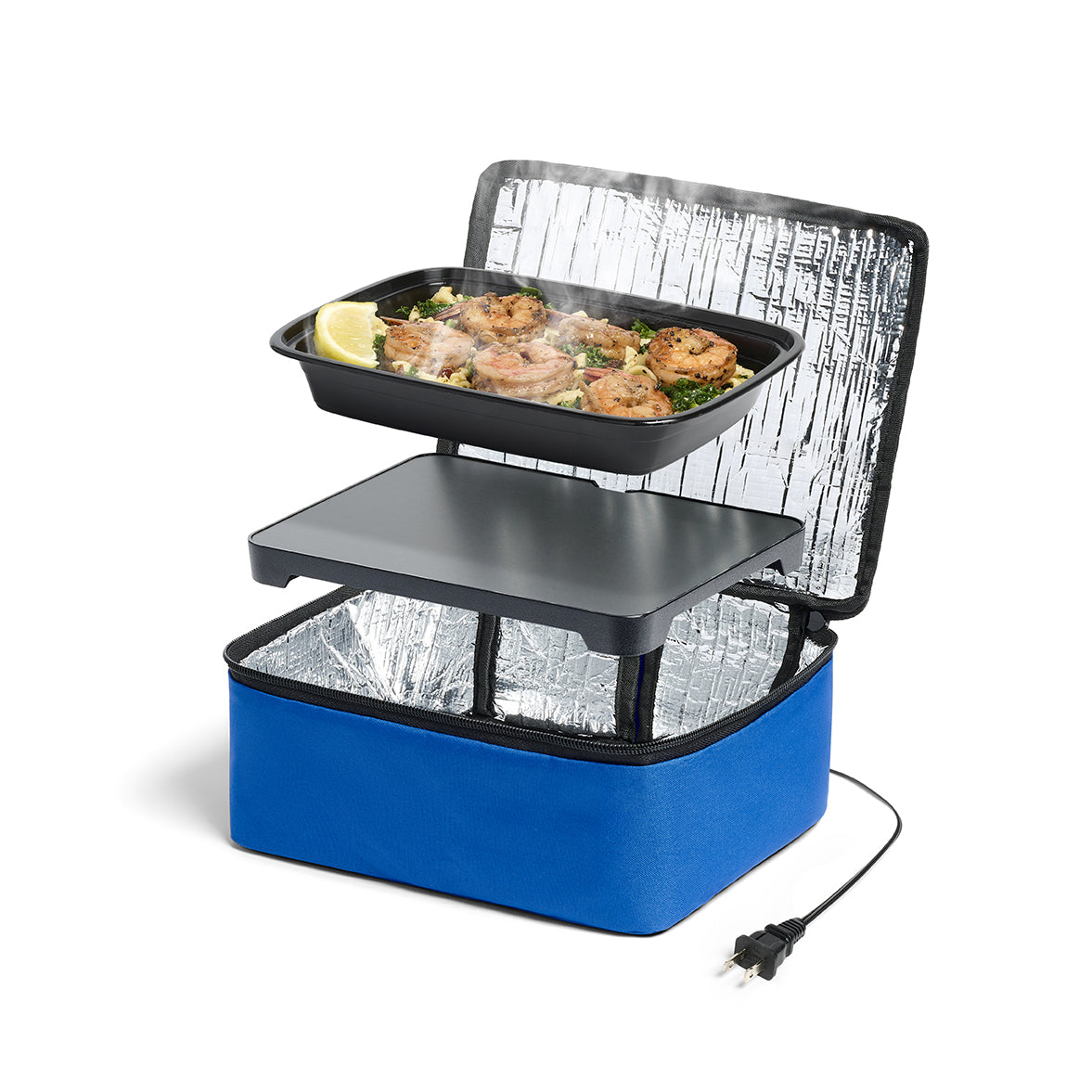
    • HotLogic Mini
    • Electric induction burner / "dorm" hob
    • Mini CrockPot
    • "Dorm" size microwave
    • Electric cooler

  7. Travel pillows and blankets, personal pillowcase

  8. Towel

I, personally, find that I only need 2 kitchen gadgets: an electric kettle (mine looks like the white one top-left) -

and the HotLogic Mini -

The HotLogicMini is a soft-sided lunch-box style "slow cooker" that uses a low-temperature hot plate inside an insulated bag to heat food. It is safe to use with most containers (although I would be cautious when heating up restaurant leftovers in styrafoam containers) and even safe enough to touch without burning (but it will be hot so don't grab the plate and hold on). I have accidentally left plastic forks inside when heating, and most of the time they're fine. Occasionally they warp a little but are still usable. It is safe to travel with and can be checked or carry-on. It can be purchased with a standard wall plug or a car plug, so make sure you read the listing carefully when purchasing to get the correct plug.

Anything that has "microwave cooking instructions" can be cooked in the HotLogic, usually right in its own package without any de-packaging faffing about - just stick the whole container right inside! I will put a whole can of soup inside and eat it straight out of the can like "campfire beans". I also put a whole bag of microwave rice and a tin of canned chicken in the HotLogic together, then I drain the chicken and add it directly to the bag of rice for a wide variety of chicken-and-rice meals. Be careful, though, packages, especially metal ones, can be very hot and will need to be opened carefully because of the pressure build-up from heating.

The HotLogic is a slow cooker, so you will need somewhere to plug it in for a couple of hours (1-2 depending on if the food is frozen / raw or room-temp and cooked first). Unless you stay inside one track room all day (as I do when I'm working), this may be best to leave in your hotel room, assuming you're staying on-site.

The good news is, though, that because it's such low-temp cooking, you can leave your food in there heating all day long and it'll be fine. I once started my food heating in the morning but then at lunch time found out that management was feeding us. So I ate the free catering and forgot about my lunch until it was time to go home, leaving it heating for like 8 or 10 hours. I just put it back in the freezer overnight and reheated it the next day and it was fine. So plug in your meal before you go downstairs in the morning and pop back into your room whenever you're hungry later for a hot meal.

I have literally not had to buy my lunch at work since buying one of these more than a decade ago and I have started using it at DragonCon for the last 3 or 4 years and I love it. Many of my coworkers have them or similar items now because they are so convenient. I seriously ought to become a distributor for them or get a commission or something because of how many video techs I have talked into buying one. If I ever thought about it, I would have a box of these and a box of screen pullers to sell at every gig I work.

The electric kettle is very important for anyone who likes hot drinks. Hotel coffee pots are notoriously unsanitary, and if you like anything other than coffee, using water heated by a coffee pot (especially the k-cup type) adds a bitter coffee tinge to whatever your drinking. You can even make coffee using "homemade tea bags" out of coffee filters and steeping your grounds in your hot water like tea bags. The longer you let it steep, the stronger the drink will be. Some kettles have batteries or USB cords or act as thermoses so you can bring your kettle around with you like a large water bottle and drink down on the con floor.

For food, while your specific dietary needs may vary, if you just follow the Food Pyramid you should be able to eat a healthy diet that is suitable for a weekend or a week at con even without access to a full kitchen and from-scratch meal prep. You want a good source of protein every day, complex sugars and carbs, healthy fats, and a source of vitamins and minerals that isn't solely a daily multivitamin. I car-camped for 2 weeks with the above diet and was fine. Oh, and minimize the caffeine use. I know, fandom cons are extended parties and everyone wants to be awake for the whole thing, but seriously, keep the caffeine to the bare minimum, especially later in the day.

Plan for at least one hot meal per day (hot food seems to be important for emotional and mental health, and going without for too many days can negatively impact your mood and immune resistance abilities) and have ready access to a variety of "grazing" food throughout the day, that includes just a bit of "indulgent" food, again for mood and emotional / mental health.

To sum up -

I carry a small, lightweight, easy for me to carry all day, mini-backpack with my daily essentials and a few "just in case" items that I have found to be very helpful at conferences. I make the investment to carry or wear comfortable shoes. I practice good hygiene including bathing, deodorants, good tooth care, and good sleep practices such as plenty of sleep hours and bringing my own pillows / pillow cases and towels. And I get 1 hot meal and around 1200-1800 calories per day and some kind of food that makes me happy with the diet above (I do not need more than 1200 per day).

Drink water, buy a HotLogic if you can afford it, wear good shoes even if it doesn't work for the outfit, shower, brush your teeth, and get sleep.


Also, this video was made 12 years ago so there are a couple of points that are out of date, but it's still pretty applicable:


joreth: (polyamory)

New for Pride month! Our exclusive Trans Flag Phoenix design on dozens of t-shirts and other products!

Visit the revamped & updated Poly Tees to find many of our old favorite t-shirt designs now reinstated and a whole bunch of new slogans recently added.

Plus, only 3 more days left to get 15% off your entire purchase!

Almost all of our designs are customizable too! You can choose from a wide range of products for each design, many products are available in different colors, AND if you go to the product detail page for most of our designs and click on the "edit" or "pencil" icon below the image, you can even change the design color and print type!

Also keep checking back with us because new designs are being added all the time.

Visit www.PolyTees.com for all our new inventory and sales!

I have been working for MONTHS to get this site back up!

Several years ago, my shirt printer decided to get rid of all text-based designs, which were the vast majority of my designs. It was such an overwhelming process to put them all back in that I kept putting it off.

Well, I finally got most of them back up (the ones I could remember, anyway, and the ones that the printer's moderators aren't currently holding "in review") and I added a whole ton more, just in time for Pride month.

If you see a design that you like but it's not on a product you want, or you almost like it but want it tweaked in some way (like my "Independently Owned & Operated Since 1977" shirt and you want your own year), or even if you have a totally new idea for a design, please let me know either through email or comment or PM on any social media you can find me on and I'm happy to make those customizations where I can for no extra charge.

So please visit the shop and like & share the links and pages with others! Income from this store is partly how I am able to survive when my industry dries up for the summer and (how I hope to survive once I finally leave this hellhole of a state and don't have a job waiting for me) and thanks to all my designs getting purged, I haven't had this income in several years now. So your likes, thumbs up, positive reviews, comments, engagement with the page, and shares are SUPER helpful!

joreth: (shiny)

There is this little Florida roadside diner place that I used to pass every day on my way to work in Orlando, that advertises "grapefruit pie". The picture on the sign had been so washed out by the sun that I really couldn't tell what grapefruit pie was, but I was intrigued. After several years, I finally stopped in to try this pie.

The diner boasts that it won a pie contest several years in a row, and it was so popular that they even offered the recipe for free on their website. Before I knew that, I bought a slice of pie. I was ... disappointed. It really looked like someone really just made jello with fruit bits in a pie crust, and it vaguely tasted like key lime pie. So I went to the website to look at the recipe, and ... yeah, that's basically what it was. In fact, it wasn't even *grapefruit* Jello, it was STRAWBERRY JELLO! With bits of grapefruit in it!

I could totally do better than that!

So I started thinking ... HOW could I do better than that? After thinking about it for a while, I came up with a Jello parfait recipe that I wanted to experiment with - no idea if it would make a good *pie* or not, but it sounded like a good Jello dessert?

I made the first experiment today, and it worked out wonderfully! I have more experimentation to do, though, because this Jello was not terribly firm thanks to the citrus, and it completely liquefied again after sitting out for about an hour. It gelled back up after another night in the fridge, but next time I will try boiling the OJ first, which kills the enzymes that may be responsible for interfering with the gelatin process.

Anyway, it's ridiculously easy to make, so here it is:

Ingredients:

  • 1 package of Orange Jello
  • 1 cup of boiling water
  • 1 cup of orange juice
  • 1 can of mandarin oranges (drained)


  • 1 package of vanilla pudding
  • 1 cup of heavy whipping cream
  • 1 8oz tub of whipped cream


Directions:
 

  1. Add 1 cup of boiling water to the powdered Jello in a bowl with a roughly 3 cup volume. Stir until thorough dissolved, about 2 minutes.

  2. Add 1 cup of cold orange juice to the Jello. 

  3. Add drained mandarin oranges.* 

  4. Put Jello in the fridge to solidify for several hours, even overnight. 

  5. Pour heavy whipping cream into medium mixing bowl. 

  6. On medium speed with a hand mixer or stand mixer with a whisk, beat whipping cream until frothy. 

  7. Add dry pudding powder and whisk until well mixed and solid. 

  8. Add whipped cream and whisk until thoroughly mixed and store in an air-tight container until ready to serve. 

  9. After gelled, spoon Jello into a cup or bowl in a small layer, then spoon whipped topping over the Jello in a layer, alternating Jello and whipped topping until cup or bowl is pleasingly full. Top with a dollop of whipped topping.

*Mandarin oranges will float to the top, leaving the bottom of the Jello fruit-free. For a regular bowl of Jello, this is undesirable, but since the Jello will be spooned or scooped into dishes, this can be compensated for. Make sure to add scoops of Jello without oranges to each layer in addition to the scoops from the top that include oranges, so that the oranges are spread evenly among the layers and among the servings and the un-fruited Jello is similarly spread evenly.
joreth: (polyamory)

Q.   What can make even a poly person jealous?

A.   The same things that make non-poly people jealous.  Because, here’s a secret … you ready?

Poly people are people.

That’s right, we’re just regular old human beings like everyone else.  We are not emotionless sociopaths, we are not aliens, we are not relationship wizards.  We’re just people.  We have all the same emotions as you do, and we fuck up our relationships just like you do.

The only real difference is that we have a culture that prioritizes curiosity, authenticity, and autonomy.  That doesn’t mean that individual monogamous people don’t prioritize those things and it doesn’t mean that individual poly people are necessarily *good* at those things.  It means that we like to *say* that those things are important to us.

So we are pressured, from our culture and from our own internal sense of morality, to respect our partners’ right to make choices about their own bodies and emotions, and we are pressured to constantly inquire within ourselves about what the signal light on our dashboards is trying to tell us, and then to solve the actual problem.

Because that’s what jealousy is - it’s a signal light telling you that something is wrong.  That’s all. Sometimes that signal is trying to tell you that you’re in a relationship with someone who is not respecting *your* autonomy, or your boundaries, or whatever.  Sometimes that signal light is trying to tell you that you have unresolved issues to deal with that aren’t your partners’ fault.

Some people don’t like signal lights.  They’re annoying.  So they put a post-it note over their dashboard and try to pretend like the light isn’t on at all.  That’s the culture that most people come from, including most poly people.  It’s the culture that tells us that if you see a signal light, if you feel jealousy, you need to make the thing that’s lighting up your dashboard go dark - you need to stop the activity that’s making you feel jealous. Doesn’t matter *why* you feel jealous, just stop the feeling whatever the cost.  Take out that light.

Poly culture tells us to pop the fucking hood and get your hands dirty trying to figure out why the damn light is on in the first place, and then fix. the. problem.

Unfortunately for us poly people, none of us are born mechanics.  We’re all learning this shit as we go too.  So our signal lights go on for the same reasons everyone else’s do.  We all got the shitty factory programming.

But *some* of us stop the car, get underneath it, and shine flashlights around until we find the problem.  Some monogamous people do that too.  Because we’re all just people.

joreth: (Super Tech)

I keep getting asked about costume storage, and I'm rewriting the same answer over and over again in costume and cosplay groups, so I decided it was past time that I made an actual blog entry about this.

I have a lot of costumes. I mean, I have A LOT of costumes. And a lot of dance clothing. And dress-up clothes. And work clothes. Let's face it ... I just have a lot of clothing in general. When I still lived in an actual dwelling, I had a 2 bedroom apartment so that I could use my entire second bedroom as a walk-in closet. I don't mean that I wanted 2 bedrooms so that I could use both closets, I mean that the whole bedroom was one giant fucking wardrobe.

After moving into an RV, I needed some kind of long-term storage option for all my clothes. After a handful of years and some trial and error, I finally came up with a system that I really like. I'm very excited about my new storage system.

I found that 28 quart "under bed storage" bins have roughly the same volume as cardboard file boxes (also called "letter boxes" and "banker boxes"), which is what I was using to store everything in before (because they were uniform in size and shape and both big enough to be useful but small enough to carry and limit the contents for weight control).

Plus, because they're longer and flatter, I can put clothing in it with fewer folds, leaving them on hangers and in garment bags and just sort of "accordion-folding" them into the plastic bin. And the plastic holds up better than the cardboard. Also, I color-coded the bin lids. My costumes are all in white bins, my regular clothing is in silver lids, and my "not one costume, but a bunch of the same item" stuff like petticoats and corsets are in green bins.


The picture is a little bit outdated - this was taken before I added several more costumes and before I really nailed down the color coding, so it's not very consistent in this picture, but it got more consistent later on.

I have one bin per costume (or one costume per bin) with all of its bits including accessories and shoes (other than those costume elements I reuse in multiple costumes, like my petticoats). Each costume gets a checklist for all the items that belong to the costume, with the line items that are stored in that bin checked off and the "shared" items not checked off so that I know to look for them in another bin.


These checkists are in a plastic sheet protector and I use wipe-off markers to write on the plastic over the paper when I check something off for an event or to make notes, so I can just wipe it all off afterwards and still have a clean checklist.

And THEN, I have every single individual clothing item and element recorded in a free, online database that includes its location.


When I go to a con, I can just pick up the bin for the costume I want to take, check the checklist to see if there are bits located elsewhere, and I take the whole bin. If I am flying instead of driving, I take the garment bag containing the costume out of the bin and pack just the garment bag with the costume.


I made a template version of my database so that anyone else can use it. All you have to do is create a free Airtable profile, then click the link that takes you to my template, and "copy" that database into your own profile. From your profile, you can edit the database however you want.

I highly recommend this method or something similar. For my non-costume clothing that needs to be stored, I put all clothing items of similar type (i.e. "club tops", "work shirts", "suits & slacks", "pants", etc.) into these bins, tight-rolling them the way that flight attendants pack their clothing (tutorials can be found on YouTube for this very efficient and compact folding method). These items are similarly catalogued into my database so I can find them later. It's truly a space-saver that also protects my clothing from pests and the elements.  It's also super useful for moving.

If you're looking for a better storage method of clothing and soft-goods, I recommend buying a bunch of under-bed storage bins and if you want to get really organized about it, some sheet protectors for checklists, some chalkboard labels for the outside of the bin, and some different color lids to color code.  Then check out my wardrobe database template for boss-level organization.
joreth: (dance)
I was given a compliment that was definitely intended as a compliment and that I'm taking as a compliment and that, even though it includes a comparison, was definitely not intended to insult the person it was comparing, but nevertheless the compliment shouldn't actually need to exist and I'm using as a metaphor for a larger conversation on gender.

I have decided that there is actually a partner dance that I don't like: country swing.  There are no patterns for the feet, it's literally a dance all about how fast and how frequently the lead can spin his partner (because gender norms).   Now, dance involves the body so a dance style that doesn't focus on memorized step patterns can still be a legitimate dance style.  But this is a dance style that is all about sequences of tricks with no concern for steps or musicality and relies on the strength of the lead to make the follow go where she is supposed to go.

And don't get me wrong but the really good country swing dancers do use step patterns and have musicality and the follows do as much work as the leads.  But that's not the social dance experience.  Usually it's a dude spinning the fuck out of some thin, young woman with no regard to how well it matches the music that's playing or whether she even knows how to do what he's making her do.  Brute force will spin her and stop her without dropping her whether she knows what to do or not.

So, there was a guy at the wedding I went to recently who claimed to be able to two-step and swing dance.  My sister grabbed him for a two-step and he was all over the place with her - no control, no musicality, just "slow-slow-quick-quick-spin-slow-slow-quick-quick-spin-spin-another spin-slow-slow-quick-quick".

When they sat down, he said that he was really rusty with the two-step and that he was better with swing.  I would rather have danced a two-step with him, but since he said he was better at swing, I asked him to swing dance with me.  So we got up and did a country swing exactly as described above - spin, spin, spin, who the fuck cares about beats and music?

I was told later that the dance with my sister looked pretty out of control and my mom was worried that he was actually going to hurt my sister, but she was amazed at how well I kept up with him.  And I kind of downplayed it because 1) my sister was never as into partner dancing as she was into line dancing; 2) she hasn't danced in a while and I try to keep up with my dancing; and 3) I know exactly what "country swing" is and I know how to handle guys who dance like that.

So I've been feeling a little pleased that I impressed people by dancing with someone who had very little control and making it look like we were less out-of-control than we really were, mainly because *I* kept control of *me*.  And it's legitimately not an insult to my sister, because he was the lead, so all problems were his fault.  She's not even a poorer dancer than I am, necessarily, he was just that bad of a lead.  I am, after all, a better follow than a dancer.

Here's the metaphor part:  Too many cishet dudes are allowed to move through life like these country boys move across the dance floor - full tilt, without regard for their surroundings, who is around them, how they impact others on the floor, how out of control they are, dominating their partner, and with no regard to the mood of the music.  And I have spent a lifetime developing the coping skills for how to keep my own feet underneath me when one of these guys swoops by and spins me around.  And that's a compliment because it is, indeed, a skill that I've worked hard at and I am a good dancer (and "dancer") because of it.

BUT I SHOULD NEVER HAVE NEEDED THAT SKILL IN THE FIRST PLACE.

I should not ever be complimented for how well I can compensate for men's failings and flailings.  Because men should not be allowed to stomp all over the floor and through life the way they do.  But so many of them do so, that we just gave it its own dance style name and genre and said "yep, that's legit, that's how you do that!"

And we have done the social equivalent of tolerating and accepting men who do that in life.

Country swing is actually a really fun style to both watch and dance, *when done well*.  But what *I* (and competition judges) think counts as "done well" and what social dancers think counts as "done well" are two very different things.  It is, and should be, a legitimate style.  But the way it's executed on a social floor is just fucking dangerous.  It may be athletic, but it's not artistic, and it's not considerate. It's performative without being connective.

So don't be one of these country swing dudes.  Pay attention to how you move through life, how you impact those around you, the space you take up, whether your partner is (or is able to) contribute equally to your partnership or are you just flinging them around with you, and for fuck's sake at least try to learn something about musicality because musicality is just emotional connection manifest physically.  With a little math.
joreth: (polyamory)
Reminder: A very large portion of poly people did not come to polyamory through "opening up a relationship".  There are more than one avenue to discovering polyamory.  If you never "opened up" a relationship, you are not alone, and not even a tiny minority.

I know it seems like it, because "couples who open up" are the only ones who ever get any air time, but I promise that you are part of a very large segment of the community.  I am one of them.  I never "opened up" a relationship.  I discovered my own internal desire for ethical non-monogamy when I didn't have any romantic or sexual partners at all and every relationship I got into after that point was deliberately non-monogamous from the moment I entered into it.  My partner, Franklin, has just never had a monogamous relationship in his life.

There are so many of us that we have a diverse collection of stories of how our relationships look.  My non-monogamous history looks very different from Franklin's history, even though neither of us tried to "open up" a previously monogamous relationship.  We are not a small segment of the poly community, NYT articles to the contrary.

Also, not all people who discovered polyamory for themselves while not in a couple ultimately become solo poly. Solo poly is not synonymous with "single". Just FYI.
joreth: (BDSM)
I watched a Korean movie on Netflix called Love & Leashes, about a submissive guy who transfers to another department at work and meets a woman in that department who he wants to be his Master. Although she is ... "intimidating", she has never heard of BDSM before, but she finds the idea intriguing.

Korean culture is very different from USian culture, and how they conduct relationships is different. Going into this movie, I didn't know if what I was watching is actually how BDSM relationships are done in Korea or if it's more "the writers know nothing of this subject but thought it would sell a movie script", because it's definitely not how I would recommend conducting a D/s relationship here. But a USian friend of mine who has been living and teaching in Korea for the last several years chimed in to give some background:
It's based off a webtoon by an anonymous author. And the style in the movie is pretty spot on with Korean bdsm forums and the lingo in Korean is super accurate and could only be known by pretty extensive research or experience.

Even the word for fake Dom -- 변바 is in it. It's super niche bdsm slang. Same with 연디 date d/s.

When it shows twitter handles those are a few letters off from real people I know irl in Korea. The background info is... eerily exact to the real bdsm scene here.
Even not knowing if it was a culture difference or uninformed writing, 20 minutes in and it was already 50 shades more charming than the piece of shit I've been choking down lately.

The characters' motivations are clear and their behaviour is consistent with both their personalities / histories, and also with what is known about BDSM, kink culture, and kink psychology. There's no abuse happening at all - it's being led by the sub with negotiation and boundaries from the dom, there was discussion and concern about unfair power imbalances due to the work connection, and it was established that the "newbie" to BDSM had personality tendencies in this direction already and does not find kink to be disgusting or that it must be the result of some childhood trauma.

In other words, everything that is happening so far makes sense, in context.

It's very rom-comy, not erotica, and I think that helps. Trying to make her dark and foreboding as a dom would, I think, remove a lot of its charm.

It does make me miss having a puppy, though.

Some of my notes while watching it:


OTG they're so awkward! It's very endearing.

OK, her digging her red heel into his fully clothed back is so far way more erotic than every sex scene in 50 Shades combined.

Puppy play, verbal humiliation, pain, service submission, nurturing dom ... someone here has actually at the very least read about D/s and not just attended a public dungeon with play restrictions.

AFTERCARE!!!

[discussing how his last girlfriend dumped him for being into BDSM]
"Do you really enjoy all this pain and suffering?"
"It hurts ... but I still feel so alive, you know?"
"I don't get it"
[crestfallen] "It's understandable."
"I mean, if it makes the person you like feel more alive, why can't you do it for them, you know? It's not like it's anything bad."
[slow hope]
#SoMuchBetterThan50ShadesOfShit

The movie version feels very manga, without being cartoony, if that makes sense.

They are so adorkable


By the end, I felt it had remained charming the whole way through. It was very much a rom-com complete with confusion arising from not communicating and a ridiculous happy ending, but it was so very pro-kink and the leads were sweet and adorkable and endearing.

Note to all writers: this is how you write "quirky" and "relatable" characters, not by making them Hollywood pretty but having everyone else describe them as "plain" while giving them no personality but making them clumsy.  Also, don't soften a "hard" edged woman.  Not everyone who has a strong personality is using it as a wall to hide behind and keep people from getting too close, and making a woman softer and smaller is not how she finds someone to love her.  Plus, it's totally possible to be "strong" and even "hard" without being a bitch.

Also, a submissive man is not "weak".  We see the male lead here standing up to his bosses and taking control of situations when necessary but also never stepping over the women around him when he needs to be aggressive.  He supports them and uses his privileged position to make them heard, within the cultural context.

Anyone wanting to write about kink in an erotic setting where there is a conflict to overcome needs to address the idea of shame.  And unlike the current most popular example, the goal is not to reinforce the shame of the kink tendencies, but to either overcome it or to find a way to deal with social shaming in an appropriate cultural context without internalizing it.  This is a good example of one way to address shame well.
joreth: (feminism)
Finally got around to watching the Ms. Marvel series on Disney+ and I'm SUPER impressed with the cinematography.  It's clever and creative and quirky and both subtle and outrageously cartoonish and it's seamless to the live-action happening.

Really, just these opening scenes is ushering in a new era of YA television, honestly.  It's told in a similarly serious tone to any adult TV show I would love but it's so fun and colorful and engaging that I think it probably appeals to a much younger audience.  I think it's a great way to bridge the generation gap, actually.

The pace of the effects slowed down and got more subtle after the first episode or two, so that we could focus more on the story and not get distracted by the visual onslaught of creativity but the effects remained throughout, maintaining its young style.

And the story was, in Disney fashion, heavily pro-family.  Other reviews have covered the cultural accuracy and since it’s not my culture, I’ll just say that I both recognized some cultural aspects from my time on the Bollywood circuit with Indian clientele and also recognized more universal elements of love and family and being a teenager and generation gaps that it seems we all go through in our own ways.

The series is really quite impressive, technically speaking.  It is more “comic booky” than some of the other Marvel series, or rather more YA comic booky because there are darker and more subtle and sophisticated ways to still be comic booky (see Netflix Marvel and M. Night Shyamalan’s Unbreakable), which makes sense as it features teenagers but it’s fun even for adults and has plenty for everyone.

I found this show utterly charming the whole way through, and the cinematography especially is impressive.  I think this is a good one for GenX and older Millennial geeks to watch with the kids.  If you have kids who are old enough to sit through a series with a multi-episode story arc, I recommend giving this one a go with them.
joreth: (boxed in)
Something I want to be careful of is the vilification of gaslighting. And by that, I mean that I want to draw a line between "this behaviour has harmful effects and we need to stop doing it" and "the people who gaslight are evil manipulators deliberately trying to drive you insane".

The reason why I want to draw that line is because characterizing it as the latter makes it too easy for people to distance *ourselves* from acknowledging when we do it. "I am not an evil manipulator, so I can't be gaslighting anyone." Even "evil" abusers see themselves as the victim in their stories.

The reason they abuse is because they have a *belief* that the actions they take are genuinely right, good, acceptable, appropriate, or warranted. Many of them feel that they are a good influence on others or that they are trying to better their victims or doing what they do for their own good. They can't change until they recognize that they are doing something wrong.

See The Villains As OurselvesSo when we use the latter definition, we give them justification room in their minds to excuse their actions. But if we use the former, then we ALL have to take a look at our own behaviour and keep working on bettering ourselves, and we can do that without the cognitive dissonance fighting us and telling us that we are a "good person" so this can't apply to ourselves. This makes it harder for outright abusers to excuse their own actions if the culture around them encourages this kind of reflection and correction of everyone.

Gaslighting is such a normal part of our society that we're mostly all raised with it all around us. That makes it difficult to identify when we do it ourselves.

One of the classic examples I use to illustrate non "abusive", well-intentioned gaslighting is a mother trying to get her child to eat her vegetables, the child says she doesn't like them, and the mother says in exasperation, "yes you do, now just eat them."

We likely have gaslighted people in these kinds of minor situations many times over our lives and never realized it, so never recorded it in our memories. Why should one of these totally normal conversations stick out in our minds, especially years later? It's *the way things are* in so many circumstances.

Meat BodyI can't remember anything specific but I'm sure I've said to people at various times "oh, yes you do!" when they said they didn't like something or didn't want something, and I'm sure I had good intentions when I did it. I'm not "evil", I'm a meat body driven by a belief engine and a product of my environment, which means I'm flawed.

The best I can do now is to be mindful of my language and try not to contradict people when they tell me their inner landscape. If I have reason to doubt them, such as suspecting *them* of trying to manipulate me, maybe I can ask for confirmation or I can point to conflicting *behaviour*, but I will try not to outright tell other people what they are feeling.

In this post, I want to be clear that I'm doing something that I often rant against doing - stretching the definition of a very importantly narrow term. Gaslighting is not simply remembering things differently, or even *just* telling someone with confidence that their memory of a thing is wrong, even if the "thing" in question is part of the other person's inner landscape. The original term "gaslighting" is, in fact, the second definition I used in my opening paragraph.

In the movie Gaslight, which is where the term comes from, a husband is *deliberately* changing the level of the lighting in the house (created by gas lights, not electric lights), and when the wife comments on the change in light, he *deliberately* says there is no change, so that the wife comes to doubt her own senses over time. The husband does all this *deliberately* so that he can have his wife committed to an asylum so he can access her money. This is a 1940s villain caricature, an evil mustachio'd villain who knows he is doing evil and doing it maliciously and selfishly.

The problem is that this is not how real life "villains" operate. And that's the point that I'm making here. It's important to keep a narrow definition of terms like "gaslight" and "abuse" and not round up just anything uncomfortable to these terms. But we have to *also* make sure that we don't keep the definitions so narrow that it only applies to people in black hats cackling in their lairs and stroking their white cats while they plot world domination.

Because that leads to everyday, ordinary people doing horrible things and justifying themselves because they are not evil villains. We have everyday, low-key examples of people trying to convince other people that they are not experiencing the things that they are experiencing. This is not the same thing as correcting people's flawed memories or understanding of factual claims, although that can also be weaponized. I'm talking about "yes, you do like broccoli!" when you do not, in fact, like broccoli.

These small little disregards of our inner landscape *lead* to large disregards of other people's inner landscapes, because it's the same thing but a manner of scope. The mother *believes* that it's in her child's best interest to eat veggies. And she's right, it is in her child's best interest, and the mother is, in fact, in a position of authority and power over the child to do "what's best" for the child. This is the nature of that relationship.

So it's a very small step to go from a parent / child power dynamic who uses an agency-dismissing tool to manipulate and control one's behaviour, to a romantic partnership dynamic who uses an agency-dismissing tool to manipulate and control one's behaviour *for one's own good*. This is a tool we have been given by our society, so it's a tool we may not even notice that we are pulling out and using because our brains are little more than belief justification engines.

And if our society has also encouraged us to see villains as black hatted evil caricatures of people, then our giant justification engines are going to work overtime to make sure that we are not Bad People(TM). And since we are not Bad People(TM), we therefore cannot be doing the things that Bad People(TM) do.

And THAT is the point of this piece. Gaslighting, the action, needs to be understood as a Very Bad Thing, but it needs to be separated from our personal identities as a thing that only Very Bad People do. The action is a tool that we have all been taught how to use. It's normal and reasonable for people immersed in a culture that uses this tool to reach for the tool themselves. It is an *inappropriate* tool, but the people who use it are regular, everyday people who have understandable reasons for reaching for it.

And now that you know it is a common, ubiquitous even, tool in all of our toolboxes, we ought to be on the lookout for when *we* reach for this totally normal, common but unhealthy tool. Gaslighting is not a tool reserved only for the most evil of all evil people. It's a tool that everyone has been exposed to, and taught how to use. All you have to do now is teach yourself how to put that tool down and reach for another one.
joreth: (polyamory)
"My marriage is permanent! We place the relationship above the people in it! All other relationships are expendable as long as the marriage lasts forever!"

"Wow, that's not cool. Anyone my spouse and I date will automatically become an equal member of our triad! They're not expendable, they're exactly as permanent as the marriage!"

*sigh*

OK, so, I suppose it's a step up that you don't consider other people to be disposable or expendable. Yay? But you're still making the relationship more important than the happiness of the people in the relationship and you're still removing people's agency by deciding ahead of time what each relationship *will* look like, whether the people in those relationship want it that way or not.

I know it's really hard to see, because benevolent sexism is also really hard to see, and these are analogous things, but this is still problematic.

Benevolent sexism is where we switch from thinking that women are money-grubbing sluts who can't do math and shouldn't vote or talk in public and should be stoned to death for showing their ankles to unrelated men, to thinking that women are goddesses and need to be coddled and revered and pampered and who are better at nurturing and domestic tasks than men.

"But wait, isn't it a good thing to treat people well and to compliment their skills?"

Well, yes and no. it's a good thing to treat individual *people* well, but "well" depends on the recipient's definition, not yours. And it's not a "compliment on their skills" to say that "women" as a group are better at things when we all have different levels of ability and interest and especially when those things are things that society doesn't value highly and certainly doesn't pay for the way that we pay for everything else that requires specialized skills.

Malevolent sexism and benevolent sexism are two sides of the same coin - both versions put all women into a box and all women are required to fit into that box whether they actually do or not. And, especially in the case of benevolent sexism, if they don't fit into that box, they are punished for it. So women are still hindered, limited. A gilded cage is still a cage and my wings are still clipped even while sitting on a padded swing.

Plus, studies have shown that benevolent sexism is very strongly correlated to malevolent sexism - meaning that the society that has one also has the other. So just because a single person might think that women are "goddesses", that attitude only exists in a culture where someone else thinks women are "demons". So the benevolent sexist has to contribute to the overall culture of sexism that ultimately harms the women he claims to love (assuming he doesn't directly harm women as well by punishing women for not behaving goddess-like).

This "our third is an equal" attitude is basically the same thing as benevolent sexism. It might *seem* like it's a compliment or benefiting that "third", but it's still putting people into boxes and still expecting them to conform to an externally imposed role. A more ethical way of doing things is to just meet people, see how you click, and then talk to everyone involved to see what each person wants out of each relationship and allow each relationship the freedom to develop however it wants to.

My relationship with Franklin has always wanted to be what I used to call "emotionally primary" (before I dropped all ranking terms entirely, because I learned that even "descriptive primary" still contributes to this whole problem), meaning that our relationship has always pulled us towards stronger emotional connections with each other. But our lives have pulled us physically apart. If we had given up on the relationship just because it didn't meet our preset expectations of what a relationship with strong emotional connections *should* look like, we would have had to break up more than a decade ago.

But then I would have missed out on the last 15 years of a very emotionally nourishing relationship and I would be missing out on the very exciting future that we are trying to plan now.

I wish we would just erase this whole "equal" language from our poly vocabulary because people don't understand how to use it ethically. "Equal" is more often used as a blunt object to bludgeon people into predetermined roles, than out of any sense of equality or egalitarian values.

I am not "equal" to Franklin's other partners and they are not "equal" to me. I am equal to FRANKLIN. He and I have the same amount of power in our relationship to negotiate our own personal boundaries and the direction of our relationship, and *only* he and I have the power to negotiate our own boundaries and the direction of our relationship.

I cannot determine how his relationships go with anyone else, he can't determine how my relationships with others go, and nobody we are dating can determine how mine and his relationship together can go. This is what is meant by "equal".

People who talk about "equal" in this prescripted sort of way, much like people who defend hierarchy, tend to mix up all sorts of elements into the word "equal". The criticisms are almost exclusively about power structures. But these defenders want to throw in strength of emotional connection, time / attention priorities, and financial obligations.

Our relationships with other people are too *different* to be ranked as above, below, or equal to another. Franklin and I both care about our other partners very deeply and we cannot quantify our emotions to say who we care about "most".

So that's the emotions part that most people who talk about "equal" usually get confused about. I think it's foolish, at best, to even bother trying to rank how much you "love" each person, and at worst, it leads to the mindset that allows you to think of people as "disposable" and "expendable" because you don't "love" someone as much as someone else.

Priorities like time and attention are all different because we are all different people. Trying to make everyone "equal" is to dismiss their individuality, which dismisses their very humanity. Even identical twins are still unique individuals. We all want different things, and we all place importance on different things.

And there are *so many* things to account for here! My "quality time" isn't going to be the same as your "quality time" - it depends on our Love Languages, our preferences, our interests, and even our mood at any given moment. Spending time on the couch watching TV together might count as "quality time" most of the time, unless there's some other issue in our relationship that's coloring the experience for us, and then it won't "count".

There are just so many variables and so many unpredictable things to account for, that to even attempt to tally all things up and make them "equal" is an exercise in futility. And, in my observation, usually just tends to make the insecurities about priority worse when you start micromanaging relationships to make them "equal".

Financial obligations are pretty much the same thing - too many variables. People like to winnow it all down to "we have a mortgage and kids", but there are so many different things to consider like income disparity, cultural power differentials between gender and economic class, tax breaks, unpaid emotional labor, other relationship status, other support networks, other dependents ... there's a reason the US tax code is basically inscrutable without a degree in accounting. Finances are complicated.

To start ranking a relationship's importance based on only a few financial criteria is to ignore the impact that all these other criteria have on a relationship. Which is basically how we got to the point of women complaining about emotional labor in the first place.

A relationship between people who share a mortgage shouldn't be automatically more "important" than other sorts of relationships, just make sure that one obligation is cared for, like all the other obligations. That doesn't mean that the relationship overall deserves a higher ranking, or that one who doesn't share a mortgage deserves a lesser ranking. Relationships that don't involve mortgages can be every bit as "serious" and "committed" and "entangled" as those that do.

Just ... stop with the "disposable" shit and stop with the "equal to my other partners" shit. We. Are. Different. Each person is a unique individual, and consequently each *relationship* is a unique entity because the people in them are unique. Even *you* are a different person in the context of one relationship vs. another relationship. Pretty similar, sure, but that relationship influences who you are, which changes who you are.

Which relates back to a recent post I made about how you can't "add a third to our existing relationship" because that relationship no longer exists, having been permanently altered by the change in status. You have created all new relationships, including with your preexisting partner. *Everything* is different now - your relationships and the people in them.

They. Can't. Be. Quantified. Or. Ranked. Without. Dehumanizing. Or. Objectifying. Them.

Which is why even insisting that "our third will be equal in all things" is just the other side of the coin of the "disposable" perspective. It's a prettier side, to be sure. It feels kinder, it feels fluffier, it feels nicer. It even feels more ethical. I remember the first relationship I was in that espoused this canard, and I remember feeling valued at the time. And then I learned the dark side of what this actually means.

Because it comes from the same place - disregarding the uniqueness, the individuality, and the agency of the people in the relationships and valuing the relationship itself over the people in them.

For more discussion on this topic, here is the FB thread that sparked it.
joreth: (feminism)
I watch a lot of '70s and '80s sitcom re-runs with feminist characters. Most of the time, that's why I like them.  But that was the era of 2nd Wave feminism, which is notoriously sex-negative.  So I occasionally have imaginary conversations with these fictional characters defending sex-positivity. This bit popped into my head today after an episode including a porn actress:
We all agree that we should have the right to say "no" and have that respected.  But what good is that "right" to say no if we're not allowed to say "yes"?

That "no" is just as restrictive as anything else the patriarchy imposes on us.  That "no" doesn't give us any freedom at all.  We are still being judged by patriarchal values of sexual objectification.  Required to have sex, required to be chaste - it's two sides of the same coin.

I will say "no" when I mean "no" and "yes" when I want to say "yes".   And if I want to say "yes" more often than someone else, or less often than someone else, as a warrior for the right of women to own their own bodies, the right to say "yes" should be just as important as the right to say "no".

To be judged as "lesser" than other women because one says "yes" is to buy right into those same patriarchal values that led us to fight for the right to say "no" in the first place.  You are still judging me for my sexuality, you are still defining my own boundaries for my body for me, you are still taking away my freedom, my choices, my agency.

You don't have to say "yes" if you don't want to.  But I shouldn't have to say "no" if I don't want to.  Consent is meaningless if you can't say "no", but the right to withhold consent is meaningless if you can't say "yes".

"But self-respect, blah blah blah."

I respect myself by listening to what my body wants and honoring it, not by allowing men to place their own narrow filter over me, telling me when I am worthy of respect by them (and myself) and what makes me not worthy of respect.

I respect myself when I have sex because I want to, and I respect myself when I don't have sex when I don't want to.  I even respect myself when I trade sex for money, at least as much as I respect myself when I trade literally any other labor or experience for money.

It's not the act of sex in exchange for money that makes it disrespectful, it's the commodifying of labor and service to trade for survival that's disrespectful.  

I am worthy of respect from myself and others because I exist, and no other reason is necessary.  My self-respect is not subject to the whims of other people's values.  That wouldn't be SELF respect, then.  Certainly, allowing other people to decide what to do with my body against my own desires and interests would not be respecting myself.
joreth: (polyamory)
www.morethantwo.com/polyprisonersdilemma.html

I wrote a rant a while back about my observation of a gender-based set of tendencies in the poly community. This is basically what I was talking about - People socialized as men have a higher tendency to start out defensively while people socialized as women have a higher tendency to start out cooperatively. But I don't mean that in the emotional sense, because often there is no clear gender line between people who feel *emotionally* cooperative and people who feel *emotionally* defensive.

So, let me expand a bit on what I mean there.
"I tend to see a lot of people in poly relationships who are very uncomfortable with the idea of meeting a lover’s other lovers. This is one of the most common sources of angst I’ve noticed for people who are polyamorous, especially if they’re fairly new to polyamory.

Meeting a lover’s other lover presents a host of opportunity for cooperation or defection. You can reach out to the other person and try to make that person feel welcome; you can be closed up and defensive to that person; you can even be actively hostile to that person. And, of course, your lover’s lover has similar choices."
When it comes to people who think about the idea of metamours, and who feel uncomfortable with the idea of meeting the metamours, I, personally, have not noticed any gender differences. Newbies, generally speaking, feel all kinds of anxiety about meeting metamours - should they or shouldn't they? How should they meet? When? Under what circumstances? Etc.

But when it comes to *actually* meeting, I've observed that, in heteronormative relationships (regardless of the gender or orientation of the participants, these are relationships that fall into heteronormative traits, habits, patterns, can take advantage of hetero privileges, etc.), it usually falls to the women to making it happen. Women are the ones encouraging the men to meet each other, and women are the ones voluntarily reaching out to other women to meet (or ask in the forums how to go about doing so).

Not without trepidation, not without playing dominance games, not without anxiety. But actually *doing* the emotional labor in poly relationships, I see more women doing more of the work.

In my observations, men have a tendency to just wait around until their women partners instigate or organize some kind of event that will bring the men into proximity with each other. Where they might bother to chat, if they happen to be near enough to hear each other, but unless they find some kind of common interest that sparks curiosity and enthusiasm, men have a tendency to just leave it at that and not put forth much effort to go uphill trying to build connection that takes some effort and doesn't happen spontaneously and easily. And if the men are the pivot points, they just sit back and let the women meet or not meet.

But women as the pivots have a tendency, in my observation, to keep talking and prodding their men partners to meet. They're the ones who schedule the dinner date, or host a party, or set up Skype for the men to meet each other. And if the women are the metamours, they are less likely to wait for their pivot man to insist on meeting and they'll send an email to their women metamours, introducing themselves and arranging a coffee date, or whatever.

These observations are not related to how each person *feels* about meeting metamours and not related to the *strategies* each person employs in meeting the metamours. I've seen people of all genders play out dominance games or pull rank or be passive aggressive, and I've seen people of all genders have excellent communication skills and get along well with metamours.

It's the *labor* that's involved that I had noticed often falls along gender lines and that's what I was ranting about in that post. And it has been my observation and experience that, when the women do all this early emotional labor involved in reaching out and establishing contact, then shit gets done because the groundwork has been laid.

Sometimes the "shit" that's getting done is productive. The women build friendships and a level of trust that enables them to weather turbulence in relationships because they built a foundation to have faith that trouble will eventually be worked out. That foundation gives them a sense of resiliency that makes the metamour relationships more likely to be successful and closer-knit.

And sometimes the "shit" that's getting done is not productive, including hierarchical primaries laying foundations for rank-pulling and place-setting and generally undermining the relationship between their partner and metamour. This is when the traps for hierarchy are set for future snapping shut on the poor secondaries and when cuckoos get the eggs in place to push out of the nest.

My point was that "shit gets done" because they start the work early.

But when men, generally speaking, just kind of passively allow their women partners to take the lead, they end up not having these sorts of foundations with their metamours. And then if a conflict ends up happening (which it doesn't always, but if it does), then the men don't have that connection, that trust that they will find a solution together through collaboration. They see themselves as on an island with their woman partner, who sometimes sails over to another island and stuff just kinda happens over there, and then she comes back. They don't see themselves as really *part* of their metamours.

And when men passively allow their women partners to do all the emotional labor in facilitating their own metamour relationships, that adds to the anxiety and stress and *effort* of the women maintaining those metamour relationships. Regardless of whether they all start out cooperating or not, the women metamours in this scenario are doing it all on their own while the men pivots just sit back and let them hash things out. The women carry the burden of maintaining both their romantic relationships and the metamour networks.

I generally have good metamour relationships. Not without their bumps, but pretty healthy and collaborative. But I'm an introvert and managing a lot of emotional relationships is fucking *exhausting*. It would be nice to have a little help facilitating, especially in the beginning when I don't know my metamour very well and we haven't yet found our common paths.

Add to that, the effort I have to put in to maintain *other people's* metamour relationships, because without me poking and prodding, none of my men partners have ever reached out on their own to meet each other.

I take that back - Sterling often reached out without me prodding him. He would often ask me if it was OK to contact one of my other partners and he would reach out to them. But he's the most social extrovert I've ever dated and has none of the social anxiety or concern that people might find his reaching out to be intrusive.

I've dated other extroverts before (and, in fact, I prefer to date extroverts to compensate for my own introversion), but they were either too concerned with pushing themselves on people, they gave up after a lack of reciprocation, or they were simply too passive and content to spend their energy on their own friends and partners.

And I see this *all the time* in other people's relationships too. Once I started seeing the gender split, I couldn't unsee it and it makes me very frustrated at how poor men's communication and collaboration skills are, especially initiating.

But all of that is a side-step to the point of this link. This link is focusing more on the things that people actually *do* to or for their metamours, not the more abstract application of, basically, using the cooperation / defection as a filter through which I see emotional labor.
"In a very literal sense, you make the social environment you live in. People take their cues from you. Even in a world of people who adopt a hostile, defecting strategy, it is possible to do well. On your first move, cooperate. Open yourself. Invite this other person into your life. Only if it is not reciprocated—only then do you become defensive, and stay that way only for as long as the other person is defensive."

"It turns out that even in complex situations, the simplest strategies tend to work the best. In fact, consistently, the programs that were most successful were nice, meaning they never defected before the opponent; retaliating, meaning they would defect if the opponent did, but only to the extent that the opponent did; forgiving, meaning they cooperated and forgave if the opposing program stopped defecting; and non-envious, meaning they did not attempt to score greater gains than the other program."
The bottom line is to start out being nice to someone, start out hopeful and optimistic and see your metamour as an opportunity instead of a threat. If you do that, they are more likely to do it in return. Couples keep asking how to get their potential "thirds" and "secondaries" to "respect" the primary relationship? The only way to do that is to start out by respecting your secondary and their other relationships.

You *have* to give first. But unicorn hunters never want to hear that answer. They *think* that they *are* respecting their secondaries, but the very act of wondering how to *make* someone "respect" a preexisting relationship is an act of disrespecting the other person. You get respect for giving it.

And then, you have to let them fuck up at least once first. That's the Tit For Two Tats strategy that this link mentions at the end. Start out being nice. Then, when they fuck up, assume good intentions and continue being nice. Only after they show a pattern of operating in bad faith do you start reacting defensively, not before.

Intimate relationships are not a medieval war game. If you try to put up battlements first to "protect the primary relationship" from this interloper that you're hoping will "respect" you, you will lose.

War strategies are basically methods for how powerful people fight each other to stalemates - both sides shore up their own walls first and then warily eye each other over the spikes in the walls and promise to cooperate as little as they can possibly get away with before the opposing side decides to retaliate. It's a game of how much can you optimize your own wins before you lose them in a battle when your opponent gets pissed off at your optimization.

Intimate relationships are the opposite. It's a trust fall. You have to open yourself up to vulnerability and you have to be willing to be hurt for the potential greater payoff in the future. Because you WILL be hurt. Your partners and your metamours will fuck up and your tender side will be exposed. That's the nature of the relationship.

But the goal here isn't to optimize our own gains *in spite* of an opposing force. The goal here is to build a cooperative structure where sometimes one side loses a little but sometimes the other side looses a little too and it all balances out in the end where both sides come out further ahead together than they would have alone. This takes them out of opposing sides and puts everyone on the same side.

The goal is to get out of the Prisoner's Dilemma entirely and build up systems where cooperation is always in everyone's best interest, and voluntarily taking turns conceding is in everyone's best interest because it'll payoff in the next round, and everyone is on the same team.
joreth: (anger)
Here's something else I'd like to see everyone stop doing - if someone is mean to you on the internet, stop calling that "abuse".

Yes, there are ways to be abusive on the internet.   And yes, there are people who do that.  But most of the time, it's not *abuse*, which is about *power*.  It's someone being a jerk.

I'm a jerk.  I'm mean to people.  But don't confuse me losing my temper at something really fucking irritating that you did with "abuse".

When we start "rounding up" behaviours as "abuse", we dilute the whole conversation around abuse, particularly domestic abuse, parental abuse, and intimate partner violence, and also bullying.  These are very real, very serious issues that we need to keep talking about and keep talking about.   Someone yelling at you on the internet?  Not abuse.  Even if it hurts.

Did they dox you?  Did they reveal personal information?  Did they violate your consent?   Did they use their position of power and authority to silence you?  To turn people or entire communities against you?   Did they withhold a valuable resource from you?

These are things that can be discussed in a conversation about abuse.

Did they yell at you?  Tell you that you were hurting them?  Accuse you of hurting others?  Tell you to leave them alone?  Call you petty names (but not names with the weight of systemic oppression behind them)?  Block you from their personal profile?   Use swear words where you could read them?   Disagree passionately with you?

These things are not abuse.   Depending on the context, they could be someone being a jerk (or they could be a legitimately valid reaction to you being a jerk).  But these things do not constitute abuse.

Stop throwing that word around like it's going out of style.  You are devaluing a very, very important word.
joreth: (boxed in)
OTG don't start a relationship with someone who is in the process of leaving an abusive partner!  And for fuck's sake, don't get upset when they act inconsistent or seem to reconcile or "go back" to said abusive partner.  Abuse does all kinds of fucked up shit to a person's head and they really need to find their own identity before beginning a new relationship.

Escaping one abusive partner into the arms of another creates a coercive dynamic because of the fucked up shit going on inside the victim's head, *even if you try very hard not to be coercive*.  The key part here is the loss of identity.  Abuse wipes out victims' identities, and without a clear sense of who they are as an individual person, they are unable to create healthy boundaries for themselves in other relationships *which makes those other relationships coercive by nature*.

You cannot force someone out of an abusive relationship before they're ready, and you SHOULD not encourage them to leap straight from the abusive relationship to a new relationship, poly or otherwise.

Be "on call" for them to go pick them or their stuff up at a moment's notice, field or facilitate the finding of a new place to live so that their abuser doesn't find out about it, believe them and give them space, and most importantly, don't take it as a personal rejection or blame them when they inevitably backslide in some way including going back to their abuser.

Abuse does all kinds of fucked up shit to a person's head.  If you can't be a proper support system for a victim, which includes not pushing them into leaving before they're ready and not complaining about how hurt you feel or that they "used" you or "played you" or "ditched" you when they end up not leaving or they gradually stop talking to you or they go back to their abuser, then back the fuck out of their lives.   Otherwise, you risk making things worse for them.

For a better idea on how to be a "proper support system" for a victim, check out the resources in the back of Why Does He Do That? by Lundy Bancroft which includes books on how to be the loved one of an abuse victim.

This was in response to a "couple" who wanted advice on how to start a relationship with "a third" who was trying to escape an abusive partner.  Other people's responses were ... abhorrent.  Some of them argued for this couple to "just go get her out of there" and a few suggested that it's not the best idea but you can be careful or otherwise not treat this like an actual life or death situation that it could become.

To that, I must give a reminder:  escaping from an abuser is the most dangerous time for a victim.  This is the time abusers are most likely to escalate the violence to murder.

This is not only dangerous for her, it's dangerous for everyone around her.  She doesn't need to escape into your home, she needs to escape to a place that knows how to keep her safe from an escalating, now pissed off abuser and that fully understands the situation she is in.  Every time you hear about some woman and her kids or her parents or her new boyfriend being murdered by an ex, it's almost always during the time she is trying to escape the ex.  Everyone around the victim becomes a target for an enraged abuser.

What do you think an abusive ex, hell bent on power and control and now extra pissed off that his little punching bag is leaving, is going to think of the new boyfriend *and girlfriend* who "stole her away"?  He's going to *blame* the couple and polyamory as being a bad influence on his girlfriend and believe that he needs to teach everyone a lesson and reassert his authority.  This is the time when previously emotional-only abusers escalate to physical violence too.

I can't stress enough what a dangerous time this is for her and why the concern needs to be what's in her best interest, not what's in your pants.  That's also why you can't force her to leave if she's not ready.  Only she understands the extent of the danger she is in, and if her mind has to rationalize why she stays in order to keep herself safe, then that's what she needs to do.

Please, everyone, read Why Does He Do That? by Lundy Bancroft.  This is so much more serious than most people who haven't been there really understand.
joreth: (feminism)
https://qz.com/991030/your-single-coworkers-and-employees-arent-there-to-pick-up-the-slack-for-married-people/

Not poly but an example of couple privilege, which is so deeply embedded in our culture that we bring these kinds of values with us into poly relationships unless we are consciously fighting against it.

How many unicorn hunters argue that their mythical "third" should be the one to move in with them because they have the family so it would be more of a hardship for them to move? How often do we see excuses for ignoring or dismissing or mistreating secondaries because they're "single" but the couple has a "family" to protect. How often do solo polys bear the brunt of the emotional labor, the financial strain, and various "responsibilities" because the "family" is a priority and needs to remain as such?

#RhetoricalQuestions #CouplePrivilege #IHaveMyOwnResponsibilitiesThatNeedPriorityButNoOneToHelpMeLikeThat

"In fact, single people do more to maintain their relationships with their friends, neighbors, siblings, and parents than married people. They are better at staying in touch with them, and helping and encouraging them. It is different for couples who move in together or get married. They tend to become more insular, even if they don’t have children. When aging parents need help, they get it disproportionately from their grown children who are single."

"Single people are rooted in their communities and towns in significant ways. They participate in public events more often, and take more music and art classes. They volunteer more than married people do for a wide variety of organizations."

"Ideally, only in special circumstances should employees be asked to justify their requests to take time off. Otherwise, in a culture that still celebrates married people and their families... single people may be treated unfairly. For example, employers may be tempted to take more seriously a request to take time off to care for an ailing spouse than an ailing sibling or close friend."

"When single people are caring for their parents and others who need their help, they do so at greater economic risk than married people are. If they put in fewer hours at work, or step away from their jobs, they do not have a spouse to pick up the financial slack—or keep them on their employer-sponsored health insurance. Similarly, when single people get laid off or lose their jobs, they are particularly vulnerable for the same reasons."

"Even more significantly, single people are excluded from more than 1,000 federal laws that benefit and protect only people who are legally married. ... When lifelong single people die, they cannot leave their benefits to anyone else—they go back into the system—and no one else can leave their benefits to a single person either."

"Financial disadvantages in taxation, Social Security, health spending, and housing expenses add up. By one estimate, single women, relative to married women, lose out on somewhere between a half million and a million dollars over the course of their adult lives."
joreth: (feminism)
www.newyorker.com/tech/annals-of-technology/duck-sex-and-the-patriarchy
"Freedom of choice, in other words, matters to animals; even if they lack the capacity to conceptualize it, there is an evolutionary difference between having what they want and not having it. Unfortunately for female ducks, though, evolving complex vaginal structures doesn’t solve the scourge of sexual violence; it exacerbates it. Each advance results in males with longer, spikier penises, and the coevolutionary arms race continues."

"Contemporary anti-feminists often portray men as victims of the coercive social control of women, even as they actively organize to diminish women’s sexual autonomy by impeding their access to health care, contraception, and abortion. But this view is a grotesque distortion. Like convoluted duck vaginas, feminism is about autonomy, not power over men. Although one is genetic and the other is cultural, the asymmetry in ducks between the male push for power and the female push for choice is mirrored in the ideologies of patriarchy and feminism."

" By evolving to regard violent, antisocial maleness as unsexy, females may have instigated the evolution of many elements critical to our biology, including big brains, language, and even our capacity for self-awareness and reflection."

"When sexism becomes unacceptably antisocial and hopelessly unsexy, then patriarchy may finally give up its remaining weapons."
joreth: (dance)
Bringing me back to my high school theatre days, where I learned tap as a drama geek. Tap is intricately linked to the history and evolution of jazz music, which means that it's also intertwined with the history of swing dancing, a current love of mine.  All dance is related in a twisty, convoluted, branchy evolutionary web much like actual evolutionary biology (although with multiple root points rather than one-ish), and all dance is related to music.

Because tap and jazz were the very first styles of dance that I learned, this is why I say that being a dancer is to be a musician.  We are part of the music, making music, affecting the music.   We weave in and out of the music like any other instrument.

And tap dancing is a study in racism and privilege that parallels the same study in jazz music - first the development by discriminated peoples and the blending of cultures, then cultural appropriation, then being discarded when no longer novel or when too "pure" for the white middle and upper classes to connect to.


joreth: (being wise)

Misanthropic humanism (n): When you know ppl suck but still get pissed when they're mistreated, exploited, oppressed, & deceived. #Atheism ~ @TheGodlessMama


"Wishing everyone on the road would die in a fire and also have affordable health care and the right to use any toilet they want." ~ Rachel Primeaux Jordan

Finally found my philosophical worldview label.

Being Seen

Jul. 16th, 2022 12:00 am
joreth: (being wise)
When your partner *sees* you...

Franklin:   What I love most about my wife Joreth

Joreth takes zero shit from anyone about anything.  Try to manipulate, judge, or emotionally blackmail her and she’ll laugh in your face.  She never, ever asks questions like "is it weird if I do thus-and-such?" or "will people like me if I do this or that?"  What you get with her is her raw, unfiltered self.  You never have to wonder where you stand, you never have to search for hidden meanings.  She is who she is without fear or shame, and she apologizes to nobody for being who she is.

Runner up:  her passion.   As far as she's concerned, if you don't love it with every fiber of your being, it's not worth doing.
joreth: (feminism)
Every time some man asks why I'm wearing my iPod (or now my phone) on my arm, I cock my head to the side and say in a blatant "this should be obvious, why are you even asking?" tone:

"No pockets," or "pockets are too small."

It's my way of constantly reminding people of casual and everyday sexism.

Women never ask me why I'm wearing it on my arm.  They sometimes ask me if it's a health monitor (as do some men), but they always say what a good idea it is if they bother to say anything at all (except my mother, who sometimes wishes I wouldn't wear it when I'm dressed up, which is exactly the time I need it most because - no pockets!)

To be fair, about half of the men also think it's a good idea, but every comment about my armband has to be prefaced with a question about why I'm wearing it in the first place.  These men simply can't come up with the answer on their own.  Women know why I wear it on my arm.  That men don't is a symptom of how habitual it is for men to not consider what it's like to exist as someone other than them.

Who asks me about my armband is literally privilege in action.  That's what privilege is like - small, everyday, relatively unimportant stuff that some people never have to think about and others of us have to spend time, energy, or money to compensate for.  In order to ask about my armband, specifically why I'm wearing it, one has to be able to look at me, recognize my attire enough to identify the armband, and never have had the necessity to try and find a place to carry one's phone because a convenient phone-carrying place was built in to literally every possible outfit that one has ever purchased (which itself is often purchased without much thought other than price and approximate fit).

Imagine going through life never once needing to consider how you might need to carry the 3 most important things to carry around on a daily basis - keys, wallet, phone.  And never realizing that only some people never have that consideration.

It should be obvious why I wear my device on my arm - because I fucking want to and it's more convenient or comfortable or useful than alternatives, otherwise I would wear it somewhere else.  This shouldn't ever have to be asked.
joreth: (feminism)
"Geez, what's the big deal?  So what if he wants to open your door or pay for dinner?  It's such a minor thing to be making a fuss over, just let him do it!"

You're right, this one instance *is* a minor thing.  So YOU shouldn't be making it into a big thing if she insists on not doing it.  If it's just a "little thing", then don't get all pissy when she doesn't want you to do it for her.  It's just a "minor" thing, right?  So it shouldn't bother you at all if she doesn't want it.

Oh, right, because it's not a fucking "minor" thing, it's a big fucking deal to both of you.  That's why there's an argument in the first place.  It's a symptom of much, MUCH bigger things, only we're the only ones willing to admit that these things mean more than they seem on the surface.

You're in denial. If it's not a "big deal", then shut up and let her get her own damn door or pay for her own damn meal.  It should be no skin off your nose to let her have her way if she cares more about this "minor thing" than you do.   Or can't your fragile ego handle her "minor" difference of opinion?


"Ladies first!"

That's right, taking point is the most dangerous position that requires the keenest senses for detecting threats and protecting everyone behind them.  I shall scan the room to determine it's safety and security so that you can feel safe before you enter an unknown area.  Thank you for acknowledging that you need a woman to lead and protect you.

#OrMaybeItCanJustBeWhomeverIsMostConvenientToEnterFirstBasedOnDoorMechanics #LetsNotPretendThisIsReallyChivalryBecauseYouClearlyHaveNotThoughtThisOut #ThisIsPureBlindAdherenceToSocialProgrammingOnYourPart
joreth: (feminism)
Found a couple of new identity words that I like, but I don't think they feel right on me. (All words written in the feminized form because the post is referencing a feminist movement regarding the labels).

I posted back on Cinco de Mayo the differences between certain labels for people of Mexican descent, and how I preferred "chicana" over "Latina", as a reclaimed, formerly derogatory word that emphasizes the dual nature of being of mixed ethnicity and living in the US as well as the association with activism.

A few years ago I learned about "chingona" and "maldita". As far as I can tell, "chingona" derives from the verb "chingar", which is "to fuck" and is considered vulgar - a swear word. But more than just "a fucker", a "chingona" is colloquial for basically "a fucking badass" and is also a derogatory slur that some are attempting to reclaim, particularly the feminine version that I'm referencing in this post.

A "maldita" is a step beyond "fucking badass", somehow. The literal translation is "damned" or "cursed" or "accursed", but the colloquial use as an identity label is like a chingona on steroids? They are kinda like Spanish words for "thug", with similar classist and racist undertones and a similar embracing of the term by some.

These are words that I would have vehemently rejected when I was a teen, back when I also rejected "chicana" because of the class implications of "gangbanger", "thug", "good for nothing", "low class", etc. I wasn't one of *those* Mexican-Americans. I spoke proper English and I had a proper education and I lived in the suburbs and I eschewed gang violence and tattoos (and used words like "eschewed").

I live very far from the gang violence I grew up on the peripheries of back in the '80s today. Now I live in poverty, often in a house that would have fit right in with the ghettos I turned my nose up at. I still eschew gang violence and I still speak with a "blank" American accent (slipping into a Southern drawl every now and then).

But many people have been blurring the lines between "thug" and "activist", and many of them have been reclaiming words that are normally used to condemn and dismiss them. Like "chicana". I feel that my temporal distance from the California gangs of the '80s and my observations of how civil unrest is sometimes deliberately masked by oppressors to resemble general "thuggery" has given me a new perspective and newfound respect for the title "chicana".

With my memories of the gangs and my distance from my Spanish-speaking culture, I don't feel that I can claim "maldita" and "chingona" for myself, nor that I fully understand all the subtle cultural nuances of the terms. But I like that I learned about them and I like that they exist. I think they'll be rolling around in the back of my mind for a while.

https://web.archive.org/web/20170417034346/https://soyxingona.com/about-me/what-is-a-xingona// - "A Xingona is a woman who is on her game. Basically she has skills that no one else has strived for only by first hand experience. Xingonas aren’t brought down by bias, machismo, prides, and over-rated ego. She gets shit done because she can and she will."

https://alvaradofrazier.com/2012/07/14/frida-kahlo-chingona-artist - "The term 'Chingona' is a Spanglish term, slang, for a bad ass, wise woman, powerful, individualist, self-activated, a woman who lives a life for their own approval, self-empowered, a strong woman..."

https://www.huffpost.com/entry/how-i-define-my-chingona-fire_b_5887de69e4b0a53ed60c6a35 - "Chingona: noun. 1. a Spanish slang term meaning 'bad ass woman'. Although the word 'chingona' is a Spanish term, it is not limited to Latinas. A chingona is any woman who chooses to live life on her own terms. PERIOD. She is the scholar AND the hoe. At the same damn time. OR she is neither. The point is: she gets to choose. And whatever choice she makes, is the right one."
joreth: (dance)
https://pudding.cool/2017/05/song-repetition/index.html

Basically, music has always had a mix of repetitive and non-repetitive music, and the most popular music *of any era* tends towards the more-repetitive end of the spectrum. Which I find annoying, but I do like a *little* repetition in my music because totally free-flowing, non-rhyming music doesn't work for me either.

Basically, people in general like "catchy" music, and that involves some amount of repetition. That's just how it goes.

This debate has always reminded me of the Dragonharpers of Pern book where a girl born to a fishing village has a unique skill for, what comes down to, "pop music". Her fishing family dismisses and actively discourages her talent for music in a classic blue-collar, working class anti-elitism way that many working class people feel about artists in general.

When she finally gets to their version of Juliard (where music and education are one and the same thing and a very elite profession), her catchy little ditties are dismissed as "twaddles", kind of like the vicious rivalry between opera and musical theater or opera and rock music. There is only One True Way to play music!!!

But much to the dismay of both her high-brow professors and her working class family, the bulk of the population loves her music because it's catchy and fun and easy to remember. Since music is used to teach in this society, "easy to remember" is a very important element. It brings their most cherished lessons out of the tightly grasped fists of only the elitist of the elite singers / academics and into the open arms of the general public.

If Mozart were also a history lesson, we would have even more trouble remembering history than we do today with our focus on dates. But if Britney Spears could also sing an accurate song about history and *that* was taught in classes instead, we'd have a lot more well-educated people in our population these days.

Anyway, point is that the reason why music is so "repetitive" has nothing to do with "kids today" and everything to do with how our brains work as humans. In spite of the hipsters out there who adamantly deny that they like repetition or that music keeps getting "watered down", human brains in general like repetition *to some degree*, and always have.
joreth: (being wise)
Idea:  I would love to run a talk on Personality Type systems & Trauma - how experiences interfere with your Type expression & what to do about it.

One of the things that really mess people up when it comes to MBTI and Love Languages and other sorts of "puts people in boxes" systems is that the pop-psych versions are not good at explaining how all of our learned experiences affect our behaviour and our mindsets (which is not the same things as our inherent personality), so by the time we take one of the tests (which are really fucking crappy - all of them, not necessarily the *systems*, but the *tests* or "assessments"), we don't know how to answer them properly to account for all of our learned experiences.

This is even more important when it comes to trauma and serious negative experiences.  People going through serious negative experiences like depression or breakups or loss or massive life-changing upheaval often find themselves answering these really shitty test questions in ways that result in different Type codes than they got before the traumatic event or ongoing situation.

These tests, which I can't stress heavily enough are really fucking terrible, don't know how to tell you how to disentangle all of these layers that affect how you answer their questions.  So people take this shitty tests and think that their personality type has changed or that they don't speak a particular Love Language when they actually do.

People then take these mixed up results and go about their life operating under false conclusions.  Which, in a best case scenario, causes a few bumps in relationships because they say one thing but behave or react another so their partners don't really understand them or have trouble predicting them or their model for the partner in their heads is not very accurate.

But in a worst case scenario, this can lead to some serious long-term psychological difficulties because people are not getting the love or attention or security they need because they're looking and asking for the wrong things.  Being denied a sense of security or feeling loved over a long time period can really mess with one's head.

Introversion / extroversion is a good example of this.  It's probably the most common one I see, but I have no real data to back me up on how common it really is, compared to other type categories.  But basically, if an extrovert has some kind of traumatic event, and their brain tries to compensate by making them "feel" introverted now, they might latch onto the phrase "ambivert" and start behaving or treating what seems to be their "introvert side".

But if this is actually a side effect of trauma and they are really an extrovert, then their *real* extrovert needs aren't being taken care of adequately and they can compound the damage from the trauma by not using the best tools for healing *for them* because they're neglecting their extroversion needs and treating their new "introversion" like it's a real part of them instead of a coping mechanism that should be used more like a tool or an indicator light rather than just accepted as the new "normal".

So I'd like to do at least one talk, maybe a 101 and a 201 talk, on how trauma can affect one's perception of oneself and also one's external behaviour with respect to Type systems, how to recognize when this is the reason for confusing test results, and how to treat one's authentic self while being considerate of the trauma and its consequences on behaviour and internalized feelings.

Maybe some of our Type systems students and experts can collaborate on a project like this?

I originally wrote this post in 2017.  I'd still like to do this.  My observations over the years since this post seem to continue to support my ideas on the subject.

My hypothesis is that we don't really "change type", we have some kind of trauma that requires a drastic coping mechanism that may or may not appear to be the "opposite" of some innate trait, and then when we think we have "changed type", we start feeding that coping mechanism as though it's a "trait" and not a tool, and neglecting the original innate trait, leading to a spiral of secondary trauma.

The extroversion / introversion example is still the clearest example, but I also see it in love languages.  If we "need" a certain thing for our well-being, such as an extrovert needing social interaction, then we experience some kind of trauma that leads to a self-isolation coping strategy, and we then think that we have "changed type" to an introvert (or the non-existent "ambivert") so we start doing introverted "self-care" because we think we're an introvert now, we then neglect the extroversion that is *still there under the coping mechanism*, which ends up harming us because our needs aren't being met.  But we don't know why because we're responding according to our new Type! What could be wrong?!

You need to heal the trauma and also still take care of your original self in ways that work with and around the trauma and coping mechanisms.  But nobody knows how to do that because, as far as I know, I'm the only one talking about how trauma affects type systems.
joreth: (polyamory)
"You were with your partner and all of his other girlfriends? Did you feel ... I dunno, alone without anyone there for YOU?"

I wasn't there alone without anyone there for me.   I had plenty of people there "for me".  My partners' other partners are not on "his side".  We don't face off like some weird poly West Side Story.  My metamours are MY metamours, not just his partners.  My metamours are my family.  Even the ones I'm less close to.  We've built our own intimacy together, our own relationships, our own bonds.  Between the strength of our ties and the length of time we have been together, "his side" is also "my side".

Because we're in this together.

After all my past breakups, I typically have 2 outcomes (with few exceptions I'll get to in a minute) when it comes to metamours: 1) I was socially friendly with my metamours while we were together but not really intimate, so when we broke up, my metamours and I remained socially friendly because the poly community is small and we continued to cross social paths.  Some have faded out over the years, but no real drama.

Or 2) my ties to my metamours got even stronger and, in many cases, both of us lost all contact with the guy who brought us together but became even closer post-breakup, turning them into metafores.  The term "metafore" is a portmanteau of "metamour" and "before". It means a former metamour whose emotional bonds are still close after the breakup so that they still feel like a "metamour" even though they are technically no longer.

Not all former metamours become metafores - only those who still feel like "family" so that you still want to call them by a familial name.  Metamours who don't remain that close but who are still friendly and metamours who lose ties completely don't have a special title - friends or "former metamour" is usually used.

One exception to these two outcomes was when my relationship to an abuser ended and I had to cut off contact with his entire side of the network in order to prevent them from passing along information to the abuser that would help him keep tabs on his victim (a former metamour of mine) with whom I was still in contact.

But even then, even knowing that they were enabling an abuser, the loss of that family was devastating.  The loss of my entire support group was even worse for me than the breakup with the boyfriend itself.  Other exceptions were when the relationship between the mutual partner and his ex was so toxic that she and I either also split apart because of the breakup or we were never close to begin with.    

Although, interestingly, one metafore relationship  really only developed long after I had broken up with our mutual partner AND as *they* were going through their own breakup a couple years later.  He had begun dating her too close to the end of our relationship for us to have the opportunity to get to know each other while we were both still metamours, but we became friendly after my breakup with him, and then when they broke up, she and I bonded and became close.  So really, our mutual relationship with him was practically incidental to becoming friends with each other.

I do not develop the same level of close intimacy with all of my metamours.   I and some of my partners over the years have been ... let's say popular.  I have not been able to keep up with everyone that my partners have dated, especially when you add in the short-term relationships that never really took off.  And even with some of the longer-term relationships, we didn't always have a lot of depth to our friendly and genuinely caring feelings.

But when I think of all the times I have spent in the company of the amazing people that my partners have liked and loved over the years, it's never felt like two "sides" squaring up.  I've felt that way when I was monogamous and I met a partner's family-of-origin for the first time, but not when I was poly, and I've occasionally felt that way when meeting a partner's *friends* when the social group is not also made of polys.

But hanging out with his other partners?  Not that I can ever recall.   I've never felt out of place, isolated, alone, overwhelmed, or ganged up on.  In the kind of poly that we do, I've always felt like we were all our own individual bodies, weaving in and out of each other's lives, and their presence adds to my own tapestry of life.

And honestly?  My luck and skill with choosing partners has been way less successful than my luck and skill at forging healthy, supportive metamour relationships.  It's kind of ironic, given my former Chill Girl "I just don't get along with women" status.  I mean, I have some good relationships with exes and some not so good, but the majority of my ex-metamour relationships are, at worst, fade-outs and not blow-outs while many transitioned to metafores.

So no, when we all get together, it's never "don't you feel alone without anyone there for you?"  It's more like feeling that we are all there for each other and all there as individuals, not on anyone's "side".

It's more like coming home.

#MetamoursAreTheTrueTestOfPoly #AmorphousSquiggle #InternationalPolyJusticeLeague #IPJL #MetamoursMakeTheFamily #gratitude
joreth: (being wise)
I honestly don't understand why Johnny Carson got the reputation he ended up with.

There's a local TV station here that plays The Tonight Show reruns every night, after back-to-back double features of classic shows all day.  I often leave it playing in the background while I'm crafting because I like those old shows.

Then Johnny comes on.  He starts out the show with a standup comedy bit before he moves onto the interviews.  Almost every night, he bombs.  He has a few good jokes in there, but he also has a lot of dead air, where he goes "wow, OK" because nobody laughs and he realizes that he lost the room.

So, it's not that I don't get his humor a generation later.  It's that I'm watching him make jokes that his own audience isn't laughing at.  He's also a terrible interviewer.  OK, he gets a lot of famous people on his show, and he also gets some really quirky non-famous people on his show.  But the interviews *aren't actually any good*.  They're filled with dead air, dead-ended questions, and lackluster performances.

Occasionally he gets a guest who gives a good interview in spite of Carson's lack of interviewing skill, because that guest is just that charismatic, but then that guest totally dominates the interview, steam-rolling over Carson and stealing the stage.

As far as I can tell, the only parts of his show that his audience seems to enjoy are the comedy skits that he throws in, and those are also hit-or-miss with his audience.  Sometimes he gets non-stop laughter, sometimes he gets no reaction.  But he gets bigger laughs with these bits than with any other part of the show (except for when his band leader takes a pot-shot at him).

And yet, he went down in history as the King of Late Night and all other late night shows have laboured to live up to Carson.

Frankly, I think pretty much every show afterwards was better.  And not by my personal tastes, I'm going by the audience's laughter and the control of the interview.

Unless this TV station just happens to have chosen a collection of episodes with a high percentage of bad episodes and I just happen to tune in on those nights with all the bad episodes and I miss all the good ones. But somehow I think that's a really low probability coincidence.
joreth: (Default)
www.buzzfeed.com/connordunlap/build-an-80s-mixtape-and-well-tell-you-which-gu-x669

"You got: Nebula

You've got hard edges because you have a soft, easily breakable heart — just like Nebula. People are often wrong about you, but when they earn your loyalty they earn it for life."
I'm OK with this result in spite of the fact that the author of this quiz knows jack shit about '80s music. Half of this shit wasn't from the '80s and the other half wasn't in the category listed. One Hit Wonders? Like the one band that is in the Music Hall of Fame with 6 Grammys? Or the bands who had multiple hits?

Never mind the fact that the music in the movie series centers around the '70s.
joreth: (anger)
Reminder:   Friendship is not the consolation prize, nor is it the stepping stone - the landing pad where you wait in the queue for your turn at a romantic relationship.

Friendship is the goal.

If you approach your relationships from the perspective that you will enjoy it in whatever form it takes *including platonic friendship* and that is your end-goal, then maybe, sometimes, occasionally, it might turn into a romantic relationship as a *consequence* of being a decent fucking person that they enjoy being around.

However, if you approach your relationships authentically instead of as tools to get you the one kind of relationship you think you want, then it won't even matter if it doesn't turn into a romantic relationship because you will have achieved the "right" relationship anyway.  So don't try to be friends with someone if you are interested in them romantically and think being friends is the way for them to learn enough about you that they'll eventually return your feelings. If you aren't interested in the friendship for the friendship's sake, just don't be friends.

Because, I'll tell you a little secret here, you aren't their friend if you do this.  If they never develop romantic feelings for you in spite of all your effort being their "friend", they're not the one stringing you along.  You're the one pulling the bait-and-switch by dangling a friendship in front of them under false pretenses.

If you're thinking "how can I get someone to like me / love me / have sex with me?" and you come up with any sort of answer that includes any variation of "be their friend", you're wrong.  Being their "friend" is not how you "get" someone to like you.  Being their friend is how you BE THEIR FRIEND.  What you "get" out of it is the pleasure of BEING a decent person who someone wants to be friends with.

Don't be friends with someone unless you honestly want their friendship and are fine with that being it, because you're *not* friends with them otherwise anyway.
joreth: (Default)
It has been 5 years since I discovered that there is a symbol for adoption. Apparently I am doomed* to be represented by hearts.

The triangle stands for the 3 relationships in an adoption - the biological parents, the adoptive parents, and the adopted child, which some organizations apparently refer to as a "triad". The heart weaving in and out of the triad stands for the love that ties the three relationships together.

Not all adoptive arrangements turn out to be good ones, so I imagine there will be some people (probably adoptees) who do not accept this symbol. In my case, I think these elements are particularly appropriate.


*(I grew up hating hearts because they were "girlie". So it was with great reluctance that I embraced the infinity-heart poly symbol, which I only did because, at the time, the alternative was a freaking *parrot*, which was even worse than the heart and harder to make into jewelry, and nobody came up with anything that the collective community liked better, although some of us have tried)
joreth: (::headdesk::)
I get really frustrated when I start a conversation with someone and we are mostly in agreement from the outset, but somehow I end up arguing by defending a more polarizing position mainly because the other person either didn't see or refused to acknowledge that we were mostly in agreement from the beginning.

Like, when I started out a book review with "polyamory isn't ALL about sex, but we are talking about sexual-romantic relationships so let's talk about the parts that *are* about sex" and the first two comments were from one person pissed off that I would dare suggest that sex has anything at all to do with poly relationships and another who is pissed off at the suggestion that romantic relationships have nothing to do with sex.

So I ended up simultaneously having to defend the idea that of course sex is an important part to most people's experience of romantic relationships AND of course sex isn't the single defining element that makes romantic relationships different from other kinds of relationships.   I didn't necessarily disagree with either point, but instead of talking about nuance, we got bogged down here.

Or the time I said that I was unequivocally opposed to the for-profit prison system, but that I thought prisoners *should* be given *some kind of* pathway for learning trades that they could use to become contributing members of society when their time is served or for earning income to pay for the debts that their crimes have created.

Somehow I ended up arguing with someone about the *current* prison system when I was never in favor of it to begin with, but because work opportunities for prisoners and the current legalized slavery are conflated, my opponent got bogged down in minutia instead of the actual issues when he completely overlooked my caveat that *it should be done ethically and with an eye towards reform, responsibility, and reparations* instead of punitively or for the personal gain of corporate owners.

Or the time I ended up arguing in circles with a friend of my mother's about why I don't have any medical insurance when I agreed that all the reasons *for* medical insurance were a good idea and all the suggestions for earning or saving money were a good idea *if one had access to them*, all because she ignored the part where I started my half of the conversation by saying that I was working for a union who was putting money away for me in some kind of emergency fund (which, btw, I can't access now that I'm not working for them anymore even though I put in that money from my own labor, but that's another rant and a point I didn't know at the time).

Look, I already agree with you, how the fuck did we end up yelling at each other on opposite sides of the debate?

#RhetoricalQuestion #RulesLawyersDoThisOften #SoDoPeopleWhoPedanticallyMissThePoint
joreth: (dance)
*sigh* Met a really cute NASA engineer who is also a very good swing dancer, and who has taken it upon himself to learn other styles of partner dance.  I knew it would be too much to hope for that he was poly, but he *does* come from an area where another dancer recently came out as poly, so it might not have been *that* big of a fantasy.

Except he's ULTRA Christian.

Reason #46 why I hate living in Florida - unlike other similarly-sized metropolitan areas, the partner dance scene is conservative and religious so I can never hope to find potential dating partners who also know how to dance.  At best, I might meet guys who are open to me teaching them some basic dance steps.  Which is fine, I enjoy teaching and I enjoy sharing my passion.

But what it usually means in practice is that we end up breaking up before they ever get proficient at dancing and I don't have anyone to challenge *me* to get better; I never get to play the student so I never progress above my current level, which is advanced-beginner or maybe beginning-intermediate.

I have only ever dated one person who is as good (technically, he was better) of a dancer as I am, and we only danced maybe 3 times while dating.

Dancing is such a strong passion of mine that I feel a distinct black hole in my life that I don't have a romantic partner to share it with. I *did* have a couple of partners who were actively working on learning how to dance while we were dating, but for logistical reasons like distance, I never actually got to dance with them and, as I said, I don't have the opportunity to challenge myself.

Of all the things that white men could have decided wasn't "masculine" enough, they had to choose dancing.  Y'know, that hobby that has strict gender roles where the man is in control and athletic and gets to hold women in his arms, and requires a good sense of rhythm and is guaranteed to attract the attention of just about every woman in the room?  Yeah, that's not "masculine" enough for white dudes, so for generations, we dumped dancing as a culture until most white men are convinced that they can't dance and never developed an interest in it.

Yay fragile white masculinity.

However, in some religious circles, partner dancing is still encouraged.  Mormons and that weird "progressive-conservative" southern Christian type still partner dance, so in this backwards superficially-progressive state if I want to dance, it's with people who have a strong religious faith.  Which is fine for dancing, but pretty much rules them out as a potential dating pool.

"Orlando is really just a small southern town with delusions of grandeur." ~Joreth Innkeeper
joreth: (Default)
https://web.archive.org/web/20200812000957/https://powderroom.kinja.com/mixed-and-mixed-up-1611452213
"Place me in a room full of people from the island and yeah, I look white by comparison, but put me in a room full of my mother's side of the family or my wife's and suddenly I look quite dark.  It's not how we identify that matters, but how people identify us – and most people aren't going to look at us and say "Oh, you're mixed, a bit of both."  They'll pick which seems farther from them..."
To most people, I look white.   My grandparents were immigrants and didn't speak English.  But they insisted on assimilation, so my mom and her siblings learned English in school and my mom doesn't even have an accent anymore. Her siblings still do, but they stayed in Texas and married other Latine people.

My mom, however, married a white man (who doesn't speak the language).  She never spoke Spanish at home, so I never learned it until I took it in high school.  And then, I learned Castilian Spanish, like, from Spain.  My high school Spanish teacher was an Olympic athlete who immigrated from Spain after he retired from sports.  We learned proper grammar and pronunciation and how to read.  After 4 years, I STILL couldn't speak to my little Mexican abuela (grandmother).

My dad's father refused to attend his son's wedding to my mother, because he was marrying "a spic".  He didn't want all her Mexican-American relatives to show up and park their cars along his nice, suburban street because the neighbors would "think the Mexican Mafia is in town".  He lived in a suburb of Los Angeles - not exactly an area bursting with white purity and because of that, a really hostile history with race relations (ask me about the zoot suit riots sometime, no it's not just a song).

Eventually my mom and grandfather reconciled and she learned to call him "dad" (the way everyone on both sides of the family call all in-laws).  But I never forgave him for that.

Later, my sister got pregnant by a boy who was half-black - a neighbor who lived across the street from my cousin's house, around the corner from my grandfather, and a boy we had grown up with our whole lives.  This same grandfather who didn't attend my parents' wedding, refused to look, speak about, or acknowledge in any way, my nibling when he was born.  The infant, and later toddler, waddled all over his house when my sister came to visit him, and as far as my grandfather was concerned, there *was* no baby in his house.  Because the kid was a quarter black.  And yes, he said this, I'm not guessing.

After a couple of years, my sister actually moved down to LA to live with the father's parents (across the street from our cousins, around the corner from dear old gramps).  So she was there *all the time*.  My nibling was the sweetest, most even-tempered, caring and compassionate kid I've ever met.  He was so concerned for everyone else's happiness.  Eventually he melted my grandfather's heart and my grandfather came to love him too, just as he came to love my mom.  So my sister forgave him.  It was "just his way", he was "just born in a different time".

Bullshit, so was my grandmother and she wasn't an asshole.

Anyway, my point is that to most people I look white.  So I am the recipient of a lot of white privilege, which I see as a burden but the fact is that my life is easier than others in some ways.  But I am not white to everyone.  I chose to leave the public school system for high school and attend a very prestigious private school.  It was the first time I was surrounded by a sea of blonde hair and blue eyes.  There were other minorities there, but I definitely stuck out with my so-dark hair and then-tanned skin.

I am treated as white by the people of my own heritage, a heritage I was kept from in the interests of my mother's family's survival - an outcast in my own culture - and I am treated as a minority by some white folks even though my upbringing and experiences are closer to theirs than any other.

I am treated however is most convenient for the other people to view me.  Lately, with my pale skin from never going outdoors in this thrice-damned hellhole of a state, it is more convenient for people to treat me as white, meaning that other white people talk to me as if I'm "one of them", i.e., a racist fuck too.  I hear all the shit white people say when they think there are no POC around to judge them.

I used to be proud to talk about my Scottish heritage, but not in many years.  These days, I'd rather wear the Mexican-American label, even though I have been disconnected from my culture throughout my life, because I want more people to consider how arbitrary their racist judgments are, and I want them to look me in the face and understand that I am one of those people they just made a joke about.
"Being mixed means, more so than for any other racial group, how we identify is out of our hands.  We get identities put upon us, and it's only by coincidence that those identities match our own.  Society doesn't make it easy to not fit in a single box, and if there are two boxes to choose from, we get pressured to choose one.  Our monoracial brothers, sisters, mothers, fathers all police us to some extent."

"I knew it was because I wasn't white, but being mixed meant I was white, in a way.  It meant that despite being every bit as culturally white as my white friends, I had this Latino baggage hanging over my head and seeped into my skin which did nothing but cause trouble.  It meant that no matter how white I was, I wasn't white enough.  I was always going to be ambiguously brown".

"I don't speak Spanish like a gringo – one of my dear friends has told me that I definitely don't exhibit the issues most white Americans seem to have with the language.  But I don't speak like anyone actually does.  My Spanish is the Spanish of a student of Spanish, not a native speaker, and my accent is mishmash of various accents which sometimes leaves my consonants indistinct and my emphasis slightly off."

"And I realized I stood in a multidimensional web of hierarchies where I was privileged in some ways and disadvantaged in others.

Feminism, socialism, anti-racism, fighting for queer rights – these things are inseparable for me.  They all tie together.  And it's being mixed which opened the door for me to see the Gordian knot of oppression rather than just the few strands which pertain to me directly."
joreth: (polyamory)
I have written about the benefits of metamour relationships before, and I recently wrote about my frustration with feeling burdened by the default responsibility to maintain metamour relationships, and I'm also working on the section of my breakup book regarding the metamour's role in a breakup.   So this subject in general is on my mind.

I just want to make it clear to any current, former, and future metamours that, regardless of what happens between myself and any partner, our metamour relationship is on its own merits.  If we find value in a connection, I will maintain that connection independent of what is happening between myself and the person who brought us together.

If we have largely unrelated orbits, I will not force a connection between us no matter what is happening between myself and the person who brought us together.

Our connection is our connection.  We may not have been brought into each other's circles if it hadn't been for a mutual partner, but the size of those circles and how we maintain them is between us.  Our connection may be *influenced* by what's going on between either of us and our mutual partner, because, as I said before, we are not islands.

But you are not my friend, or my distant acquaintance, or even someone I don't connect with, *because* of our mutual partner.  You were *introduced* to me because of that mutual partner, but what we are together is because of who you and I are as people.
joreth: (anger)
I wish I had a magical power where I could mediate a dispute between two sides and every time someone opened their mouth to distract, obfuscate, argue, or otherwise not say something helpful, I could raise my finger in the "shush" position AND THEY WOULD.  I would calmly tell them to try again, and they could start again, but if they just found another way to do the same thing, I could shush them again.  And they would all be forced to sit there until they learned how to properly discuss contentious topics.

It would help if *I* had that skill myself, so that I knew what "properly discuss" techniques were, but since this is a magical power, then I would magically know.

I had a partner once who I was attempting to teach about feelings, their importance, and how to identify and use them.  I remember one particular argument we had where I was trying to just get him to state his feelings.  That's it.

He said "I think they're wrong."  I said "that's not a feeling that you are having."  He said "well I FEEL that they're wrong."  I just could not get him to understand that the correct answer is "I feel frustrated and hurt and defensive."  He was just dead set on deflecting the conversation onto what OTHER PEOPLE were doing, not on what he was feeling.  In our entire relationship, I never got him to understand this.

I've seen other people who go into discussions where one person is trying to understand but the other person just keeps taking every attempt to understand as an attack and reacts defensively.  I want to make them put down their defensive positions and just talk.  Stop *arguing*, and start *revealing*.

Whenever I see an image of Impeachface McTinyhands, I have this same frustration.  Every time he opens his mouth, I want to bang a gavel at him to interrupt him until he learns how to fucking answer the goddamn question.  Spiceyspice too.

My head is filled with banging judges' gavels and Dr. Evil doing "shhh!" and Ruby Rod with his "zzzzzzZZZZzz!"


No.  Just stop it right there.


Try again.   Nope, that's still not it.


Nuh!  Try again.


Uh uh.  No.


Nope.  Stop. ...
joreth: (dance)
Dance Studios:  We want more people to learn how to dance!  And come to our dance parties!

Non-dancers:  OK, well, we don't know how to dance and we're not really passionate about it, otherwise we would already be learning how to dance.  So, how do we get into this dance thing?

Studios:  Well, first spend hundreds of dollars on private lessons, and a couple of hundred on special shoes, spend several weeks in lessons and practice every moment at home, and then you can come to our dance parties where everyone there already knows how to dance!

Non-dancers:  Uh, that sounds kind of intimidating.  Don't you have, like, a group class somewhere that we can just drop in to see if we like it before we start spending all that money and committing every week?

Studios:  NO YOU MUST COMMIT IF YOU ARE TO BECOME A *DANCER*!

Non-dancers:  OK, well, we weren't really interested in becoming a Dancer, we just thought learning a couple of dance moves might be fun.  You're the one asking for people to show up to your events.

Studios:  *Fine*, we'll add a lesson at the beginning of our dance parties.  We'll teach the same 3 steps over and over again for every dance party that we throw, and then we'll immediately open the dance floor to people who have been dancing for years and just throw you into the mix where you have to ask experts to dance with you and try to keep up with other experts moving around the floor.   How's that?

Non-dancers:  Yeah, didn't solve the whole "intimidating" problem.  We'll just stick to asking our token dancer friend to show us a few moves, and then never practice them again.

#IfYouWantPeopleToDoYourActivityYouHaveToMakeItAccessible


Non-Dance Friends:  Ooh, We've always wanted to dance!  Will you teach us?

Dancers:  Well, there are lessons available, and for safety you'll need suitable dance shoes.

Friends:  We don't want to spend any money, so can you just show us some things?

Dancers:  Well, you also need the space to do it, and that's my personal time that I'm giving up.  Renting space costs money, and if I teach for a living, you're asking me to do my job for free.  Plus, we already know that you need repetition to actually *learn* things.  If you really want to learn how to dance, you need to practice regularly.

Friends:  Nah, that's too much work and we're too busy with things that we prioritize higher.

[some time later]

Friends:  Ooh, we've always wanted to learn how to dance!

Dancers:  Well, there are lessons and dance events available...

#FromTheOtherSide #WeLoveToShareOurPassionButItTakesReciprocalEffort
joreth: (anger)
I tell ya, I'm really irritated at men who think they don't act emotionally.

I recall once where I was complaining about someone who emailed me to say that they weren't going to buy anything from my t-shirt shop until I included this one gender combination on my shirts that I had left out when I had come up with like a dozen different combinations, and I said that I was going to refuse to add that combination just because he demanded it and if he wanted that combination he would have to request a custom shirt to purchase like anyone else who wanted something that wasn't already in my shop.  My partner to whom I was whining pointed out that I was reacting emotionally, and I said "yup! I am feeling petty so I'm just not gonna" or something to that effect.

I had another relationship once where the entire fucking relationship could be summed up as "he doesn't believe that he reacts according to his emotions and thinks everything he does is perfectly logical and reasonable".  OTG he was like the most irrational, illogical, emotion-based person I've ever known, he was just really good at *justification*.

Like the time that he got all freaked out when I started dating someone new.  He refused to acknowledge it, but he had been hurt really badly in his first serious relationship (and now that I know more about culturally enforced, misogyny-based abuse, I can see now how he did it to himself, but that's another tale).  So every relationship he had after that point was arranged to prevent him from feeling that hurt ever again.

So he refused to tell me that I couldn't date this other guy, which is a good thing.  And he refused to *ask* me if I would not date this other guy, which is also a good thing.  But he couldn't admit that he was *bothered* by me dating this other guy.  Instead, one week, before I and the other guy even decided that we wanted to date, my then-partner counted hours.

So, here's the thing... there was a special, one-time showing of an indie film happening in the new guy's town, which was 2 hours away from me and my then-partner.  He organized a group of mutual friends to go and invited me along.  My then-boyfriend wanted to go too, which I thought was weird because he never expressed interest in that type of movie before or in that group of friends, but whatever, it was a group outing.

So we get to the movie and the new potential moves into the row of seats.   My boyfriend cuts me off to get into the row before me and sits next to the potential, so that I couldn't sit next to him.  So I stood there, looking at him oddly until he got up and let me sit between them.

After the movie, everybody hugs everyone goodbye as is common in that group of friends and my potential gives me a kiss on the cheek, which is new for us.  The rest of the way home was stony silence until I pushed him into an argument.  He got all pissed off at me for inviting him along on this "date", why didn't I just tell him to stay home so that he didn't have to watch his girlfriend making out with another dude?

Keep in mind that this guy was a poly *veteran* and I had 2 other boyfriends at the time, one of whom he has watched flog me and make out with me at parties before.

So no amount of explaining or clarifying that this wasn't a "date", that I didn't "invite" the boyfriend, he invited himself, that we didn't "make out", and that I had already told him that the new potential was a potential and we were dancing around the idea of dating.  The argument ended, but never got resolved.

But I tell that story not because of the content of the event, but because the 4-hour round trip car trip that I took *with my then-boyfriend* and the 2 hours spent at the theater *in a group not talking to each other* was "counted" among the hours I had spent with the new potential.  Which is bad enough on its own, but then he also *deducted* an entire 24-hour period that I had spent with him that week, which was not scheduled and which cut into my crafting time even though I had a con deadline coming up, but that I offered to spend with him anyway because I could tell he was feeling anxious and left out and I wanted to reassure him.

So, if you add up the 6 hours for the movie and take away the 24 hour spontaneous date, that makes 6 hours for new guy and 4 hours for existing guy, so clearly new guy wins and I'm obviously more interested in him than existing guy and planning to dump him soon.  Those are numbers!  They're objective fact!  There are no emotions here!  6 is clearly bigger than 4!  You can't argue against that!!!  He's not being irrational or lashing out because of his emotions, he's just plainly stating facts.  And facts are facts.

I mean, except for the part that his numbers were completely pulled out of his ass, the point is that he couldn't admit to reacting out of his emotions, which don't necessarily reflect reality.  No, he had to retreat into "logic" and "reason", which were anything but logical or reasonable.  But to him, he had to have an *argument*, a *case* to win.  There was no sharing together, no collaboration, no acknowledgement whatsoever that feelings ARE FUCKING REAL THINGS and affect the way we perceive the world and the way in which we see ourselves.

His problems were way deeper than this example, btw, but I don't want to spend any more time on talking about him because it's not just him.  One of the reasons why I always identified more as masculine is because I have such little patience in dealing with emotional conflict.  Almost every relationship I've ever been in has ended in *his* tears because he has such overwhelming emotions that he doesn't know what to do with them.  But, at the same time, these guys just. refuse. to admit. that they're feeling feelz.  So I get stuck in HOURS-long debates, day after day, as they try to "reason" with me about whatever the fuck has them feeling insecure.  So after a few years, I just threw my hands up and said "fuck, you guys are so fucking emotional!" and stuck with casual sex for a while because I was so damn tired of managing other people's emotions.

Then, I started getting into poly relationships with guys who supposedly are better at communication and not so attached to toxic masculine standards.  Nope, same bullshit.  Emotion fucking everywhere, but long "debates" to hide them behind.   And Cthulu forbid you point out to them that they're having a fucking feeling!  Well, anger is OK to feel, and frustration.  But being afraid?  Feeling not worthy?  Feeling small?  Feeling unloved?  Shit, even the good emotions - happiness is OK (not to my fucked up ex above, though), but tenderness?  Vulnerability?  Even elation and non-sexual passion is touchy because if you feel *too much*, that's also not manly.  Or something.

But feelings are what give us the motivation to act.  They're how we prioritize what we want to act on and how we're going to act.  We literally cannot make decisions without feelings.   And when some guys get it in their heads to do something that ends up hurting someone else, they get really entrenched in the idea that they've logically, rationally, thought everything through and decided this was the best course of action, when in reality, they *felt* something and reacted and then post hoc logicked up their justifications, which they now are invested in maintaining because to do otherwise would reveal the illusion that they are reacting in emotion.

I'm even willing to concede some things if they say "I want it done this way because I'm feeling emotions" instead of trying to logic me into agreeing with them.  I had a freakout with a partner a while back, and I asked him to do something for me that, honestly, is a little unreasonable.  But I owned it.  I knew when I asked him that it was unreasonable, and I admitted it and I admitted that I asked it of him because I was feeling.

So I also said that it was OK for him to say no, and I had to really mean that.  Before even asking, I got comfortable with the possibility that he would say no, and I resigned myself to just dealing with the feelings.  If this is how men approached it with me, I might be a little more willing to bend on some things.  I might actually be willing to do the unreasonable thing, because this kind of self-awareness and ownership is a good sign that they really will work through the feelings and the unreasonable thing won't be a permanent setting or a pattern of the future.

But, in my experience, that's not what guys do.  They have an emotion, they react, and they instantly come up with all kinds of "logical" reasons for taking action.  We know that people do this all the time, about, like, everything.   There are even studies for it.   See?  Logic & reason & science, so there!  So when I get mad about it, we have to fucking *debate* every goddamn detail like it's a fucking courtroom case that can be won or get thrown out for a technicality, and all of it misses the main point - that he's feeling something.

There are 2 other examples here, both from one guy.  In one, he refused to admit that he was afraid and that his fear was clouding his judgement.  In the other, he owned up to the fear, but then made his partners responsible for it.

The first example: he was absolutely terrified of HSV.  Y'know, the "std" that is the most common and least harmful of all of them?  The one you can get from your fucking grandma?  But not just from fucking your grandma, just to be clear.  So, through a long chain of network metamours, he "discovered" (because he forgot that it was disclosed it to him when he became connected to the relevant part of the network) that some metametamour had HSV, but that all the people between him and that person consistently test non-reactive for it.

So he threw a fucking fit over it and the idea that one of his partners was fluid-bonded to someone who was connected to this other metametamour.  He didn't want his partner and her other partner to be fluid-bonded because of his phobia, so he bombarded them with "studies" about how latex barriers reduce the risk of transmission.  He retreated into "logic" and "studies" and "science" because he couldn't admit that he was terrified of something that actually posed no threat to him (and I mean that literally, he later tested reactive for HSV himself and had it the whole time, he just didn't know about it because he was asymptomatic).  It would be like a big manly man admitting a phobia of mice or something.  Instead, he had to scour the internet looking for studies on rabies in mice and people who got sick from exposure to housepets.  There's even more outrageousness to the story, but this post is already long.

The other example, he was absolutely terrified of his partners having other partners.  And by "terrified", I mean that he described his feelings in terms of someone going through a PTSD trigger episode and he used that to justify the use of PTSD therapy techniques to deal with it.

What I mean is that he admitted that he was having a totally irrational emotional meltdown at the very idea of his wife having a male partner.  He owned up to that.  But then he *used* that to justify controlling his wife's behaviour.   He ranked various sex acts from kissing to PIV, even breaking down different *positions* for sex as their own separate item.  Then his wife was not allowed to do each act until he went through a "desensitization" process that included first thinking about them doing the act, then talking about them doing the act, then them doing the act in front of him, and then finally doing the act without him present but her describing it afterwards.  Each time resulted in shaking and a literal catatonic state, and only when he could do that stage without shaking and going catatonic could the wife and her boyfriend move to the next stage.

However, as the wife racked up individual sex acts that she was allowed to do with her boyfriend, this guy used that as "proof" that he was "getting over it".  See?  This is how PTSD is treated!  There are papers on it!  He's following an approved psychological method!  It's science!  How can it be wrong?

As I read through Why Does He Do That, on the section on how individual psychotherapy and marriage counseling actually enables abusers because it doesn't attack the root issue and instead solidifies the attention back on the abuser (which is what he wants), this is so clearly what's happening here.  He's going through the motions of being a "sensitive" man, of acknowledging his "feelings", but then he pawns off the responsibility for dealing with those feelings onto his female partners and backs up his actions with "logic" and "science" and "reason".  And he never reached a point at which he had to stop "desensitizing" himself to things, he just got "desensitized" to specific actions.  He still "needed" this massively invasive controlling behaviour because he never stopped feeling his feelings.   He just moved various activities in and out of the "trigger" category by making his partner responsible for "triggering" him.

He, like so many others, can't just say that he's having strong feelings and those feelings are making him act like an asshole because it's hard not to act like an asshole when you're feeling strong feels.  Just, will guys just fucking start owning up to lashing out in feelings for a change?  Maybe then we can start moving onto what to do about those feelings so that you don't act like an asshole in response to them, but right now I'd settle for guys who just own it first.

And you?  You right there?  The guy who is shaking his head in amazement at all the assholes I've known and feeling just a little bit smug that you don't do this (or you stopped doing this)?  Yeah, you probably still do.

joreth: (being wise)
*Sigh*  Normally I have no problem blocking people who are becoming a pain in the ass, but when it's a *friend* who says *several times* that he will back out of an argument and then refuses to do so, sometimes I have to hang up the phone for him.  But I'd rather not, and it hurts to do it.

I already know that when I lose my temper, I'll say things that I will later regret.  So when I back out of an argument, I back out.  I know that I can't be trusted to have a productive conversation when I'm too emotionally invested in my position to really hear the other side.   If you have the foresight to know that about yourself too, then seriously, back out when you say you're going to.  Because I guarantee, no matter what the person on the other side of the argument is like, you will only make things worse if you stay in an argument past the point that even you recognize that you need to take a break from it.

The other person could be the best, most calm and collected arguer ever, or they could be a total douchebag, and either way, if you're not in the right emotional space for the argument, anything you say is going to make things worse.  Which is why I back out when I'm getting pissed off.  Unfortunately, though, online spaces don't offer very good ways to "back out" and they rely on the other person's cooperation or nuking them.

I wish FB had an option to just, say, put someone in a time-out.  I mean, I know that you can unblock people later, but it's so ... final, so harsh.  Maybe I just want to stop someone from talking at me for a while.  It's like, if you're in an argument with someone in person, you can leave the room.  But if you're in an argument with someone at a *party*, then you have to either leave the party to prevent them from following you around the party to continue arguing or kick them out of the party.

Sometimes, neither is an acceptable option for the circumstances.  Sometimes, I just want someone to stop talking at me while I go into the "quiet room" at the party, or go talk with someone else on the other side of the room.  I can turn off FB for a while and let them rant and rave at an empty inbox, but then I can't wander around FB.  That's me leaving the party.  Besides, then they're still ranting and raving and those messages will be there when I get back.  Leaving might prevent *me* from saying something I don't want to say, but it doesn't make someone else take the space they need but won't take.  And obviously I can't kick *them* off FB (nor would I want to).

Unfriending & unfollowing aren't always the right options either.  When the problem is that someone I know posts shit that I don't want to see, then those are two reasonable options.  But when the problem is that someone keeps talking at me, unfriending and unfollowing don't prevent that.  I don't necessarily want to stop seeing *them*, nor do I necessarily want them to stop seeing *me*.  I want them to lose the ability to contact me for the moment, either DM or comments or tagging me.

And, maybe I don't *want* to actually unfriend someone.   I grew up understanding that friends and family argue sometimes, and it's not the end of the relationship.  Sometimes those arguments are some pretty ugly fights, even, and it still doesn't mean that the relationship *has* to end over it.

I've been reading some stuff (citations not at hand atm, but check out The Gottman Institute for more on that) that suggests that there is a point in an argument at which nothing productive is happening because the participants are "flooded", meaning too emotional, and taking a break at that point significantly increases the chances of a resolution post-break.  My family did this intuitively.  I think it's one of the reasons why I maintain such strong emotional ties to members of my family who have such different worldviews from me.

Sometimes I just don't want to be in *this* argument right *now* and the other person doesn't seem to have the self-control to stop arguing.  But, for whatever reason, I don't want to nuke the relationship.  It would be nice to have, like, a 24-hour Wall of Silence, where neither of us can message each other or comment on each other's posts, until we've both had some space and time to calm down.   But, y'know, you're still friends, and maybe you can even still see each other's posts and still interact in groups or mutual friends' comment threads.  You just can't PM them or talk *in their space*.

But as long as people can't seem to help themselves and continue talking at others past the point where even they recognize that they are not in the right frame of mind to be continuing the conversation, I have to resort to blocking.

And I don't like that.   There's not enough nuance in our online responses, and I think that hurts us individually and as communities.
joreth: (feminism)
Country music has a bad reputation for being pretty misogynistic.  The current crop of pop country is especially bad about that, sparking an epidemic of songs about girls in tight shorts who do nothing but sit in the cabs of pickup trucks.  But like most genres, country is actually pretty diverse and has a prestigious lineage of feminist music.  I've been building a playlist of "feminist" country music and I'm up to more than 50 songs so far.

Unlike Hollywood, however, this list is nuanced and shaded.  The movies would have us believe that there are only 2 kinds of feminist representations - the badass Strong Female Character who can kick ass (except when she needs to be rescued by the leading man, of course) and has no other personality, and the man-hating harpy.

But this playlist shows many sides to the "strong woman".  It's not all about women beating up their abusive men in retribution, although those songs exist too.  In many places, it intersects with classism (although, to be fair, it's still predominantly white, as is the larger country genre, but there is one song in there about interracial relationships at a time when they were still taboo), where sometimes some ideals have to be sacrificed for the more immediate need of survival. Sometimes it's not about triumphing at all, but about existing in a misogynistic society.

There are tales of revenge, of liberation, of parenthood, of singlehood, of being caged, of sexual freedom, of running out of choices, of standing up to authority, of making the system work in her favor, of rejecting her circumstances, of accepting her circumstances and making the best of them, of birth control and abortion and sex, of career options and motherhood choices, of sorrow and pride and love and heartache and loneliness and optimism.

They are all stories of being a woman. This is what feminism looks like.

joreth: (Flogging)
It turns out that my most treasured passions are all basically one form or another of kink, as I posted about 5 years ago after a particularly exhilarating camera gig I had:

Riding the downhill side of the stagehand's version of the "performer's high". #SweetAgony

Working in entertainment is a lot like what I get out of #BDSM, now that I think about it.  Euphoric highs mixed and intermingled with physical pain, followed by utter exhaustion, and maybe an emotional crash or two, but maybe not, you just don't know until it hits.

Smiling through the sweat and the tears, anger mixed with pleasure, and the dichotomous twins of an excruciating awareness of the physical self and a simultaneous fog of floating consciousness, disconnected from the body.

#AndNowToSleepPerchanceToDream #ForOnTheMorrowAtOFuckThirtyIAwakeAgain #AVLife #backstage #StagehandKink #LivingTheDream #RockNRoll
 
joreth: (Default)
www.buzzfeed.com/andyneuenschwander/which-female-mythological-monster-are-you

Accurate

You got: Harionago

The Harionago from Japan often appears as a woman with long, beautiful, flowing hair...that has sharp barbs or talons at the ends. As the legend goes, the Harionago laughs at men who pass by on the street, and if the men laugh back, she stabs them with her hair. In short, the Harionago takes no bullshit, and neither do you.
joreth: (Default)
Just FYI: I have a "user manual" for myself. The long, in-depth version is a tag in my blog for all the blog posts that are about me at http://joreth.dreamwidth.org/tag/me%20manual and a shorthand "cliff notes" version is built from a template created by Cunning Minx and can be found in its own blog entry at https://joreth.dreamwidth.org/301768.html.

I have yet another sort of Me Manual in the form of a YouTube playlist of songs that I feel represent me or some aspect of me.  I call this Joreth's Theme Music and it can be found at www.youtube.com/playlist?list=PLMySpg8nvA5OSIHTfi6XwgQdbEQSyLjoq


I also have a playlist of songs that represent my biggest frustrations and topics that are very personal to me.  I call this playlist my Killing Spree Playlist, as I jokingly refer to the playlist I would have on my iPod if I some day finally snapped and decided to climb a water tower with a sniper rifle.  This can be found at www.youtube.com/playlist?list=PLMySpg8nvA5Ml3lMWhzUJMc78UVwnd8gM


I highly recommend creating your own Me Manual or User Manual.  You can use the very convenient form that Minx offers or you can create your own.  Sharing yourself through song or other forms of art is an interesting and creative way to supplement a more plain-speaking sort of Me Manual like the text-based Q&A template that Minx offers.

I then also encourage everyone to share them with prospective partners, current partners, and friends, and I encourage everyone to *read* the user manuals of their lovers and friends.
joreth: (Dobert Demons of Stupidity)
https://theoutline.com/post/350/the-sickening-business-of-wellness

"The wellness industry has exploded into superfoods, detoxes, and celebrity healers selling magic crystals, and the press and the public have gobbled it all up in a shitshow of capitalism and pseudoscience. So are any wellness products worth your money, and is any of the advice being shilled by its gurus going to make you healthier? Evidence says… no."

"How, then, does a cleanse, even one made with organic fruits and vegetables, detox your system of chemicals? Simple. It doesn’t."

“studies have shown that fasts and extremely low-calorie diets invariably lower the body's basal metabolic rate as it struggles to conserve energy.” - This one is personal to me. Because of my anorexia, I have an extremely low metabolism. This means that, now that I'm aging, I'm putting on weight as one does with age, but I can't diet to lose the weight because any drop in calories sends my metabolism into "starvation mode" where it starts hording energy deposits (like fat). I would have to *literally* starve before I would see any weight loss from caloric reduction.

"Health is all the stuff that you know you should do. Wellness is all the peripheral shit that someone marketed to you because it sounded almost like health. It’s modern-day snake oil, and today it either comes from extremely well-off celebrities who look healthy under 18 layers of makeup, internet charlatans who probably know they’re full of shit, and people who might not know there’s no science to back them up, but they do see your open wallet and know when business is good."
joreth: (Dobert Demons of Stupidity)
I am not a fan of Dan Savage.  He occasionally says something not terrible, but so do a lot of other people who don't fill the rest of their time with toxic nonsense.  Just because a stopped clock is right twice a day, it doesn't mean that you should rely on that clock as your timepiece.  A working clock is also right those same 2 times a day, but it's right all the rest of the time too.

This rant is brought to you by Savage's Campsite Rule.  This rule states that you should leave your partners "better" than you found them, including no stds, no unwanted pregnancies, and no emotional or sexual baggage because of their experience with you.  Aside from that being literally impossible to guarantee, the problem I have with the campsite rule is that it relies on the very person most at risk of being the problem to self-evaluate.

I've been involved in identifying abusive dynamics in my communities in the last several years, and what we've all learned the hard way is that abusers see themselves as victims even while they're actively abusing someone.  Asking one of them to take on the responsibility of not leaving their partner worse than they found them is like asking unicorn hunters to take on the responsibility of not harming their unicorns, or the police department to evaluate and take on the responsibility of correcting its own level of racism and corruption.  We need objective and independent evaluations, not our subjective opinions of ourselves which are inherently biased to think of ourselves as "Good People".

Abusers blame their victims for their situation.  The abuser always come away from abusive relationships thinking that *the abuser* was the "good one" and that the victim is worse off without the abuser in the picture.  I'm sure we've all heard "what does she see in that loser?  She could have a Nice Guy like me!  Women just want guys who are assholes!  They don't even have enough sense to notice a good catch like me when I'm right in front of them!"

Abusers think that their victims are not capable of making good choices for themselves and they require corrective action from the abuser.  The abuser is the one who knows how the victim should live / date / dress / eat / work / be! The victim is lost without the abuser to tell them the proper way to cook eggs and raise children and dress for work and clean the house and think about themselves!  So the abusers say.

So I'm not a fan of telling people to leave their partners "better off" than they found them because abusers - the people most in dire need of these sorts of restrictions - honestly think they *are* doing that.  They think that their victims *came* to them with baggage and that the abuser is the only one who can "straighten them out".

In the book Why Does He Do That by Lundy Bancroft, we hear stories from the sessions with abusive men.  Without exception, they believe that their partners are the fucked up ones, that their partners need their corrective hand to survive, that their partners will ruin their own lives without their personal guidance, and that they are absolutely justified in whatever tactics they employ to "guide" their victims.

We all like to think of ourselves as the heroes of our own story.  In my observation, it's the victims who are most likely to think that they are too "broken" to be a good partner for someone and everyone else doesn't really believe at the beginning of a relationship that they will one day become a bad influence on their partners.  Even without being an abuser, most of us genuinely do not believe that we will one day break up and our partners will be a bigger mess because of their experience with us.

I know that I've had partners, in my early poly days, who were absolutely not ready to deal with ethical non-monogamy.  And to this day, I still do not believe that I treated them unethically.  But their pre-existing issues did not mix well with my more advanced relationship skills or my own flaws and some of them probably have some baggage after dating me.  I am not a beginner relationship.  If you throw someone into a situation that is too advanced or too complicated for them to handle at that stage, they're likely to come away from that experience with a few issues.

*We* are generally not the right people to evaluate ahead of time what will or will not be "good" for someone after it's over.  We're not even very good at evaluating what will be good for ourselves, let alone other people.

So I think that is a terrible metric to use in evaluating ethics in relationships.  We have more concrete, objective metrics involving power dynamics and domestic violence red flags.  We should not be relying on our own subjective opinion of ourselves when it is ourselves that need evaluation for potential harm.  We are too biased for that evaluation.
joreth: (boxed in)
www.helpguide.org/articles/suicide-prevention/suicide-prevention.htm

I decided to start being open with my depression and my occasional bouts with suicidal thoughts. I decided to do this when I acknowledged that it is possible to continue to *live* while still being suicidally depressed. I acknowledge and accept that these thoughts are part of my condition and that I don't have to act on them. That makes it easier for me to talk about it publicly.
But because so many suicidal people do not talk about their depression or their thoughts, a lot of people are under the impression that, because I might mention something about death or hopelessness, I must therefore be in danger. Really, it's when I don't talk about it that I'm probably in the most danger.

And then I get all the usual reactions to people who have no idea how to handle other people having complex emotions, which is bad enough, but it's compounded by the fact that I'm not actually in any immediate danger so I don't *need* that assistance even if it was helpful, which it isn't.

A lot of the things on this list don't apply to me because of my decision to talk publicly about choosing to live while having suicidal thoughts. My talking about death isn't a "warning signal", but it might be for someone else. I'm talking about death because I can't handle needing to comfort other people with their own fears and concerned feelings about me while I'm also going through my own struggles with my own feelings. I can't do the emotional labor for the both of us anymore.

So I'm talking about it to normalize talking about difficult subjects so that the rest of y'all can learn how to do your own emotional labor so that you can better support those people you're feeling all those concerned feelings about instead of making us try to make you feel better when we feel like shit first.

So, even though a lot of this article doesn't apply to me, personally, I'm sure they apply to other people, and this list of Don'ts is particularly applicable to me.

"But don’t:
  • Argue with the suicidal person. Avoid saying things like: "You have so much to live for," "Your suicide will hurt your family," or "Look on the bright side."

  • Act shocked, lecture on the value of life, or say that suicide is wrong.

  • Promise confidentiality. Refuse to be sworn to secrecy. A life is at stake and you may need to speak to a mental health professional in order to keep the suicidal person safe. If you promise to keep your discussions secret, you may have to break your word.

  • Offer ways to fix their problems, or give advice, or make them feel like they have to justify their suicidal feelings. It is not about how bad the problem is, but how badly it’s hurting your friend or loved one.

  • Blame yourself. You can’t “fix” someone’s depression. Your loved one’s happiness, or lack thereof, is not your responsibility."
I especially love this line here: "It is not about how bad the problem is, but how badly it’s hurting your friend or loved one."

One further note on the warning of antidepressants. When I went through my therapy the last time, the doctor began to prescribe something for me that would increase my "motivation", but literally in the middle of writing the prescription, I said something or other that made her change her mind and she prescribed something to lift my mood first but that wouldn't necessarily give me more motivation.

(No, I have no memory of what either drug was or what the mechanism was to isolate those two specific emotions. I did some research later and it lined up with what she said, but now I'm left only with the memory of the *effect* of this conversation, not the details. So accept it on face value).

The thing is, that I had at that point reached a place where I was a high risk. I was willing to die. But I couldn't get up the motivation to actually get up off the floor of my storage unit, where I had fallen to sob hysterically, to reach for my gun on the upper shelf. That lack of motivation was, literally, the only reason I didn't die that night. It was just too much effort to go through with it.

So, later, I went to the therapist and we discussed options and she changed her mind on what drug to give me in the middle of the session. Now see, my depression is situational, not necessarily my brain chemistry. And my situation changed shortly thereafter. So we don't really know if the drug worked or I just got out of that depression on my own.

But what I do know is that my *mood* lifted before I gained back my motivation to do stuff. It was still some time later before I could feel motivated about things, I just didn't feel so *hopeless* anymore. And that's when I did some research about the drugs we talked about and the incidents of people who accomplish their suicides after they begin taking antidepressants.

So I now believe that there are 2 parts to suicidal depression: a lack of hope, and a lack of motivation. And I believe that if a person who is suicidal ever gets their motivation to do stuff back before they lose their sense of despair and hopelessness, that's what causes them to take their own lives.

And if we're prescribing them shit that makes them feel motivated to do stuff but they haven't gotten over whatever makes them feel hopeless as fast as they gain their motivation, that may contribute to why people suicide after taking antidepressants.

So if you know someone who is suicidal and who is finally convinced to start taking medication, be aware of this motivation / mood split.
joreth: (Bad Computer!)
Me: I'm trying to place an order and the website says "your order cannot be placed at this time. Please call customer service."

Tech Support: That's strange. Do you know why?

Me: No, that's all it says.

TS: Huh. Well, I see no reason why you can't place the order.

Me: ....

TS: [keyboard clicking for several minutes]

TS: Did you try refreshing the page?

Me: I've been trying to place this order for 2 days. Yes, I've refreshed it several times.

TS: Are you having a problem with your method of payment?

Me: I don't know, all it says is that it can't be placed at this time and to call you. So I'm calling, like it says to.

TS: Well, you should be able to place the order.

Me: ...

Me: So.... how do I make this order go through then?

TS: Uh, can I place you on hold?

Me: Yeah, whatever.

TS: [several minutes later] I can't see any reason why this isn't working for you.

Me: So, how can I place this order then?

TS: I don't know. I can't take the order for you.

Me: Well, who can take my order for me then?

TS: No one here.

Me: [hangs up]

#NotHelpfulAtAll #CustomerNONservice
joreth: (feminism)
www.racked.com/2017/1/18/14112366/dressing-like-an-adult-sophistication

This is interesting. I thought it was going to rely on slut-shaming in order to make its point, that dressing "sexy" was bad so, ladies, cover it up! But that's not the take that I got. I also thought it was going to blast millennials by comparing youth to age in this specific time. But it didn't do that either. If anything, it picked on Baby Boomers.

I'm letting my hair go grey on its own. When I visited my mother before the pandemic, I had more grey than she did because shes not ready to let the world see her age (although she finally leaned into grey hair with the social trend that came about during lockdowns of more "natural" hair styles). I have nothing against people who color their hair because they like the color. But I'm not going to color mine because I *fear* my color.

This article wasn't about shaming people for their arbitrary fashion choices of today. It wasn't yet another "kids today don't know what's good for them!" It was a more subtle look at the way our culture dismisses older women (with a nod to the effects older men get too) and an appreciative look at the experience and complexity that can come with age, as seen through fashion.
"Before, girls aspired to wear the sexy draped dresses only deemed appropriate for over-30 women who could handle the consequences of showing off their cleavage. Today, if you were to read some women’s magazines at face value, we’re left with nothing to look forward to past the minimum age of renting a car.

The culprit? The baby boomers and the 1960s Youthquake. "

"“By the age of thirty, most women were married, held jobs, or both,” writes Przybyszewski. “And they were presumed able to handle the eroticism embodied in the draped designs that made for the most sophisticated styles.” Draping gathers excess fabric into unique waves that draw attention to the wearer’s womanly curves and the tug of gravity. “It offers a more subtle eroticism than our usual bare fashion,” she writes. "

"The only acceptable way to present old age in public is to completely efface it. "

"But what if we accented our age on purpose to show off our hard-earned sagacity?"

"You could either get botox or celebrate the raw power of gathering decades of knowledge of yourself and the world. I say, let’s assemble a squad of matronly motherfuckers."
joreth: (boxed in)
When Chuck Berry died in March of 2017, I wrote this post as a memorial both to him and to the ongoing struggle of cultural appropriation and erasure. It would be more fitting to turn it into a blog post in March of any year, on the anniversary of his death, but I know me - if I waited until next March, I would forget to post it.

So I'm sharing it now because I'd rather share this bit of history and pop culture deconstruction at a random time, than to forget it entirely:

Fun Fact: Chuck Berry got famous for his song Johnny B. Goode (among others). He originally wrote it as autobiographical and penned the lyrics to say "Oh my, but that little colored boy could play" as a reference to his own amazing skill as a youth but changed it to "Oh my, but that little country boy could play" so that the song would get air time on the radio.

Another Fun Fact: Berry also wrote it in the key of B-flat, because big band and jazz music that featured horns preferred music in B-flat and E-flat. But in the movie, Back To The Future, when Marty McFly plays the song at the Under The Sea dance, he says "this is a blues riff in B..." The song that we hear in the movie is not actually played in B even though the character says it is, it's played in B-flat. But that's a really unusual key for guitarists in the '80s and for pianists who were the big names and major competitors in the music biz at the time Berry exploded on the scene.

The character of Marty McFly was an '80s guitarist. At that point in time, Rock & Roll had moved away from its jazz and blues influences, and therefore away from songs played in B-flat. So the character wouldn't have been used to playing in that key and would have likely preferred the key of B.

The song Johnny B. Goode is a classic example of the microaggression erasure of the black contribution to the history of Rock & Roll. People like to point to black musicians and say "see? We let them entertain us! We like their music!" but then we have to erase little details.

We're happy to give artists like Chuck Berry credit now, but who among us knew about the original lyrics that had to be whitewashed before anyone would even distribute his music? Everyone knew he was a colored man singing the song, but he couldn't sing about his experience as a colored man, he had to sing about a "country boy" in order to get white audiences to listen, and he had to get white audiences to listen in order to get radio time and record contracts.

And we also conveniently forget that Rock & Roll literally started in the Negro communities with jazz and blues and African rhythms because we whitewashed that too with simple little things such as changing the generally accepted keys for music based on *white* musician's instruments. Even though Berry was a guitarist, he came from a jazz and blues background, so of course he wrote his music from that influence.

But white musicians who favored piano and guitar and who lacked the horns of the big band era wrote music that was more comfortable for their instruments. And so, gradually, songs in the key of B-flat and E-flat lost favor to the point that a white kid in the '80s playing classic Rock & Roll music would have played the songs in the key of B even though it wasn't originally written that way.

This was a deliberate choice that the writers of the screenplay made, and they made it *for these reasons*. The screenwriters weren't necessarily erasing any of this history - they were acknowledging that it had already been erased by making the line of dialog say "blues riff in B" even though it wasn't.

And they taught the actor, Michael J. Fox, how to play the song in the key of B. So, we are not hearing Michael J. Fox's music, we're hearing the studio musicians Mark Campbell singing and Tim May's guitar *in the key of B-flat* because that's what sounds better and more like the original, but when we watch the scene, Fox is really playing the guitar, and he's playing it in the '80s key of B. Because the screenwriters understood the history and evolution of music.
joreth: (Default)
This post was made in March of 2017, where I first discovered that I may have a rare form of synesthesia (unfortunately I did not post what the song was, and I no longer remember what triggered it):

One of Franklin's posts mentioned how he doesn't viscerally *feel* music.  This was the first time I had ever heard that some people don't feel music physically. It's a stunning revelation for me but I don't have a long, insightful post on that subject right now.

This concept, however, keeps rattling around in my head, so I suppose I will eventually write something about it.  Right now, though, I just listened to a song that immediately made me tear up and feel awash in a complex set of emotions that I have no real-life situation from which those emotions could be applied or are coming from.

I also felt the physical sensations of liquid fur bouncing around inside my head.  None of those descriptors makes any sense at all when put together like that, but that's still the sensation I feel.

When I hear certain male voices in certain pitches and timbers, I get this soft, smooth, comforting tactile sensation in my skull that my only analogue for is my former cat's utterly soft fur.  Her fur was so soft that even rabbit fur doesn't do it justice, but it wasn't that airy, thin, fluffy sort of fur of a long-hair cat.  It was the thick, dense, *weighty* fur of a short-hair cat or, well, a bunny.  It was the softest fur I have ever felt.

When it's a bass voice of the right tonal qualities, the sensation flows like a liquid down my ear canal and into my throat. When it's a baritone voice, it bounces around like a springy ball of cotton fluff in the general vicinity of my ears on the sides of my head.  When the voice is rough like many rock singers' voices are, the soft furry feeling takes on just a hint of abrasiveness, but a pleasant scratch like a somewhat stiff makeup brush on a patch of skin that you didn't quite realize was just a tiny bit itchy.  Maybe more like a soft dog fur than my bunny-cat's fur.

So I'm sitting there, listening to a song that has no personal relevance in my life at the moment, feeling this scratchy, furry cotton ball bounce around behind my ears and feeling an overwhelming sense of loss and yearning for something that doesn't exist, and feeling the exquisitely painful relief that comes with the physical act of shedding tears.

And it occurs to me that some people can't experience this.  My first thought is that I am extremely fortunate to have this experience.  My second thought is prompted by my depression, which has to butt it's head in and ruin everything, and which says that if I didn't exist any more, I wouldn't have to feel all these feelings that are threatening to overwhelm me right now.

So my "real" brain, the part of me that is "me" in between depressive episodes, wrestles back control for a moment to remind myself that these feelings, even though they're threatening to become too much to handle and even though some of them are sad because of the content of the song, these feelings are exactly what we fought to have back.  As many songs say, sometimes we try to feel pain just to stop feeling nothing at all.  These sensations are *exactly* what make the experience worth it.

And then I remember once again that some people don't experience music this way.  And this all happened in less than one bar of music.

There's no point or moral lesson here.  I'm just sharing a glimpse of what it's like in my head when I listen to music to hopefully illustrate how powerful and important music is to me, and maybe to provide a connection point to others who experience music similarly and maybe aren't aware that there are others like them or that there are others who aren't like them.

I wish everyone could experience music the way that I do, at least once.


And then later, I made this post:

April 23, 2017 · Shared with Public

So, remember how I have begun wondering if I might have synesthesia because of how I "feel" sound?  Someone mentioned that touching a certain thing tastes bad to them and I have that same sensation but with other items.  Newspaper, chalk, and chalkboards taste bad when I touch them with any part of my skin but my fingers are the strongest, and they also make my inner ears hurt when I touch them - the ear canal near my throat. 

Which, incidentally, is where I "feel" a lot of music too.  Touching newspaper feels like someone rubbing sandpaper on the inside of my skull behind my ears, and it "tastes" kinda like what sandpaper feels like.  The action of rubbing sandpaper doesn't have a "taste", but that's what it feels like.

It's like how, nowadays we can say something tastes "blue" and everyone knows what that means because of blue, vaguely fruity-ish flavored candy and drinks.  But to me, "rubbing sandpaper" has a "taste", that isn't like if you put a piece of sandpaper in your mouth and tasted the physical paper.  And I don't get that taste *from* sandpaper, either.  But "rubbing sandpaper" has a taste, and that's the taste I get, along with a sensation of rubbing sandpaper around inside my head about where my ears and sinus canals are, whenever I touch newspaper, and to a lesser degree, chalk and chalkboards.

So if I refuse to pick up a piece of newspaper when we're hanging out together, that's why.  It's very unpleasant.  Now if you'll excuse me, just thinking about this for this long has made me really need to eat or drink something to get the taste out of my mouth, so I'm gonna go finish my Fanta and french fries, and go to bed, and try to not think about newspaper anymore.
joreth: (boxed in)
Had a dream that woke me up one morning. I dreamt that I was crashing at a friend's house out of town (as I have been known to do when I work out of town and am on my own for lodging, to save money). I don't know who the "friends" were supposed to be, but y'know, dream.

So I was sleeping over at a friend's house and I had to go pee, so I got out of bed and went into the bathroom. While in there one "friend" came home and started talking to the other "friend".

Through the door, I heard "it was totally racist, but, like, not white to black people, the other direction."

So I yelled through the door "there's no such thing as reverse racism, that's not how this works!"

I got out of the bathroom and made my way back to my room so pissed off that I had a "friend" who would still make that claim, especially because, in my dream-addled brain, this "friend" was supposed to be one of my rational, progressive friends. So, in the dream, I started gearing up for a confrontation and formulating my usual soundbites about systemic, institutional discrimination vs. personal rudeness, etc.

And I got so mad and worked up over it that this is what woke me up.

So there I was that morning, pissed off at an imaginary friend for being racist. Welcome to my brain.

Page Summary

Tags

August 2024

S M T W T F S
    123
45678910
11121314 151617
18192021222324
25262728293031

Syndicate

RSS Atom

Banners