![[personal profile]](https://www.dreamwidth.org/img/silk/identity/user.png)

Visit the revamped & updated Poly Tees to find many of our old favorite t-shirt designs now reinstated and a whole bunch of new slogans recently added.
Plus, only 3 more days left to get 15% off your entire purchase!
Almost all of our designs are customizable too! You can choose from a wide range of products for each design, many products are available in different colors, AND if you go to the product detail page for most of our designs and click on the "edit" or "pencil" icon below the image, you can even change the design color and print type!
Also keep checking back with us because new designs are being added all the time.
Visit www.PolyTees.com for all our new inventory and sales!
I have been working for MONTHS to get this site back up!
Several years ago, my shirt printer decided to get rid of all text-based designs, which were the vast majority of my designs. It was such an overwhelming process to put them all back in that I kept putting it off.
Well, I finally got most of them back up (the ones I could remember, anyway, and the ones that the printer's moderators aren't currently holding "in review") and I added a whole ton more, just in time for Pride month.
If you see a design that you like but it's not on a product you want, or you almost like it but want it tweaked in some way (like my "Independently Owned & Operated Since 1977" shirt and you want your own year), or even if you have a totally new idea for a design, please let me know either through email or comment or PM on any social media you can find me on and I'm happy to make those customizations where I can for no extra charge.
So please visit the shop and like & share the links and pages with others! Income from this store is partly how I am able to survive when my industry dries up for the summer and (how I hope to survive once I finally leave this hellhole of a state and don't have a job waiting for me) and thanks to all my designs getting purged, I haven't had this income in several years now. So your likes, thumbs up, positive reviews, comments, engagement with the page, and shares are SUPER helpful!


I keep getting asked about costume storage, and I'm rewriting the same answer over and over again in costume and cosplay groups, so I decided it was past time that I made an actual blog entry about this.
I have a lot of costumes. I mean, I have A LOT of costumes. And a lot of dance clothing. And dress-up clothes. And work clothes. Let's face it ... I just have a lot of clothing in general. When I still lived in an actual dwelling, I had a 2 bedroom apartment so that I could use my entire second bedroom as a walk-in closet. I don't mean that I wanted 2 bedrooms so that I could use both closets, I mean that the whole bedroom was one giant fucking wardrobe.
After moving into an RV, I needed some kind of long-term storage option for all my clothes. After a handful of years and some trial and error, I finally came up with a system that I really like. I'm very excited about my new storage system.
Plus, because they're longer and flatter, I can put clothing in it with fewer folds, leaving them on hangers and in garment bags and just sort of "accordion-folding" them into the plastic bin. And the plastic holds up better than the cardboard. Also, I color-coded the bin lids. My costumes are all in white bins, my regular clothing is in silver lids, and my "not one costume, but a bunch of the same item" stuff like petticoats and corsets are in green bins.

The picture is a little bit outdated - this was taken before I added several more costumes and before I really nailed down the color coding, so it's not very consistent in this picture, but it got more consistent later on.
I have one bin per costume (or one costume per bin) with all of its bits including accessories and shoes (other than those costume elements I reuse in multiple costumes, like my petticoats). Each costume gets a checklist for all the items that belong to the costume, with the line items that are stored in that bin checked off and the "shared" items not checked off so that I know to look for them in another bin.

These checkists are in a plastic sheet protector and I use wipe-off markers to write on the plastic over the paper when I check something off for an event or to make notes, so I can just wipe it all off afterwards and still have a clean checklist.
And THEN, I have every single individual clothing item and element recorded in a free, online database that includes its location.


When I go to a con, I can just pick up the bin for the costume I want to take, check the checklist to see if there are bits located elsewhere, and I take the whole bin. If I am flying instead of driving, I take the garment bag containing the costume out of the bin and pack just the garment bag with the costume.

I made a template version of my database so that anyone else can use it. All you have to do is create a free Airtable profile, then click the link that takes you to my template, and "copy" that database into your own profile. From your profile, you can edit the database however you want.
I highly recommend this method or something similar. For my non-costume clothing that needs to be stored, I put all clothing items of similar type (i.e. "club tops", "work shirts", "suits & slacks", "pants", etc.) into these bins, tight-rolling them the way that flight attendants pack their clothing (tutorials can be found on YouTube for this very efficient and compact folding method). These items are similarly catalogued into my database so I can find them later. It's truly a space-saver that also protects my clothing from pests and the elements. It's also super useful for moving.
Because tap and jazz were the very first styles of dance that I learned, this is why I say that being a dancer is to be a musician. We are part of the music, making music, affecting the music. We weave in and out of the music like any other instrument.
And tap dancing is a study in racism and privilege that parallels the same study in jazz music - first the development by discriminated peoples and the blending of cultures, then cultural appropriation, then being discarded when no longer novel or when too "pure" for the white middle and upper classes to connect to.
One of the things that really mess people up when it comes to MBTI and Love Languages and other sorts of "puts people in boxes" systems is that the pop-psych versions are not good at explaining how all of our learned experiences affect our behaviour and our mindsets (which is not the same things as our inherent personality), so by the time we take one of the tests (which are really fucking crappy - all of them, not necessarily the *systems*, but the *tests* or "assessments"), we don't know how to answer them properly to account for all of our learned experiences.
This is even more important when it comes to trauma and serious negative experiences. People going through serious negative experiences like depression or breakups or loss or massive life-changing upheaval often find themselves answering these really shitty test questions in ways that result in different Type codes than they got before the traumatic event or ongoing situation.
These tests, which I can't stress heavily enough are really fucking terrible, don't know how to tell you how to disentangle all of these layers that affect how you answer their questions. So people take this shitty tests and think that their personality type has changed or that they don't speak a particular Love Language when they actually do.
People then take these mixed up results and go about their life operating under false conclusions. Which, in a best case scenario, causes a few bumps in relationships because they say one thing but behave or react another so their partners don't really understand them or have trouble predicting them or their model for the partner in their heads is not very accurate.
But in a worst case scenario, this can lead to some serious long-term psychological difficulties because people are not getting the love or attention or security they need because they're looking and asking for the wrong things. Being denied a sense of security or feeling loved over a long time period can really mess with one's head.
Introversion / extroversion is a good example of this. It's probably the most common one I see, but I have no real data to back me up on how common it really is, compared to other type categories. But basically, if an extrovert has some kind of traumatic event, and their brain tries to compensate by making them "feel" introverted now, they might latch onto the phrase "ambivert" and start behaving or treating what seems to be their "introvert side".
But if this is actually a side effect of trauma and they are really an extrovert, then their *real* extrovert needs aren't being taken care of adequately and they can compound the damage from the trauma by not using the best tools for healing *for them* because they're neglecting their extroversion needs and treating their new "introversion" like it's a real part of them instead of a coping mechanism that should be used more like a tool or an indicator light rather than just accepted as the new "normal".
So I'd like to do at least one talk, maybe a 101 and a 201 talk, on how trauma can affect one's perception of oneself and also one's external behaviour with respect to Type systems, how to recognize when this is the reason for confusing test results, and how to treat one's authentic self while being considerate of the trauma and its consequences on behaviour and internalized feelings.
Maybe some of our Type systems students and experts can collaborate on a project like this?
I originally wrote this post in 2017. I'd still like to do this. My observations over the years since this post seem to continue to support my ideas on the subject.
My hypothesis is that we don't really "change type", we have some kind of trauma that requires a drastic coping mechanism that may or may not appear to be the "opposite" of some innate trait, and then when we think we have "changed type", we start feeding that coping mechanism as though it's a "trait" and not a tool, and neglecting the original innate trait, leading to a spiral of secondary trauma.
The extroversion / introversion example is still the clearest example, but I also see it in love languages. If we "need" a certain thing for our well-being, such as an extrovert needing social interaction, then we experience some kind of trauma that leads to a self-isolation coping strategy, and we then think that we have "changed type" to an introvert (or the non-existent "ambivert") so we start doing introverted "self-care" because we think we're an introvert now, we then neglect the extroversion that is *still there under the coping mechanism*, which ends up harming us because our needs aren't being met. But we don't know why because we're responding according to our new Type! What could be wrong?!
You need to heal the trauma and also still take care of your original self in ways that work with and around the trauma and coping mechanisms. But nobody knows how to do that because, as far as I know, I'm the only one talking about how trauma affects type systems.
Me: AHAHAHAHAHAHAHAHAHAHA
If, by some miracle, you actually can obtain all the materials for cheaper than the finished product (which, in my experience, only happens when I already have shit lying around the house from previous crafts or when I know someone in a particular industry who has shit lying around from their businesses), this doesn't take into account your time.
As a freelancer, I've had to learn how to view my time as valuable. I charge X amount per hour for certain labor. My time is worth at least that much. So, how many hours am I going to put into this craft? Multiply that times my going rate for work, and that's how much money the craft is "costing" me by not earning that money for that time.
It's easy to rationalize that I wouldn't be working anyway, so I'm just filling my spare time with activities that include crafting. But that's how we end up with the stereotype of the "starving artist" - by not valuing our time commercially, we don't charge enough and/or don't get paid enough for what we do that other people want to have but don't or won't or can't do themselves.
This is how we ended up with "interns" who are legal adults but who can't pay any bills because they got talked into working "for the exposure / experience". This is how we ended up with an entire generation of people not earning enough to feed themselves and another generation thinking that they're so "entitled" and willing to pay them wages that can't they can't feed themselves on.
Also, raw materials are fucking expensive when you have to buy retail or in small quantities for one-off products. Ignoring the more abstract issue of time, materials cost more than you'd think (if you don't already work intimately with those products).
That prom dress costs $200?! Ridiculous! Except that the same material bought at a retail fabric shop for 1 dress costs $300 plus your labor.
I have no problem with anyone wanting to make anything. As a crafter, obviously I make stuff. And, as I mentioned above, because I craft all the time, I probably already have stuff lying around that can be used in my crafts. Kinda like cooking - the first time I had to buy a $15 jar of some spice was a major investment, but if I only use a fraction of a teaspoon per recipe, then the *next time* I make it, it'll be way cheaper. What spice is it? Saffron? that's more expensive per oz. than gold?
But as a *producer* of goods and services, it really rankles me when my work and the work of artists is dismissed on the, usually mistaken, notion that it's "cheaper" to do it oneself. Or on the dismissal of homemade products by people trying to save money as somehow being "less" than store-bought manufactured goods because they don't count the labor involved as part of the financial investment.
There's that one comic out there somewhere that has a guy behind a desk complaining to a graphic artist that he just paid some "outrageous" amount for something that took the artist (or coder, I can't remember) 20 minutes to make. So the artist reminds the boss that he didn't just pay for 20 minutes of work, he also paid for the years of schooling and training that it took to be *able* to do the thing in only 20 minutes. If the boss had invested the tens of thousands of dollars into a similar education, then sure, he could have done the same thing in the same amount of time.
As a poor person, I definitely know how much "cheaper" things can be when comparing up-front costs. I get into that argument all the time from the other side. But then you can't count your *labor* as a dollar value. If you did that, it likely wouldn't be cheaper. And for someone on an income as low or lower than mine, that actual dollar value vs. potential dollar value is significant. I can actually afford some things I do myself because the bank won't come to collect on the 6 hours it took me to do the thing.
But as a content provider trying to make a living off that labor, because the bank won't come to collect on my *hours*, that means that I also don't have any *cash* to give them instead when people snort at how much I charge to perform labor.
Not saying that prices aren't ridiculous sometimes. Capitalism is a fucked up system from top to bottom. Just saying that it's very rarely ever "cheaper to do it myself" when you really add up all the associated costs.
#CraftersKnowItIsNotAboutSavingMoney #AlmostAlwaysCheaperToMassProduceOrAtLeastBuyRawMaterialsInBulkToHandProduceLargeQuantities #BecauseIAmACrafterIKnowBetterEvenThoughIStillSayThisMyselfSometimes #HolyFuckAmISpendingALotOnMaterial! #CouponClippingAndItIsStillExpensive
The non-dancer and I had been having some incredibly intimate conversations recently and we were getting to know each other *really* well. He saw the effect that the endorphins had on me and thought I looked happy. I was smiling, outgoing, and having one of my best dance-skill nights where I was totally killing it on the floor. The non-dancer saw all of that and remarked on how happy I looked.
The dancer friend and I had not had that same level of intimacy and we only knew each other marginally well. But after one 3 minute song of full-body contact, he could see the depression behind the smile and the dance endorphins.
So now I want to give another example of how partner dancing gives people amazingly good non-verbal communication skills.
In 2019, I started a casual relationship with another dancer. We were becoming pretty good friends, but we still had some barriers up in the emotional intimacy department. We were having fun, but that's about it. But he's a fantastic lead and can build very good partnerships with his follows on the floor. I'll call him Michael.
We had not told anyone in our dance communities that we had been sleeping together. First of all, we weren't *dating*, so it felt weird to be making announcements about a casual relationship, but second, we are both community leaders and we didn't want to make things weird with overlapping our private and public lives.
Plus, he's ultimately monogamous and available for a dating relationship, so eventually he would want to find a romantic partner (probably from within the dance community) and having everyone already know that he's hooking up with someone else tends to make potential monogamous dating partners keep their distance. He would, of course, disclose to anyone to whom that information is relevant, but it didn't need to be public knowledge. Ah, the complex, twisty rules of mono culture.
I have another friend, who I'll call Anne, who is also a dancer. She and I have a similar level of platonic emotional intimacy - decent friends but still getting to know each other. Anne and Michael have their own friendship with each other, and it's possibly a closer emotional relationship than I had with either of them.
So, on this particular Wednesday night, I went to my usual dance event, and I met a guy there who was interested in using the venue. The manager wasn't there that night, so he wandered over to my event to make connections. So we chatted and I let him in on how our event was arranged and stuff. I'll call him Nick. I was feeling some chemistry between us, but I wasn't sure how much of that was real and how much was just because I had really good sex earlier in the day and I was still all after-glowey.
I found out that, in addition to Nick being a promoter, he's also a Latin dancer. So I invited him up to my DJ booth to pick whatever song he wanted and to dance with me. So we did and he's a fucking amazing dancer - one of the best I've ever danced with.
Earlier, he had given me his business card, offering to help me with promotion of our event. It felt like a pretty typical networking type of exchange. Later, while bent over my laptop looking at music (he also gave me a ton of his own music, so we were talking and exchanging files), he suggested I call him to get together and do more music exchange when we had time and more drive space, and he gave me his personal number.
Now, this could have gone either way. It could have been more networking, or it could have been a soft flirt to see if there was interest. I enthusiastically accepted his number, y'know, to exchange music. Then we danced. He said several times that he was impressed, given that I'm not a Latin dancer, I'm a Ballroom Latin dancer (which is different) and a beginner at that.
So I put on a bachata, which I like better than salsa, and we danced again. Then he mentioned another style of dance that I might like and when I asked him what it was like, we danced again. I was definitely feeling the chemistry. After the 3rd dance, the conversation lulled, and I excused myself to mingle with my other guests and friends. Here's the relevant part...
As I was walking across the rather large dance floor, apparently I was smiling. Anne and Michael were standing next to each other, both watching me (everyone had stopped what they were doing to watch me dance with Nick just a moment before). Michael remarked to Anne that I looked happy.
Anne, knowing that I often get trapped by men in uncomfortable conversations because a) I'm a woman at a nightclub and b) I'm the event host who has to make the rounds and talk to everyone, suggested the possibility that it might have been a tense smile. Keep in mind that I'm still a good 50-60 feet away and it's dark with flashing, disorienting lights.
Michael, without taking his eyes off me, said "no, that's a happy look". Apparently Anne glanced sharply at Michael as she realized that he was able to tell the difference between my happy smile and my pasted, polite but tense smile. She looked at him, looked back at me, back at him, back at me, and on the third glance back at him (all of which I could see as I walked towards them), she asked him if we were sleeping together.
Surprised, he looked at her, admitted it, and then asked how she knew. She said that the first clue was his knowing the difference between my smiles, and what confirmed it was the expression on his face as he watched me walk over to them and his relaxed posture, as well as my own body language while I walked towards them.
All of this happened in the span of time it took me to walk across the dance floor. When I arrived, I told them all about who the guy was and mentioned that I got his number. Michael said "see? Happy smile!"
So, here is someone I have been dancing with for months able to tell at a glance from across a *dark* room the difference between genuinely being excited about something and being polite to a new person and my general enthusiasm for the activity. Because he is getting to know me very intimately through dancing. The sex helps, but that's relatively new compared to how long we've been dancing together, and also sex is very contextual. Dancing expresses a lot of different emotions, and we can feel that with the music and the body contact. And here is someone else who I have *not* been dancing with but who has general non-verbal communication skills, and who *has* been dancing with the other person in this scenario so she knows *his* body language almost as intimately as I do.
He can read me, she can read him, and through our mutual connection with him and our general skills, she can infer my mental state too. Kind of like the dance version of metamours.
I know that a lot of people don't like dancing or think they're bad at it. But I can't stress enough just how valuable those skills can be in interpersonal relationships. I've known some people who are just naturally that intuitive, but I don't know of any other activity that people can practice that develops this level of intuitiveness and awareness of other people. This is an activity that can *teach* and *improve* exactly this kind of non-verbal communication and intuitiveness regardless of one's starting point in intuiting non-verbal communication.
I would like to encourage more people to try partner dancing, or at least to learn lead / follow exercises, to add one more *incredibly* powerful tool to their relationship toolkit.
LONG post about dancing -
I am not a blues dancer. I have never really enjoyed blues, compared to the other dances, because it's very spontaneous and there are very few rules to it. I don't improv well. I like ballroom because there is so much structure.
Even though they are also spontaneous in that, when you get out on the floor, the lead has to come up with the next pattern off the top of his head, and a good lead will match the pattern to the specific part of the music so that a good dance becomes a visual representation of the music itself, where the dancers ARE the music, the patterns are all existing patterns that we learn.
They have a vocabulary of patterns to choose from and I can learn and memorize those patterns so that when they throw one at me spontaneously, I already know what to do. And even if I haven't learned that particular pattern, the structure of the style of dance we're doing gives me guidelines to infer what my lead wants me to do.
Blues isn't like that. Blues just takes everything that the dancer knows from lindy hop, jazz, tap, Argentine tango, Charleston, and whatever else that particular dancer happens to know, and throws it all together with no *real* basic step (there kinda is one, but it's not helpful once you leave the basic and start improvising, whereas with ballroom, as long as you keep your feet moving to the basic, everything else will follow from there) and the follow dancer (me) not only has to interpret what the lead is trying to get them to do, but also has a lot of freedom to make up whatever shit the follow wants to do in the spaces between.
This is not my strong suit.
But then I got introduced to Bachata. Bachata is basically the Latin version of blues dancing. It's all that improv but arranged around an actual basic step, so there is my structure. And I got introduced to it first in a nightclub and then again at social events.
Learning how to do a street dance actually in the "streets", as opposed to taking lessons, is a different thing. It's a more organic feel. That makes it harder, for me, actually. But it's how I've learned almost all of my dancing once I took that first basic "social dance" course in college where the instructor taught a different ballroom dance every week. With that format, I didn't get a very deep introduction to anything, but I learned how to follow and I learned how to apply things I learned from one style to another, and I learned how to connect - how to connect with a partner and how to connect all the different dances together.
So I learned bachata, and in nightclubs, it's a very sensual, flirty dance. As opposed to in the classroom where it's very formal and stiff. And I fell in love with it. Through bachata, I get all the touch that I'm missing in my personal life with no local partners. After I learned how to just let go and lean into the bachata, blues suddenly got easier for me to connect with. It's still my least favorite of the dances, but I realized something last night.
My local FWB is a fantastic lindy hopper. He's also an instructor. We were talking last week about how we both feel stuck in this intermediate level because we both spend all of our time teaching newbies and never getting to dance with people who are better than ourselves, so we don't have much opportunity to advance further.
I want to be a better, more advanced dancer in general, and he wants to become a better teacher of advanced patterns (he is a better lindy hopper than I am, but I am proficient in more than a dozen different dances and he only really knows lindy and ballet, while he can fake it at a small handful of other lindy-adjacent dances).
So we got a little bit excited at the thought that he could practice teaching me more advanced moves which would help him improve his teaching style (since he usually teaches beginners and doesn't really know how to break down the more advanced stuff that he knows how to *do*, just not teach) and I could dance with someone better than me who could take the time to help me actually improve, not just throw something at me on the floor and hope that I grasp the concept in a 3 minute song well "enough".
With my love of bachata and not actually knowing any bachata dancers to dance with regularly (and not having the time to go to bachata clubs regularly), with my recent regular exposure to lindy hoppers who also do blues dancing, with now having made a dance friend who explicitly wants to learn how to teach better, and with starting up a sexual relationship with said dancer so I feel more comfortable being physically affectionate with him in general, I've been seeking him out for blues dances when I would have avoided blues songs in the past.
And although I am still not as improv-y and as fluid as people who connect with blues dancing, I am feeling more ... loose and experimental in my blues dancing.
One of my limitations is that I can do a lot of patterns, but I don't feel comfortable doing "flare". That takes a degree of confidence in one's dance knowledge and skill that I just don't feel. I don't know when is the right time to wrap my hand around my head and shoot it out and pose, for instance, because I don't feel very confident and I don't want people to see me doing something that screams "I know what I am doing!" when I clearly don't.
This has held me back in acting too - I keep not wanting people tho think that I really believe what I'm saying or doing. Like, I want them to know that *I* know that it's all make-believe. Which completely defeats the purpose of acting. So I am not a good actor.
Flare is something I could learn, I just haven't had the time to take any flare lessons and I haven't had any dance partners that were in a teaching sort of role (it's not generally considered appropriate to "teach" people in a social setting, especially if they don't ask for it first). But I did notice last night that I am relying less on maintaining the basic pattern as a "filler" when my partner throws something improv-y at me, and I'm allowing myself to "feel" the music the way that I always did when I danced solo in goth and industrial clubs.
My FWB dance partner says that he wants to learn how to break down the moves he does so he can teach other people, because he doesn't really know how he does them. He just connects to the music and he just *feels* it. That's also how I experience music, and dances like blues and bachata are the sorts of partner dances where you can really bring that connection into the partnership of the dance. You can in literally any style of dance, but the more fluid and improv-y the style is, the more connection you can bring, IMO.
He often dances with his eyes closed, so he can feel the music better. So our interpersonal connection has to be strong since he's not relying on visual cues but all physical touch and "energy" to communicate. And the event that I host is longer than normal events, so by the end of the night everyone is pretty fucking exhausted. I play more slow lindy and blues at the end of the night because it's all we have the energy to do, and everyone seems to appreciate being able to dance while also just kind of leaning on each other.
Wanting to be close to him because of our newish sexual connection, wanting to dance with him because he's just a good dancer, wanting to do the sensual street dances like bachata and blues because I'm a little bit touch-starved, wanting to improve my dancing skill, and being so energized by the music but so tired from the long hours that I really want to keep moving but can't quite keep up the same level of dancing as earlier in the evening, has all led to me doing a lot more blues dancing and seeing improvement.
So I told him last night that he was making me a better blues dancer, even though we haven't even started any explicit teaching sessions yet. Words of Affirmation is one of my Love Languages, and since that's a thing he wants to improve at, that compliment seemed to mean a lot to him.
The reason why I realized that I was becoming a better blues dancer is because of the new guy I met last night. He's one of the best Latin dancers I've ever danced with, and he threw all sorts of patterns at me that I had never even seen before, let alone done. I managed to keep up well enough to impress him, seeing as how I'm not technically a Latin dancer (I know mostly Ballroom Latin, which is kind of a stuffy version of Latin dances).
I threw in a bachata after we salsa'd, because I like bachata better than salsa, and afterwards he said that I should try Dominican Bachata if I like the slow bachata we did. I asked him why, what's the difference, and he said that Dominican Bachata is more ... just more. He couldn't quite explain it in the moment (I was expecting, like, an explanation of the basic pattern being different or something), so he just started doing it solo.
The music was not Latin at all, it was a lindy jump blues song. But he said that Dominican Bachata could be done to anything and somehow managed to make a Latin dance fit jump blues music without losing the Latin flavor but also looking like it went with the song.
So I watched him for a few bars, to see if I could pick up the basic pattern out of his fancy steps. And I couldn't, really, but bachata (the regular one I'm used to) is kind of a marching step and merengue is definitely a marching step, so I figured I could fake it, I screwed up the courage, held out my hand, and yelled "lead me!"
And he did.
I had no fucking clue what I was doing, but I blended lindy moves with merengue patterns and Latin hips while following his lead, and by the end of it, we were alone on the floor and everyone else was applauding.
And I credit my ability to do that to my increasing familiarity with blues dancing, thanks to my new FWB.
The 5/4 Trick And Why Music Is Math
Aug. 31st, 2021 06:23 pmBut when I teach people how to dance, I actually use math. Because music is fundamentally a mathematical construct.
And I know that this [4/4 time - 2nd and 4th beat] thing is a product of my culture. It's why I had a hard time with some Bhangra dancing, because a lot of tribal and folk music emphasizes the 1st and 3rd beat (when it's 4/4 time, which is not always true in folk music). I'm aware this is a cultural thing.
But in Western music, this is one of my pet peeves. Which is why I love Harry Connick Jr. so much.
Learn how to check into the background of someone who approaches you for a story, a TV show, a documentary, a news segment, an article, whatever, to make sure they really are who they say they are and that they have verifiable evidence that they are a) working for who they say they are / working on the project they claim to be working on and b) will treat you with the proper journalistic ethics and respect.
Polyamory Media Association
 I've had enough people ask me now how to make my adhesive masks that I'm making a tutorial. At the moment, I don't have pictures of me constructing the mask, so I will add those later, perhaps the next time I make one. But I can write out the instructions. I have been putting it off because I want to make a video, so I'll add that later too, when I get around to it.
I have chosen an adhesive mask that creates a full and complete seal all the way around for better control of the air leaving my mouth (no air leak up into my eyes or glasses!), and a "beak" shape that creates a pocket in front of my mouth that makes it feel easier to breath. I wear this mask while dancing for several hours and I can breathe fine in it. If Disney employees can dance around in a full fur suit, I can certainly handle social dancing and grocery shopping in a cloth mask.
The adhesive is intended for use on human skin and during athletic activity, so it stays on even while sweating and heavy breathing and I have no reaction to the adhesive. I do tend to wash my face around my nose and mouth afterwards, though, because the moisture from my breath being trapped around my face makes me feel like my skin is getting oily, but I have not seen any irritation or abrasion or even acne or skin blemishes from wearing this mask regularly.
Items you will need:
- Kinesiology Athletic Tape
- Some kind of filter material
- coffee filter
- tissues
- toilet paper
- air filter for your air conditioning unit
- Scissors
The first thing you'll want to do is choose your filter material. This mask is not rated for anything, even if you use some kind of rated filter material, so you need to think of it as being approximately as safe for the people around you as a standard cloth or surgical mask. It is probably safer because of the seal around the mouth and the filter material, but because it has not been tested and approved for anything, you ought to treat it as if it's only as effective as the standard masks.
So you can choose your filter material to be out of anything you want. I mainly decided to create a filtered mask because I needed something in the middle of the adhesive to keep it from sticking to itself. It turns out that air filters for home air conditioning units are often the same price regardless of size - the price is determined by the level of filtration.
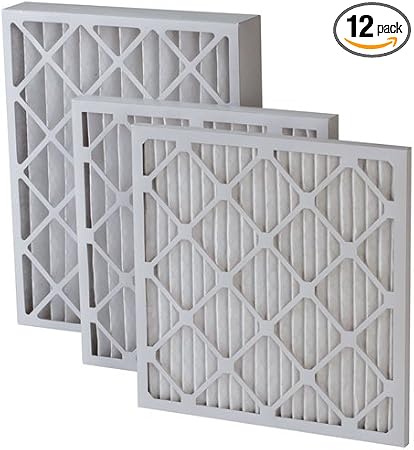 So I bought the highest HEPA-rated filter I could find, which included anti-viral filtration, in the largest size available. This may or may not still be effective once it's applied in the mask, so this is why you should treat the mask as if it's a standard mask.
Anyway, you can buy an air filter and get a TON of usable material. Combined with the cost of a package of athletic tape, I estimate my masks to cost me roughly 50 cents per mask. If you are using an air filter, you will need to separate the filter material from the frame. This can take some work, and there are YouTube videos out there showing how to do this.
Basically, you need to cut the chicken wire off of the face of the frame (on both sides) and then cut the filter around the edge to separate it from the cardboard frame. It's simple to do and regular scissors will cut the wire, but the wire is sharp and can poke or cut you while you're working, so take care with this step.
Once your filter material is free of any packaging, you can work with it to make masks and you can store the excess (if any) in a plastic bag for the next mask. If you choose to use coffee filters or tissue or any other filter material, this preparation step should be significantly less work.
So, now that you have your filter material and it's ready to be worked, you can start constructing your mask. Next you will need to prepare your athletic tape.
Kinesiology tape tends to come in 2-inch strips or rolls. Some brands of the tape come pre-cut into roughly 10-inch lengths. Most of them include a grid on the back to use as a cutting guide. I found that the pre-cut strips fit me well if I shortened them by about 4 squares (approximately 7-8 inches). This will take some experimentation on your part.
I can wear a mask with a pre-cut strip that has not been shortened at all, but I like it better at around 7-8 inches in length. I have a very small face and I fit most large children's size things. Average people will probably fit fine into 2 10-inch strips "standard" version. Larger people may need to to use the un-cut rolls and make it longer and/or with 2 1/2 or 3 strips instead of 2.
So choose your tape color and determine the length you need.
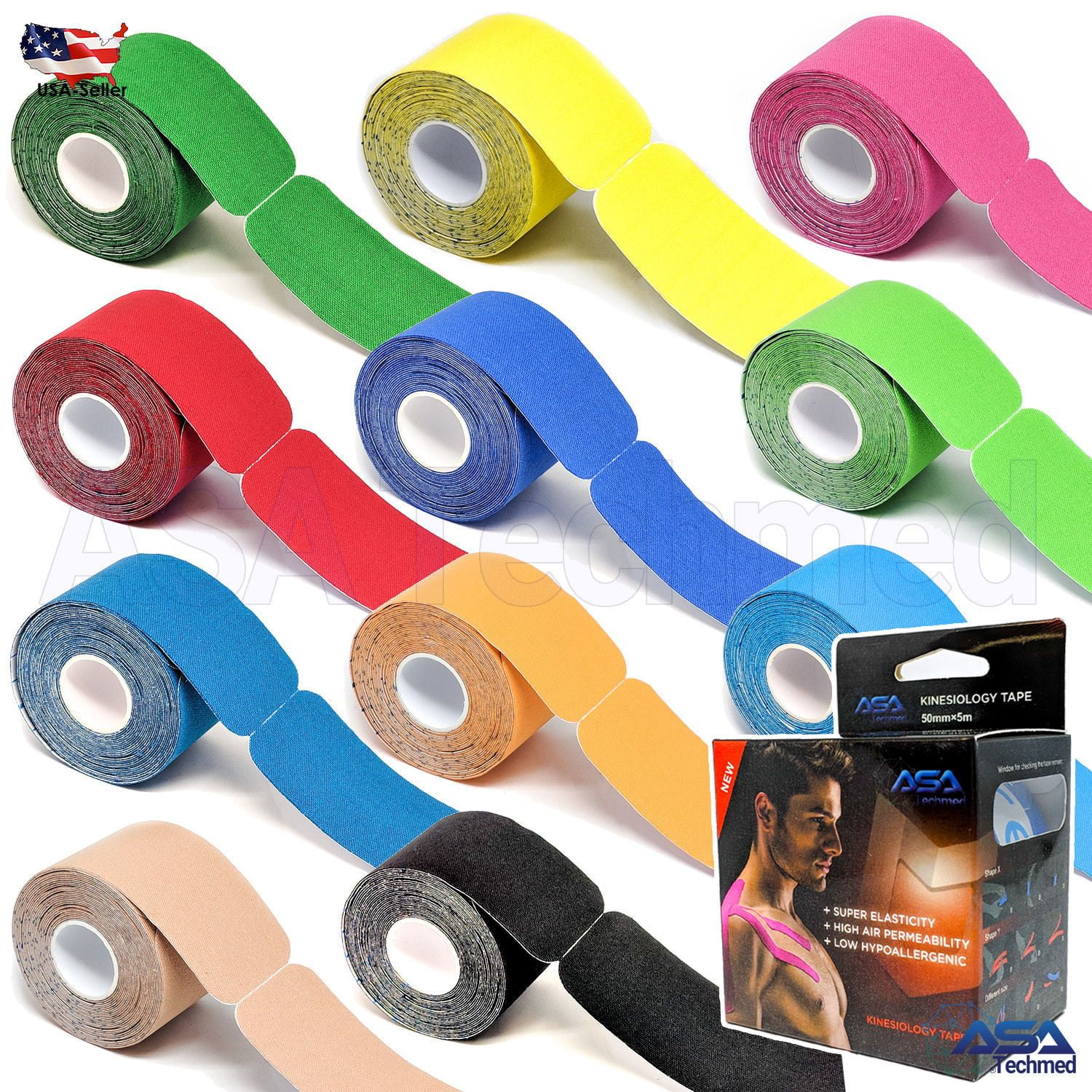
Now that you have your tape and your filter material, we can begin the instructions:
- Take 2 strips of tape of the appropriate length. Peel back the adhesive backing along the length of one of the strips by about 1 square (1/4 inch). Place the other strip face down onto the now-exposed adhesive, overlapping the two strips and creating a double-width band of tape just shy of 4 inches wide.
- Remove the backing from both strips and place face down on a surface with the adhesive face up.
- Cut 2 strips of the filter material, one smaller than the other. The larger strip should be approximately the dimensions of your double-wide mask, minus about a quarter inch all the way around (so, if your mask is 4" x 10", you'll want a piece of filter material approximately 3.5" x 9.5" - this does not need to be exact and it can be a rough cut. The important part is that one piece is bigger than the other and the bigger piece is smaller than the whole mask). You can also choose to have only 1 layer of filter. In this case, make your filter to the "larger filter" dimensions.
- Place the smaller filter in the center of the double-wide strip, right on the adhesive. Place the bigger filter over it and press down around the edges that are touching the exposed adhesive. If you go with only 1 layer of filter, you only need to do this step once - place the filter in the center of the adhesive, leaving about 1/4" of adhesive exposed all the way around.
- Now you should have a rectangle of athletic tape with a patch of filter in the middle and a strip of exposed adhesive all the way around.
 Carefully fold the mask in half, so that the short ends meet each other (but don't touch!). Along one long side only, press the exposed 1/4" inch of adhesive edges together to create a seam. This forms your "beak" shape. It looks kind of like one of those simple leather or duct tape wallets kids make at summer camp.
- Now, with that seam on the bottom / front, going from your chin to your beak's "nose", place the beak over your mouth and nose and press the rest of the exposed adhesive over the bridge of your nose and smooth down your cheeks.
- You can choose to leave your chin free of adhesive, so that air escapes out the bottom if you want to get a straw inside to drink (this basically makes it about as protective for others as a surgical mask with its gapping around the face) or you can seal the adhesive all the way around your face.
Leaving a gap at the bottom will also make it cooler, so I tend to do this after I've finished dancing, when I'm back at my table, to cool off and to drink water, but I close up the seal at my chin when I'm interacting with other people.
 So that's it! Once you get the hang of it, it's really simple and only takes a few minutes.
 Current recommendations are that disposable masks should be replaced about once a day or if it gets wet while reusable masks should be washed at least once a week - for those not in the medical field and only using them in moderate settings.
I tend to wear mine for about a week, using the reusable washing guidelines, because these are so much heavier duty than typical disposable masks and I generally only go to the grocery store and to my office. I tend to make a brand new one on the very rare occasions that I go dancing with my established dance partner. I do not recommend making these ahead of time because you expose the adhesive during the process, which will decrease the length of time you can wear one.
To reuse it, I keep the strip backings. Then, when I take my mask off, I fold the backing strips in half, and I insert them into the mask, with the fold of the backing tucked into the fold of the mask. They end up crossing each other like an L or a V.
Then I press the mask flat with the backings between the layers to keep the adhesive from sticking to itself, and store it until I need it again.
After about a week of wear, the adhesive stops sticking consistently. My record so far was 6 days of 8-hour use with 1 evening of dancing (and sweating) in the middle of that run. It now takes me about 10 minutes or less to make a mask (depending on if I have to cut off more filter from the pack or if I have some strips already pre-cut). I was also able to wear a mask that I had made probably 3 or 4 days prior so it was sitting open for several days. I did this for testing purposes, so I recommend changing your mask more frequently.
Here are some pictures of me in the mask:


And here is a picture of my red and black lace version:
 This was made the same way, but before I removed the backing to add the filter, I added the lace. I found a 2-inch black lace ribbon that I liked. I cut 2 strips the same length as the athletic tape and placed it over the top of the tape. Using my hot glue gun, I glued the lace around the edges and along the center seam.
To hide the glue, I also took some strips of black sequins and hot glued that all the way around the edge and along the center seam. This held up during several hours of dancing and in a combination of temperatures, which can stress hot glue. If you use a fabric or material that is at least 4 inches (or wider than the mask), then you only need to glue around the edges, not along the center overlap seam.
Once the glue was dry, I completed the steps starting with step #3, adding the filter and folding the mask into shape.
Adding the lace and sequins really classed up the mask. I could see doing this with a variety of colors of lace, or just sequins, even individual sequins in a pattern all over instead of a ribbon strip. But the bare tape in a variety of colors is pretty festive all on its own too.
And here is a short video of me dancing in the first mask I made:
Q. A conference in your field had a last minute cancellation, what keynote speech could you give on short notice?
A. This actually just happened to me. I was scheduled to give a presentation at a conference, and the day of, someone canceled and I was tapped to fill the slot in addition to my scheduled talk. I have several that I can give with short to no notice and I can participate in panel discussions on a very wide range of topics with little to no notice.
I am available to come to any type of event where a talk about relationships and communication is appropriate and I can tailor my existing topics to match your group, as well as develop new talks for your group. I have very reasonable speaker fees and I can work with individual groups and your budget. This is not my primary source of income so I have some flexibility in accommodation.
My partner, Franklin, and I are also going on a road tour sometime in the near future (dates TBA) where we can be booked together or individually to speak at your event or as a Guest of Honor at your event along the way. Please contact me for more information.
The Five Love Languages For Polyamorous Relationships:
Adapting the concepts from Dr. Gary Chapman's "The Five Love Languages", this workshop will cover what the Five Love Languages are, how to identify yours and those of your loved ones, and how to use them to better facilitate communication. The ideas on this workshop can apply to partners, primaries, secondaries, spouses, metamours, FWBs, friends, and just about anyone else! The Five Love Languages is just one more tool in the toolbox for clearer communication, expressing emotional needs, and showing love in relationships.
Breaking Up Ethically:
Former sweeties Joreth and Sterling team up on a book about how to break up! The main part of this book is now a workshop! Our society puts a lot of emphasis on the Fairy Tale where each person meets their soul mate as a teenager and lives Happily Ever After. Consequently, we never really develop any skills for how to break up with someone in an ethical way. We are also inundated with a lot of really bad models for breaking up. After a very successful breakup (and some very dismal breakups), these exes share some tips based on personal experience, community observations, and a background in psychology and relationship communication on how to handle breaking up with someone ethically and compassionately and how to get dumped with dignity.
[can be presented with Sterling or solo]
Present Like A Boss:
How to craft a polished presentation for any topic and any venue, how to find your "voice" & "style" as a presenter, and how to use PowerPoint! We'll cover basic tips and tricks for speech writing and stage presence, how to choose your own presenting style, little-considered flare that really makes your presentation stand out, and technical lessons on how to use the PowerPoint software and other technological considerations. Attendees are encouraged to bring their laptops with them and try out the PowerPoint lessons right there in class! Basic how-tos for the beginner along with some interesting tricks that even experienced speakers might not know, from a public speaker, teacher, media representative, and a PowerPoint Operator for some of the biggest public speaking events in the country.
Joreth has spent time in just about every public speaking situation you can imagine, including performance (acting, dancing, singing). But in addition to being on stage, Joreth has also spent the last couple decades or so working backstage at concerts and large corporate conventions with arena-sized audiences and the top audio and video technology. She brings her technical expertise as a camera operator, PowerPoint operator, and video engineer to explain how presentations look from the inside and back end, to better improve the experience from the front.
Simple Steps to Better Communication:
Like dancing? Want to learn? Don’t like dancing? Can’t dance? Want to communicate better?
This workshop is for you!
Partner dancers communicate with each other using a non-verbal process called Lead & Follow to negotiate steps and navigate a crowded floor with other dancers and obstacles.
Joreth & Sterling will break down this communication technique into simple exercises and explain how they apply to your everyday, interpersonal relationships. You will receive real, practical tools to take home with you and increase your awareness and understanding of your partners and metamours.
[can be presented with Sterling or solo, and also with or without a focus on a particular style or category of relationship]
Poly 101:
Do you know someone who is polyamorous and want to understand them better? Do you work with clients who might be polyamorous and want to better serve them or work with them? Have you just heard of this word and want to know a little more about what it means?
This is the presentation for you! This presentation is for laypeople, counselors, and anyone who might be curious about the basics of polyamory and isn’t necessarily polyamorous themselves. We will cover some terminology, a little bit of history, and how it all works in a way that will help you to get a better handle on what all this stuff is when you talk to someone you know who is polyamorous. And you may learn a little something about yourself in the process!
Polyamory & Skepticism:
What in the world does polyamory and skepticism have to do with each other? Isn’t that, like, doubting everything you hear? Why would you want to mix that with romantic relationships?
Both polyamory and skepticism are incredibly misunderstood terms, and have more to do with each other than one might think. In this discussion, we’ll go over some vocabulary - what people *think* they mean and what they *actually* mean, some principles and core concepts, some parallels between the polyamorous and skeptical communities, and where the two overlap and where they diverge.
We will also address when, how, and why it’s important to put a little skepticism in your polyamory (and maybe a little polyamory in your skepticism?)
Funny thing about nerds - part of the definition of a nerd is someone who is passionate about certain subjects and, with very little prompting, can talk about that subject in detail and minutia for ages.
Funny thing about me is that I'm not just a nerd, I'm a Renaissance nerd - I have LOTS of subjects that I can pop off about for literally hours at a time (see my recent post about someone casually mentioning Mexican gang slang resulting in a 5 hour lecture with multimedia examples on Cholo Culture in the 1980s in California).
So, just off the top of my head, here are some things that I think I could give a talk about with no preparation (but if I had time to prepare, I could give a fucking fantastic presentation about), many of which could be given as a broad overview of the subject or broken down into specific components and given as their own 30+ minute talk:
- polyamory (and almost every sub-section of that as its own talk);
- kink;
- science education;
- skepticism;
- poly and skepticism;
- polyamory in movies;
- solo polyamory;
- why solo polyamory is not inherently contradictory with cohabitation;
- the history of partner dancing (and the history of its music);
- the history of each specific partner dance;
- how to partner dance;
- how to figure out which first dance to learn;
- dance shoes and which ones to buy first;
- how to use dance exercises as a non-dancer to improve your relationship communication; how to breakup ethically;
- the 5 Love Languages;
- the misconceptions of MBTI;
- how to give a presentation (with further advanced modules of stagecraft by itself and how to do a decent PowerPoint by itself);
- The Winchester Mystery House;
- Theatrical lighting 101;
- Life As A Career Stagehand (seriously just gave this talk to a couple of middle school classes a few weeks ago);
- Dealing with the media (how to interview for a news article or show without coming out looking like a fuckup):
- Tablecloth Circle Skirt Construction;
- how to make rewearable liquid latex outfits and boots;
- vaccines - the science, the history, the scandals;
- Pockets Are Political;
- The politics of fashion in European and American history;
- What is and is not actual fashion in:
- the Victorian era
- the Edwardian era
- the 1920s (no fringe!)
- pre-WWII
- the 1950s;
- White appropriation of black culture in music;
- How "I like everything but rap and country" is racist propaganda;
- The interconnectedness of music genres;
- You probably don't "hate country music" because you probably don't even know what it is;
- How American politics and racism influenced music which influenced dance which influenced music which influenced politics...;
- Cholo culture;
- The Chicano movement;
- How the Chicano movement led to Cholo Culture;
- The role of women in either the Chicano movement or Cholo Culture;
- The Zoot Suit Riots
Him: The dude in the song is kind of an asshole.
Wrong Answer: No he's not! You have to understand the culture he comes from! It's very machismo and he's expressing his strength and virility and the women find it attractive! That's the culture and time he comes from! That's how he's *supposed* to sound in order to find partners!
Correct Answer: Yeah, he really is. But the hook is just really working for me, so I've been listening to a lot it lately.
Me: I totally love this song! The juxtaposition between the lyrics and the mood of the melody is hilarious! [plays ridiculously bouncy song about "violent" sex]
Them: Uh, that song is triggering for people who have had violent experiences.
Wrong Answer: No it's not! You're just overly sensitive! It's totally meant ironically when sung today. And anyway, in the era in which it was written, it was considered a sign of one's passion to be stricken with strong feelings for someone! You just need to listen to it in the appropriate context!
Correct Answer: Yep, I can see that. I interpret it differently because of my long history with kink, so I will only play it for people who have a similar interpretation and background and who can appreciate irony and also dissonance in lyrics vs. melody.
Me: This is one of my favorite pornos [plays classic porn from the '70s].
Him: Wow, she has absolutely no concept of boundaries, does she?
Wrong Answer: That's not true! You just have to look at it this way! She's a woman, so it's totally OK to cross those kinds of lines! Especially in the era in which it was made! Men prefer that!
Correct Answer: Yeah, she does. The story line was written for a particular sort of interest, so a person can really only enjoy it if that kind of boundary pushing is your thing, or if you can enjoy things in fictional porn that you wouldn't necessarily want in real life. I like the freedom she has in this story, and that's what does it for me. But her behaviour would be totally unacceptable in real life.
Me: I listen to country music.
Them: I hate country! It's so misogynistic!
Wrong Answer: No it's not! It's respectful and chivalrous and men and women are just different so they behave differently! It's just a party song, don't get so worked up over it! It doesn't mean anything! He has a wife, so obviously he can't be *that* misogynistic!
Correct Answer: Yes, a lot of it is, and a lot of all kinds of music has misogynistic themes because the music is written from within a misogynistic culture. There are some songs that I can't listen to either, even though I'm able to like the sound of other songs while ignoring the lyrics.
Since you're aware of and bothered by misogyny, you might be interested to know that singling out country music specifically, or rap music specifically, as being misogynistic is a consequence of classism, and I can go into the why of that if you'd like to have that discussion.
If the sound of the genre doesn't bother you but you can't ignore the lyrics in order to like the sound of a song, I also have an entire library of music that is less misogynistic or not at all, if you're interested.
#ItIsNotThatHard #ActualConversationsIHave #ItIsOKToLikeProblematicMediaJustBeAwareAndHonestAboutTheProblems
"No copyright intended" does not save you from a copyright violation.
"Copyright" does not mean that you're claiming it for your own. That's plagiarism.
"Copyright" means that you have the RIGHTS to use the art (music in this case) in the way you are using it.
When you purchase a CD, you have the rights to listen to that CD in your house, your car, wherever you have a CD player pretty much. But it's for *personal* listening.
If you are hosting an event that's open to the public, whether it's a free event or not, you don't have the rights to play that song unless you purchase a license to play it at a public event. But, chances are, nobody will report you for it if you're not charging money.
If you *do* charge money for a public event, then you *really* don't have the right to play that song unless you've purchased a commercial license for it.
You can play the song you purchased from a CD or from iTunes at your house with your friends over. But you can't give them a copy of the CD. And you can't put it up on YouTube for the whole world to hear for free. Adding "no copyright intended" doesn't absolve you of a copyright violation because that's not what the copyright violation is.
Now, in most circumstances, you will probably not be reported and there will be no consequences for you, other than people like me giving you the side-eye for not paying artists for their art. I'm just telling you the actual (layman's translation of) "copyright".
And making your own art that works in conjunction with another piece of art (i.e. animating a music video to go along with an existing piece of music) makes this area a little muddier, so let's leave that part out for now.
And nobody better come in my comments with "but what about Fair Use?" because most circumstances where people are doing this don't qualify for Fair Use, because if they did, they wouldn't be using this disclaimer, they'd be using the appropriate disclaimers, so even bringing up Fair Use is a distraction - learn the basics before moving to the more advanced stuff.
If you're going to share artists' art without paying for it, at least share it directly from their channels and sources so that they get the page views or download counts or whatever.
Just don't think that "no copyright intended" is how you get out of a copyright violation. It's not about claiming the art as your own (although doing that will give the other person more of a legal case, should it ever go to court). It's about what legal RIGHTS have you purchased or been given to access that artwork.
For instance, the polydragon symbol is a copyrighted design. Franklin and I both have copyrights to it because the person who designed it is a former partner of mine and he gave us copyright to sell items with that design because he wasn't interested in doing that himself. Then I gave Bonedaddy Bruce permission to sell that design in his vinyl shop in exchange for a commission of all the stickers he sells, and also in exchange for him cutting for me all the stickers that *I* sell at cons and on my site, for which I pay him a cut of each sale for that labor.
That's how copyrights are exchanged. No one else is allowed to download, post, or sell anything with the polydragon on it (except for the graphics I have stamped with my copyright info available at the Poly Tees website). No user pics, no FB cover banners, no tattoos, no t-shirts, no Instagram pictures - nothing, unless you ask me for permission.
Songs are the same way - you buy an album or a song and you have the right to listen to it personally using the medium in which you bought it. That's it. Sharing it with the caveat "no copyright intended" doesn't absolve you of a copyright violation because that's not what "copyright" means.
If you run a red light even though you didn't intend to run a red light, you still ran that red light and you would be responsible for any fines or restitution or even any jail time or legal status as a result of the consequences of running that red light.
At least with running a red light, that could legitimately be an accident if you didn't see it or something. But uploading a song to YouTube is a deliberate act. You didn't "accidentally" upload the song, you did that on purpose. You're just ignorant of the law. However, as they say, ignorance of the law is not an excuse for breaking it. You're still responsible for following the law and the consequences for breaking it even if you're not aware of the laws.
Also, I'm not saying that I necessarily agree or that there aren't times one can justify doing so, morally or ethically speaking. I'm just saying what the law *is*.
"No copyright intended" is not a "get out of copyright violation free" card for sharing art without paying for it, with or without accepting money in exchange for sharing. That's not what "copyright" means.
#PetPeeve #StarvingArtist #MyLandlordDoesNotTakeExposureCredit #YouAreNotEntitledToOtherPeoplesLaborJustBecauseYouWantIt #AtLeastWhenIViolateCopyrightIKnowThatIsWhatIAmDoingAndWillAcceptTheConsequencesOfIt
I got booked for a gig out of town last fall, but I was being paid as a local - no travel, per diem, or hotel or anything. It's fine, it's an annoying drive but in Florida, one that lots of people are willing to make without pay. I wouldn't normally, but I took it merely because I like both the employer and the people I knew who were already booked on it. And, it's not like I was terribly busy what with my largest client still not having employed me since they fired me for wearing a hoodie, almost 2 years ago now.
Anyway, my client is not in FL and didn't know exactly how far it would be for me to drive. When he found out how far it was, he upped my rate by $50. Then he finally got word on what kind of gig it was. There was some massive security to go through and they wanted to start our call time 3 hours early (which we'd get paid for, thereby moving up the time we start overtime by 3 hours too, and since our out-time wasn't changing, I would more than likely go into OT with this new start time).
So he called me to offer me another $50 on top of my rate for my trouble (which then also increases my OT rate).
As the security implies, the gig was a Big Fucking Deal, and it should actually be a really good time. So on top of the extra pay, he also called to tell me to have a "good time" and "enjoy yourself" at the show. Which means that it was going to be a pretty big party and we'd get to enjoy some of it while we work. But my client was looking out for me and he appreciates me. And he's showing it both with extra money and with Words of Affirmation and some leniency.
One of the things I love about my job is that it sometimes doesn't feel like work. We may have responsibilities to do, but we're still working events like parties and concerts, and we're doing creative things, so working can be a lot of fun ... on the right gig. I mean, I bring my camera with me to social events, so I do a lot of my work stuff literally for fun too.
Getting paid for it, and being given authority to run around and do what I do, expressing my creativity and enjoying some entertainment can be a really good time.
This gig was one of those times. Man, I really miss working.
#ThingsIWantToToon: The Dam Is Breaking
Apr. 29th, 2020 10:08 pmA large dam is broken and hemorrhaging water. Entire villages along the banks are flooded, people and animals are being swept away by the flood and the river is full of the dead.
A person with an evil grin is placing bombs along the dam. Another person is on the ground trying to organize the disaster relief.
There is a long line of people bringing sandbags to try and control and redirect the flood.
Some of the people who handed over a sandbag have also started organizing to go after the saboteur and stop them from blowing more holes in the dam.
There is yet a third group of people in the distance with blueprints and maps and are clearly a long-range rebuilding team who will get to see the fruits of their labor only after the immediate disaster is controlled.
Off to the side, two people stand talking. One of them says "I'm not going to bring a sandbag. I just don't think it will help anything."
The other one says "the person in charge of all of this isn't perfect. Look, they're getting paid for their work here, and I heard they even backed into someone's fence with their car once. Clearly they are just as bad as that guy up there blowing up the dam, so I can't support their efforts to block up the dam or clean up the mess from the flood."
#IfYourVoteDidNotCountWhyAreTheRepublicansSoIntentOnTakingAwayYourVote? #LesserOfTwoEvilsMeansOneIsStillTheGreaterEvil #DamageControl #HarmReduction #MultiFacetedPlan #ShortTermTriageLongTermRecovery #StopTheBleedingFirstThenStabilizeThenHeal
Love Languages And Baking Cupcakes
Apr. 29th, 2020 10:02 pmGuess I need to start including "must eat my cupcakes" in the Relationship Duties section of my user-manual. #DealBreaker
#AlsoDoNotTouchMyKnivesWithoutPermission #IfISayAParticularSongMakesAGoodDanceSongThenDropWhatYouAreDoingAndDanceWithMe #ThingsToMakeJorethHappy #FunnyButMyMetamoursAreAwesomeAboutHelpingMeEatMyCupcakes #NoThisIsNotAEuphamism #EvenFranklinLovedMyWeddingCupcakesAndHeDoesNotLikeCupcakes #BakingIsOneOfMyLoveLanguages (#ActsOfServiceDialect)
This deserves it's own post, I think. I don't have a lot of time right now to really expand on this, but I am working on an expansion of the 5 Love Languages that will help people to determine what their LL is by going backwards - instead of reading the descriptions and trying to see if you fit in it, figuring out *what you are getting* out of a particular activity and matching that with one of the LLs.
Anyway, "baking" is, to me, one of my Love Languages. It's a dialect of Acts of Service.
Something that seems to confuse a lot of people who haven't really delved into the LL theory is that there may be only 5 LLs, but there are a ton of dialects, just like real languages. And just like real languages, some of those dialects are easy to see how they derived from the parent language and some are difficult, but they all derive from *something*, and often are influenced by something else.
So, for me, baking for other people is one specific way that I perform an Act of Service to show that I care about people. But it's also a form of self-care and relaxation, so that makes it difficult to identify that it falls under the Acts of Service LL.
That's the thing with all these "personality type" systems - the systems themselves are simplistic while people are messy and complicated and often behaviours serve multiple purposes or have multiple influences, making it difficult to pin down the *why* of things. They're handy short-cuts in the communication toolbox, but only if everyone you're communicating with knows what you mean by them.
I still recommend using these tools. Just know their limitations, which most people don't.
Lindy hop tends to be a "young folk" scene. I'm often surprised by how many 1940s jazz songs and artists they know, but that's the music that gets played for lindy hop, so they have exposure to it.
Then, I get accustomed to them knowing some of these classic songs, and I forget that they haven't had as much time to learn like all the rest of music history. They know 1940s jazz because that's what gets played every week at their dances, but most of them did not spend the last 30 years taking music lessons and music theory and playing instruments and studying the intersection of music and fashion throughout history. Mainly because many of them haven't even *seen* 30 years yet.
So I was talking with some 20-something lindy hoppers about hosting themed dance events. Some of them turned their noses up at '50s Rock N Roll, saying they didn't like "rockabilly" and it's too hard to swing dance to it.
...
::blinkblink::
0.o
Oh sweet summer child.
I don't even know where to start. Do I explain the difference between Rock N Roll and rockabilly, or do I talk about the evolution of jazz to R&B to Rock N Roll, or do I start right out with the cultural appropriation and how you can draw a direct line from the origins of lindy hop in Harlem to the creation of Rock N Roll a generation later, or or do I pull out my rant on how interrelated musical genres are so that it's not even that easy to see a delineation between jazz and Rock N Roll, or perhaps I can talk about the ground-breaking socoipolitical impact of Rock N Roll that, again, is on a direct line from the sociopolitical impact of jazz, or maybe I should just bombard them with video clips of lindy hoppers dancing to Rock N Roll to show them how that genre was literally created for swing dancing without even needing a verbal lecture on all the intersections of the subject?
#SuchABigTopic #SoManyConnectingLines #ItRemindsMeOfTryingToExplainToAnAuthorOfAltHistoryFictionTheImportanceOfFashionOnPoliticsAndWhyItIsRelevantToTheirStory
So then, if I don't have the word "sex work" being said in my head along with the rest of the words in the sentences, my brain just substitutes "retail job" automatically because all the anti-sex-work arguments apply to my retail job - customers being dangerous, forced into work I don't like just to survive, demeaning, customers who don't value my services, even the false equivalency to sex trafficking (which, again, is not the same thing as "sex work") works for the retail industry because of the sweatshop problems in the production side of retail.
But I have never had anyone tell me that I was immoral for spending literally hours standing on tile (because retail workers in the US are not allowed to sit, even when they're cashiers and don't move from their post), working my body for poverty-wages to make some CEO richer.
I have never had anyone tell me that I was "selling my body" when I perform a dance routine on stage, or climb a truss or load a truck, which is all manual labor using my body in exchange for money, or tell me that I was a bad person for doing so or that I should find some lower-paid job where I didn't have to "sell my body" because that would make me a higher value person / potential wife / mother.
I have never had anyone tell me that they support me but my customers are evil and should not spend money on my services (even though banning all my customers would then put me out of a job).
I've never had anyone shake their head in shame over my being exploited by capitalism (but I've had plenty of people shake their heads at me over requesting a living wage in a capitalistic society).
I've never had anyone tell me that by consenting to work for a retail employer, I am indirectly supporting those aforementioned sweatshops.
Not only have I never had anyone tell me that my job is demeaning, but I have had lots of people try and tell me that it's noble to "earn an honest day's pay for an honest day's work" and to take pride in a job well done no matter what kind of job it is. The harder the job (and often the lower it pays), the more "noble" it is. Unless it's making your fast food, I guess.
It's funny how these arguments only apply when the job in question is sex, but it doesn't apply to retail, to cleaning services, to farm workers, to call service employees, or any of the other hundreds of low-paid, high-labor, emotionally and physically draining work. But Horus forbid a person likes sexyfuntimes enough to want to trade it for money, and someone else has the money to trade it for sexyfuntimes with someone who enjoys the trade.
Literally, replace "sw" in any anti-sex-work argument with "retail" or even with "freelance art / content producer" (such as people who make a living from their Etsy products, or classic artists, or photographers, or musicians) and it applies to my life.
I HATE retail work. I loathe it with every fiber of my being. Even though I like the creative process of designing and building custom frames, I hate showing up to my job, I hate my 4-hour shifts that costs me almost as much in gas to get there and back as I make that day, I hate hate HATE our customers, I hate the physical and emotional pain I suffer from walking and standing on that goddamn tile, and I hate my pittance of a wage that I earn in exchange.
I love my freelance work, but I hate the part where I don't work for several months in a row no matter how many clients I call and beg for work, and I hate that I can be fired from a gig for the completely functional clothing that I'm wearing and my employers can pretend that I'm not being "fired" because they can just not call me for more work, but I'm not technically "fired" because this fucking state has no union power for my industry because our union sucks.
Everything that's "bad" about sex work applies to my jobs. So unless you have a solution to capitalism itself so that *nobody* has to trade *anything* for money, any objection to sex work (as opposed to sex trafficking) or to legalizing and supporting sex work and sex workers is just sex-negative condescending bullshit.
When I see you fighting just as hard to, not just abolish capitalism but replace it with something that doesn't result in me starving to death because I can no longer earn a living, as you do justifying why sex work is bad (or sex work is good but people who use sex services are bad), then maybe I won't block your ass for your deeply embedded misogyny and sex-negativity.
And I better not catch you patronizing a kink club or using sex toys (which were probably manufactured in one of those sweatshops in Asia that more closely resemble your sex trafficking ring that you're so concerned about), or taking pole exercising classes, or wearing lingerie (or regular undergarments, or any clothing that you didn't personally make with your own self-harvested fibers that you wove yourself and then cut into your clothing for that matter) either. You fucking hypocrite.
 #Irony: Today, sock hops are considered a throwback to a more innocent time, with fresh-faced youngsters in sweaters and poodle skirts or blue jeans and letterman sweaters. They're considered "good, wholesome, family fun". Lots of family-friendly organizations ilke church social groups, host sock hops so that everyone can get all dressed up in cheesy costumes and dance to our now-grandparents' music.
But sock hops at the time were wildly controversial. It's true that they were intended for teens, but the music that was played was considered by the adults to be sexualized and taboo. All that wild abandon in dancing and sexual innuendo in the lyrics were sure to lead to wanton sexual behaviour! And music being played by black musicians?! For our innocent young teenagers to hear?! The horror! (ah, American racism in the "golden age" of our history)
The reality is that they were more like the dance scene in Grease (which is not a sock hop, because sock hops were informal dances, not proms or otherwise formal events), with double entendres, and kids getting up to "trouble" while chaperones did their best to keep kids in line.

But today, we revisit them as a quaint, retro party suitable for all ages and communities.
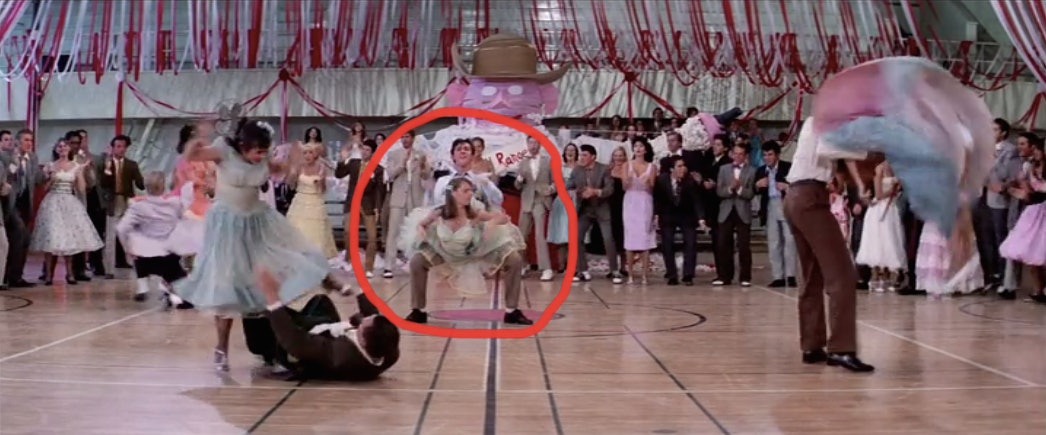
No, seriously, watch that entire scene of the school dance with the spiking the punch and mooning the TVs and the giant sexual free-for-all hand jive number - this is what a sock hop was actually like, except not a formal dance.
Also, fun fact: they were called sock hops because the kids were literally required to take their shoes off before entering the gym so that the soles of their shoes didn't scuff the floor. And, apparently, the teachers were the worst offenders of scuffing the floor so they also went in their stocking feet.
#DanceHistory #DanceGeek
I Work And I Know Things
Feb. 10th, 2020 11:23 pmI have been working in entertainment since 1989. I have a background in theater lighting and set design and construction. I moved into broadcast video in 1999 and that's where I got my degree. I've had 3 different but related majors because I've been back to school a couple of different times and each time the school didn't have the exact same major so I had to switch. In addition to broadcast media, I've also majored in film lighting and in stage lighting and set design.
I have worked in theater, in television, in event photography and videography, in wedding videography, in stock photography, in portrait photography, in animal photography (wild and domestic), in concert lighting and camera operation, and in corporate events on the exhibit floor, in meeting rooms, and in general sessions.
Back in my first time through college I even specialized in music videos and I spent my internship in a public access TV studio and got my first paid camera job op-ing for a megachurch. For a while after that, I was known for excelling in the hardest spotlight positions there are - ice shows and magic shows. When I started working in the industry, we were still splicing celluloid together with scotch tape and jogging beta decks frame-by-frame to sync up with a separate audio track.
I've done everything from stagehand and truck loader all the way up to Master Electrician and LD in electrics and from grip to V1 in video. I have also done some odds and ends of related positions like fly rail, concert, & ballroom rigging, and getting certified to drive heavy equipment like forklifts and high reach boomlifts. Some of those positions I might be better at than others, but I have at least tried my hand at them all.
I've seen the industry evolve over nearly 30 years. I've seen the death of analog and the birth of the digital age. I may be only a jack of all trades instead of a master of any of them, but when I talk about my industry, I kinda know a little something about what I'm talking about. When I don't know something, there will usually be a question mark somewhere to indicate that I'm interested in learning something I don't already know. Seeing as how I continue to take training courses as new equipment develops, rest assured that I do, indeed, continue to learn.
But when I make a statement, particularly an opinion statement, it's probably a fairly informed one.
What do you do when Touch is one of your LLs and your partner(s) is/are long distance? The last time I gave my 5LL workshop, someone asked me that question. Because of my baggage, I didn’t have a good answer, so I threw it out to the audience for brainstorming. One of the proposed solutions that I managed to remember was to wear a shirt for a couple days and then send it to the partner so they could wear something that smells like you and vice versa. Preferably a soft shirt, something with pleasant tactile qualities.
Fast forward some time and after I announced our marriage plans, a metamour started working on a set of beautiful matching quilts for us, so we could have something tangible and symbolic of our relationship while apart. This combined the Touch LL with the Gift Giving LL and threw in some metamour bonding and was related to the theme of our wedding which was about the strength of partnerships being tied to the interconnectedness of the supportive family network.
So now, a couple years later, I find myself in strong NRE with a long distance partner at the peak of some Touch Starvation. I’m operating on a deficit of Touch already and all I want to do is be near him all the time. What to do?
As we’re getting to know each other, I’m slowly learning his LLs and his particular quirks and needs and limitations. The first night after I came home from my first visit to him, he remarked about “my” side of the bed still smelling like me. That stuck in my brain. And then it hit me. I don’t exactly remember the order of events, did I think of this right then when he said that, or later at the fabric store or somewhere in between?
I came up with Long Distance Pillows. I’m quite sure I’m not the first to think of this. But I’ve never heard of them so someone else probably needs to hear of this too.
I know he likes soft things. I know he likes to sleep with pillows to cuddle. I know we both like Touch and that I, at least, am Touch Starved. I know he notices scent (not everyone does). So I found some very tactile-favorable fake fur material and made 2 small pillows.
 The pillow of Me is solid black fur with little paw prints running up one edge, because I think of myself as a cranky black alley cat - a little rough around the edges, a little weather-worn, a little dark, but soft and lovable when I choose to be. He does not abstract himself in that way. He does not associate part of his identity with colors or animals or other symbols. So I picked a grey fur that matches my decor for the pillow of Him.
Then I slept with the pillow of Me for a month. When I went to visit him the next time, I revealed my surprise and my plan. He would sleep with Him and I would sleep with Me for the week, getting our respective scents on our respective pillows. Then I would go home, taking Him with me and leaving Me with him.
We could then have something soft to cuddle while we’re apart that reminds us of each other. When we get back together, we’ll swap pillows for the time we’re together and do it again.
A few days after I made the pillows, I was in a store and I found fake fur pillows just like the ones I was making. At first I was a little disappointed that I could have just bought a couple of pillows and saved some time. But then I realized that I like the fact that I hand made ours. In addition to putting in a zipper so they can be cleaned or the inner pillow can be replaced later and the little detail of the paw prints for Me, these are things I made myself with love and intent. That means something to me.
So, here is something that hits my Physical Touch LL, particularly the dialects of tactile sensation, scent, and sleep cuddling (which I like emotionally, but physically I have some challenges with), addresses, in part, some of my Touch Starvation, and hits my Gift Giving LL, particularly the dialects of tangible items representing thoughts I had of the person while apart and of creating which may overlap with Acts of Service as I use my skills to do something useful that I’m good at to meet an unmet need for someone.
So I share this for anyone who might find it a helpful idea. If you are not a crafty person, you can buy a pillow or blanket. If money is an issue, you can send a clothing item that you already own either to give them something with your scent or to have them wear it and send it back - depending on what you have and your individual circumstances.
You can even turn old t-shirts and other clothes into pillows and blankets if you are moderately crafty and want to save money. Some methods don’t even require sewing, you just fill the shirt and tie the openings shut. Check out no sew pillows on YouTube. This might be a good idea for those who have certain sentimental items like a concert shirt you got at a show you went to together or something. Even paper items can be turned into quilt squares (I’m not a quilter so I don’t know how but I’ve seen it done) so, like, love notes or doodles on a napkin or stuff like that.
I get out of my car and look around cautiously, it's just the kind of neighborhood where you want to know what you are about to turn your back on. Nobody and nothing around.
I lean into the car to get stuff out of the front seat.
I turn back around and close the door. Behind the door is the silhouette of a cat, sitting facing me. I pause, wondering where it came from. But there is a chain link fence between me and the cat.
I turn to walk towards the house.
Another cat silhouette is behind me (now in front), slowly walking towards me. I stop. I am between the 2 cats.
I look back towards the other one. There are now 2 cat silhouettes sitting, watching me. Where did the other one come from?
I start walking towards the house again. The moving cat veers to intercept me.
All of this is done in spooky tones.
Then the motion sensor light comes on as the moving cat reaches me, and I lean down to pet a smiling, purring #TonyTheCat, as the #EgyptianFerals kittens come bounding up, only to bounce away before I get too close. Tone changes to bright, happy tone.
I make it into the house and fill a bowl of cat food while Tony winds his way between my feet and the kittens butt-wriggle-pounce on something in the yard. I smile.
#LifeWithFriendlyFerals #StreetCatSaga #TheCatChronicals #Toxoplasmosis #DamnParasite #CatSlave #MoreImportantThatCatsLikeMeThanPeopleLikeMe #FeralCatsAreMyPatronus #ThisIsNotMyCat #ThisIsProbablyMyCatNow
In those dance circles that I frequent, we have the following values that I appreciate:
Yes, the dance scene is quite heavily gendered by default, but when people *do* take the non-conforming role, the community typically accepts it and often embraces it. Women and people presenting as women are more likely to take lead roles in the Ballroom and Latin scenes, while all genders can be seen switching roles in the Lindy Hop and Blues dance scenes. The Lindy Hop scene also trends towards a younger and more liberal demographic.
I have not witnessed any ageism or fat-shaming. This does not mean that it doesn't exist, but it does mean that it's not a common occurrence. I would believe anyone who said they did experience either in my communities, but the people I talk to about it don't seem to have experienced it. People of all shapes, sizes, and ages are welcomed at these dance events, get asked to dance often (regardless of gender), and are active participants in the communities.
In my local communities, dance is seen as a social activity and a "community", so the general cultural attitude is that we want everyone to dance and we want everyone to have a good time. To that effect, experienced dancers of either role, and leads of all experience levels, feel that it is their happy duty to go around the room and invite anyone to dance that they see isn't dancing.
Ballroom dance events have a convention called a "mixer" especially for this. Because of the gendering in the dance community and also the gender roles in the culture at large that discourages men from exploring or expressing an interest in learning how to dance (thanks toxic masculinity), dance events are usually 2/3 women and 1/3 men (-presenting people).
So ballroom dance events have at least 2 points in the event where a medley of the same tempo songs are played in a row, the follows (because follows are usually women, and the women outnumber the men) line up along one wall, and the less numerous leads line up across from them. The first lead in line takes the first follow in line, dances her around the floor once and drops her off at the end of the line, and then moves up to take the next available follow for her turn around the floor. This way, everyone gets to dance, if they want to.
This is also a good way to be introduced to other people in the complimentary role if you're new. Now that they've had a chance to dance with you, they know who you are and what your skill level is (and vice versa), and that relieves some of the anxiety about asking someone to dance later.
The communities encourage more advanced dancers to see dancing with newbies as an opportunity, not a punishment or a chore. We take delight in giving newbie dancers more chances to practice because that brings more *advanced* dancers into the fold later as they improve. I'm *thrilled* to do the same 3 steps over and over again with a newbie if it means that they will develop more confidence and keep coming back.
My dance communities, because of that whole "community" and "social activity" thing, also see dating within the community as ... challenging. Nobody thinks you should NOT date another dancer, of course. But pretty much everyone looks on the dance events as meat-market-free-zones. Dances are not the place to hit on people. They are not the place to find partners.
They're like poly discussion meetings in that respect - when you spend enough time with someone at a social event, you might eventually develop a friendship out of that space, and that friendship may eventually lead to a romantic relationship. But the event is for dancing, not hooking up, not flirting, not hitting on people, not propositioning people. People frown on those who hit on other dancers in the scenes.
And because social dancing is a social activity, people also frown on excessive displays of jealousy in the scene. Some people arrive as a couple and only dance with each other. It's allowed, but it's kind of side-eyed. Because of that above-mentioned cultural value of making sure everyone is having a good time (which means everyone is dancing as much as they want to), and because of the gendering of roles and the gender disparity, my dance communities see it as sort of rude to monopolize one person's time when you could be out there sharing your love of dance with everyone.
They don't go too far by insisting that people dance with anyone they don't want to, but having jealousy and not wanting your partner to dance with others is kind of a cultural no-no. When someone in the dance scene gets a non-dancing partner, and the dancer starts to drop off the scene because their partner doesn't dance and they won't or can't dance without them, that couple is usually murmured about. The dancers in my local community see it as healthy for couples to have separate interests, or, if they share the interests, to still be able to do the interest as an individual person, even with other people.
One of the things I liked about my local dance communities, is that when my FB status changed and people found out that I had gotten legally married, not a single person changed how they treated me. Nobody asked me if my husband would "mind" if they asked me to dance, nobody changed their dance style to a more formal, stiff, polite, or distant style, nothing like that. People asked where he was and if he danced, but nobody suddenly got cautious around me or treated me as if I was off-limits.
In my local dance scenes, people are also usually very good about rejections. I can say "not right now" or "no thanks" and they just nod and move on. I'm never afraid of a bad reaction because I've never been given one in my scenes. Everyone sees it as a sign of immaturity and the men in particular are disapproving of people who can't handle rejection gracefully. And the women talk to each other.
Women and/or follows are also encouraged to ask people to dance, so they don't have to simply sit around waiting and hoping for someone to ask them. This is not one of my strengths. I still prefer to be asked than to do the asking, but once I've developed a good dancing relationship with someone, I am more likely to ask them as often as they ask me. There are no gendered rules about who asks whom, for as gendered as the rest of the social conventions are.
So my local dance communities are not perfect. There are still a lot of things that I'd like to see improve. I'd like to see more gender-neutral language (switching back and forth between lead/follow and men/women is still too common), I'd like to see more POC (there are a few, but more Latinx and Asians than black people), I'd like to have more people who share my politics so that I could develop off-the-floor relationships with people, etc.
But not respecting consent, body-shaming, not accepting role-switching, and using the dance scene as a pickup spot are some of the more egregious violations in the dance world that my local dance communities do not support. Not that these things never happen, but they are not supported by my communities. And I have to give them props for that.
For the record, when I teach my lead & follow communication workshop and when I give general dance lessons, I do my best to avoid or reduce all the other complaints as well. So if you ever wanted to learn how to dance, find me at a conference somewhere (or bring me out to your local conferences or communities!) and I will be happy to give some instruction. I don't even have to be at an event for the purpose of teaching dance - I'll teach dance anywhere, any time someone wants to learn.
(like you forgot what your last slide looked like and you hit the next button one too many times and you didn't "continuous loop until esc" so it knocked you out, or you realize you have the wrong thing loaded up and you have to quit the slideshow entirely to put the correct thing on the screen - both of which presenters did today)
In a professional show, there is a team of video engineers in the back who will switch between content sources and usually a logo. It looks very unprofessional, and very under-prepared, for your desktop with your kids or your dogs (or your wife in a bikini!) covered by a thousand folders to suddenly show up on the big screen.
Or to want to back out of Presentation Mode so that your audience sees the Edit Mode of PowerPoint on the screen, like when you want to show a video but you didn't embed it so you have to escape out of your slideshow, open up a video viewer, show the video, close the video viewer, and get back into your slide deck.
These are all unprofessional mistakes. Make your desktop the conference logo and when you plug your laptop into the projector, change your screen settings to "extended desktop". Now, the only thing that will show on the screen will be nothing but the logo background, and when you start your slideshow, it will automatically go into Presentation Mode on the extended screen so that nobody sees the Edit Mode while you start it up.
Then, escaping out of Presentation Mode or closing PowerPoint or accidentally clicking past the last slide will all default to the activity happening on your laptop and a blank background (of your logo) on the screen.
I have this and many more pro tips in my Present Like A Boss workshop.
#LiveSwitching #AlsoGoToRehearsal #OopsWhereAreMySlides?
 Here's why my Simple Steps workshop is so important (the workshop where I teach using lead and follow exercises to improve your relationship communication):
I went to an all-night dance event on a Friday - the day after I got fired from a gig over a medical condition. To say that I was having a bad week is an understatement. At that event, I had 2 friends there - one who dances and one who doesn't.
I met them both at roughly the same time. The dancer, I actually met a year or so ago, but only barely. He doesn't live in the US, he only visits here for a couple of months a year. So he came to a dance event once or twice last year, where I met him. I'm not sure I remembered his name until recently.
About 6 months ago, I started doing a weekly dance thing that I helped to organize with this dancer's father. Because it was his father's project, he attended the first couple of weeks even though that style of dance wasn't really his thing. Because it was a late-night sort of event, some of us night owls started staying afterwards to just chit chat. That's where I actually learned his name and set him apart from just "one of the dancers".
We didn't have any alone-time or any particularly intimate conversation, but we got to know each other well enough, and the others who stayed late to talk, that we have formed our own FB chat group to coordinate weekly get-togethers even though that weekly dance event is no longer.
At this same weekly dance event, I got to know one of the employees at the venue. Again, not very well, but we chatted a bit as I arrived and as I left every week, as did some of the other dancers. Then, when the dance event was canceled, we invited him to meet up with us after he got off work, since he really enjoyed seeing all of us dancers show up and now we weren't going to anymore. He and I have since had some *very* personal conversations and some intense alone-time, and we have gotten to know each other pretty well.
So, the day before this particular dance event is when I got fired from that gig. I realized 4 days later that I have officially slid back into my depression, complete with suicidal ideation. But on that Friday, I didn't realize I was heading towards depression, I just thought I was sad and upset over losing the gig, which is to be expected.
On Friday night (the next day), I went out dancing. The dancer friend was performing at the beginning of the event and I wanted to support him. That was enough motivation to push me through my growing depression and make myself leave the house. I fought my depression all night, and on at least 3 separate occasions, I nearly left to just go sit at home and cry. But I didn't. I pushed through and danced all night.
Dancing releases a lot of endorphins. It's a pretty strong mood elevator for me. But "mood" and "depression" are not the same thing, just ask Robin Williams. Once I started dancing, I got into a good mood. But the depression was still there, bubbling under the surface.
Here's my point...
My non-dancer friend remarked on how happy I looked. So I just smiled and mentioned the endorphins. Remember, I didn't recognize my depression yet, but I was a little surprised that the sadness wasn't showing through. I often post a "sneak peak" selfie of my outfits when I get dressed up and go out, and I think it's glaringly obvious in the picture I posted that night.
By the middle of the night after dancing for a few hours, I was feeling energetic and confident, and I was happy to see my friends. And this friend saw that.
But my dancer friend had one dance with me and knew something was wrong. And it was our best dance ever, yet he still knew.
He's a better dancer than I am, and I am new to this particular style of dance. So over the last few months, he's seen me go from unconfident, hesitant, and wooden, to relaxed and confident and trusting with him. So on Friday, we had our best dance ever. He was amazed and said we should have gotten it on video. And I mean it was a *good* dance - I looked like I had been taking lessons and practicing for months, when the reality is that I've never had a lesson in this particular style and I've really only danced it a couple handfuls of times in social settings.
But later, when we left the loud music and walked around outside in the quiet and the dark, the first thing he did was ask me what's wrong.
I was smiling, energetic, and *killing* it on the dance floor. But I was sliding into a depression. The friend who had some really intimate conversations with me couldn't see the depression. The dancer friend held me close for 3 minutes and, even though everything my body did was right, he still felt it.
This is why my workshop is important. With a dance partner, everything is out in the open, laid bare, raw, exposed, vulnerable. You can learn to read that, and honor that. Dance is one of the ways that can be learned.
And, of course, my workshop doesn't teach actual *dancing*, just the parts of dance that are relevant to that ability to communicate on such an intimate, intuitive level. No musicality or physical prowess or ability to memorize patterns necessary. Just pure, unfiltered flow of primal energy between two people.
He was able to read me that easily, in spite of not being a romantic partner and not knowing me very long or very well, because he is a Very Good Lead and I am a Very Good Follow. I can teach you the exercises that will guide you towards those leading and following skills.
But they take practice. He and I have been practicing, independently, for most of our adult lives. We did not need to practice with each other to learn how to read each other. We did, however, need to practice. A lot. For a long time.
 My workshop will give you the tools to grow to this level of proficiency. But it's not a magic spell, where you whisper the incantation and move in the ritualistic movements one time and suddenly you're a good communicator. You have to practice the exercises that I will teach you after you leave my workshop.
And I promise, the amount of commitment you put into it will be proportional to the results you will get in the end.
Because he could read me with one 3-minute dance, through the endorphins brought on by physical activity, through my active processes to be pleasant and sociable and pretend like depression isn't a thing, through all the noise and distraction and other dancers, even through the sensuality and flirtatiousness of the dance and the barriers we all put up just for not knowing someone very well. 3 minutes of full body contact, and he knew.
You, too, can learn how to read the people you are close to. If you are driven enough to learn. And I can show you how.
Simple Steps For Better Relationship Communication with Joreth - available to come to your event! My next workshop will be at PolyDay North - SquiggleCon in Carlisle, England. Get your tickets now!
My memoir is basically a chapter-by-chapter review of my poly explorations, to see how I've grown and the mistakes I've made over time. I'm also working on a book about breaking up. This is more of a how-to, self-help sort of break up manual. Although, to be honest, more than a little of the "do not do" stuff is shit that I've done (and the rest is shit that I've had done to me).
Recently, I wrote about having to block an ex over something that, by itself wasn't really a big deal, but was symptomatic of a larger picture of abuse, and then I ended up telling the whole tale of our breakup where he physically tried to restrain me from leaving.
As I get more informed about what abuse is and isn't, I look back over my history and I've come to recognize that more and more of my past relationships were abusive and I just never recognized it because, to me, that's just how relationships go, according to my expectations from my culture and the sheer commonality of the behaviour I've experienced.
Like, early on in my relationship with Franklin, we discussed something that I call Octopus-Hands - how I've been on dates, and just hanging out with "friends", who have suddenly tried to touch my breasts, and when I knocked their hands away, they grabbed for my crotch, and when I tried to block there, they used their other hand to go for the breast again...
Franklin was appalled. He couldn't even fathom that this would happen at all, let alone be common. When he expressed surprise, I responded with surprise at his surprise, telling him that this is just what it's like being a woman who dates men. Like, it surprised *me* that someone was surprised that it happens. I think it was my first sign that my experiences weren't "normal" - or rather, they were "normal" in the sense that they were common, but they're not "normal" in the sense that they're acceptable or universal.
I talk about my abusive ex, who didn't abuse me because I didn't "take" it but did abuse someone else, and I talk about my abusive ex-fiance who *did* sexually assault me and gaslight me on the regular. But I never considered that other ex, who tried to prevent me from leaving, and who did the whole pussy-grabbing-while-asleep-after-I-said-no-sex-tonight thing to be "abusive" until I wrote out the story recently.
The growing realization of just how many of my past experiences were actually, unambiguously abusive combined with my writing of a book on how to break up, and the periodic drive to get back to my memoir all combined at once yesterday to forge an idea that popped into my brain.
What if, after my how-to breakup book is published, I rewrite and release a serial publication of some sort detailing every breakup I've ever had (that I can remember)? Maybe I can crowdfund it, and each breakup will get its own release, perhaps on my blog, perhaps as an e-booklet or something? Might this be something people would be interested in?
If not, I'll end up publishing my original story anyway, probably as the original blog series, but later in life as planned. I was just struck by the confluence of subjects and events and wondered if I could connect all these things together.
So I wrote out a long response. And a whole ton of it got used in an article addressing Unicorn Hunters! I think it's a great article (not just because it uses so much of my own material) and I'm so pleased to have something like this I can bookmark and link to in all the forums whenever this subject comes up. I like it because the tone is so much nicer than I usually end up being because I'm out of patience, and yet it doesn't mince any words or pussyfoot around the subject, or even make allowances. That's a really hard line to toe.
I even got to throw some love out to my dear metamour, Maxine, when the link to her blog post about poly unicorn math was included. Remember, I have now added tags for all my blog articles on Unicorn Hunting, Hierarchy, Couple Privilege, Triads, and Solo Poly, which are all related to the subject of this article. Most of the posts under those tags are decidedly not so polite in tone. But if you're looking for more of my opinions on the subject, they can be found here.
I was also asked a second question, which may or may not find its way into another article someday.
In your opinion, is there an ethical way to "unicorn hunt"?
No. The term was specifically coined to describe an unethical practice. By definition, it is unethical. The words themselves mean "mythological, non-human creature" and "predatory". It is a label for behaviour that is dehumanizing, objectifying, and predatory. I write more about how and why it's unethical on my blog.
There is, however, an ethical way to form a triad that happens to have two bisexual women and one straight man - and that's by simply being one of those people and managing to run into the other two people and having the relationship form naturally out of the compatibility between those people. Don't try for one. Be open about who you are and what you have to offer a relationship, and be open to meeting all kinds of people and considering all kinds of relationships. An FMF triad may form out of the people you meet that way, and if it happens organically, without any prescripting of roles or having anybody in the relationship tell another person in the relationship what they can and can't do with their own bodies, minds, or emotions, then it might be an ethical FMF triad.
Don't try to find people for the spaces in your life, find spaces for the people in your life.
#ThingsIWantToToon: I want to show a picture of people riding an escalator with signs or markers or levels that are labeled with common Important Relationship Markers (like "first date", "first kiss", "meeting the parents", "PIV sex", "marriage", "baby", "first mortgage", etc.)
The people all look remarkably similar, bland, and like they're trudging through the process unwillingly or neutrally. Maybe one or two of them look happy and excited to be there.
In the next panel, or maybe down on the ground floor, there is a buffet set up with several different food tables scattered around in a non-linear fashion with all the same labels on the dishes, and maybe a few not listed on the escalator. People are wandering around, not in line, browsing, excitedly helping themselves to this or that, walking away with heaping plates or sparse plates, all generally looking happy to be there and full of color and "energy". Maybe a few people standing around the edges with empty plates looking nervous.
And at least one person in both groups is looking longingly at the other group.

* I am committed to discussing harm reduction plans and contingency plans for when bad things happen, because I understand that we can’t always prevent them from happening.
One style of relationships, not just in poly but in all romantic relationships, involves legislating away bad things. Fear of losing a relationship that is important is a completely natural and reasonable fear to have. It's what we do about that fear that makes the difference. For some people, the way they deal with that fear is to make rules saying that things that could lead to losing a relationship simply won't happen. I've seen lots of poly relationships with rules that say "you cannot get anyone pregnant but your wife" or "I promise not to get pregnant by anyone other than my husband." As if we can stop that from happening in relationships that include PIV sex. Oh, sure, we can significantly reduce the likelihood of that happening, absolutely. But condoms break, vasectomies fail, and sometimes someone forgets to take a pill.
A more successful strategy than trying to rule away something like that is to take all reasonable precautions (with "reasonable" being defined by everyone involved, not just the "primary couple") and to also discuss contingency plans and harm reduction. A more successful strategy is to realize that sometimes shit just happens and sometimes Game Changers come along and change the game. Therefore, we can't afford to pretend like we have control over our future. We have some, but not ultimate control. We need to accept that the best laid schemes of mice and men often go awry. If we go into our relationships with that as our premise, we are better equipped to deal with change when it happens. When it happens. Change is often unexpected, and we can't expect the unexpected, pretty much by definition. But we can expect that the unexpected will probably happen at some point even if we can't predict what form it will take.
So rather than freaking out about it, or feeling betrayed even though change was inevitable, I can accept that change was bound to come along and fuck things up sooner or later and just plan to change the plans. This is how my J-ness (INTJ on the Meyers-Briggs scale) handles P people - how a schedule-oriented person can deal with spontaneous people. I put on my schedule that this is Anything Can Happen Time. Now it's on the schedule, it's part of the plan.
I am committing myself to attempting to address contingency plans beforehand for those scenarios we can think up (like an accidental pregnancy) and immediately afterwards both for those scenarios we couldn't think up until they happened as well as those scenarios we did think up but now someone wants to change the predetermined plan, because Game Changers happen. This is especially important no matter which direction the change comes from. I might want something different than I did at the beginning of a relationship, or my partner might want something different. Either way, I need to be willing to consider alternate options. I want to be more committed to considering alternatives and backup plans than I am to any given plan, so that I can weather change with more grace and dignity than I have in the past.
(Read the full list of commitments at www.theinnbetween.net/polycommitments.html)This year, I am donating a one-of-a-kind chain mail necklace and earring set, hand-crafted by me. Made of black and white-silver chain mail in a Byzantine rope pattern with "floating bead" diamond design, it features real Swarovski crystals in the shapes of hearts and bicone beads, using my own infinity-heart design of a floating infinity in front of a solid crystal heart.
I make and sell the Byzantine Floating Bead necklace and earring sets but this particular color pattern and pendant set does not exist in any of my commercial offers and it will not. I also do not offer the infinity-heart pendants in any color on any of my products for sale - I save this particular pendant design for my own personal jewelry and even I don't have it in this color pattern.
I designed it to be as color-neutral as possible so that it would match any outfit. If I were to sell this set in my jewelry store, it would retail for $50 because of the handmade work and the unique pendant design. I hope I can bring a good price to the auction to help our local charity.
So please start saving up now for June! Remember, 100% of the proceeds goes to the Lost-N-Found Youth charity in Atlanta, GA through the Atlanta Poly Weekend 2017 conference, hosted by the Relationship Equality Foundation.
If you would like to commission me to make some chain mail or wire elf ear jewelry, my Etsy shop is www.etsy.com/shop/InnBetween
Full Floating Bead Byzantine necklace and earring set in a clear plastic case with white foam insert for storage and travel. Retail price for complete set $50. Up for auction at Atlanta Poly Weekend to support the Lost-N-Found Youth charity.

Closeup of the floating bead and infinity-heart design of the necklace and earrings.
Retail price for complete set $50. Up for auction at Atlanta Poly Weekend to support the Lost-N-Found Youth charity.

Closeup of the floating bead connection used to join the 3 Floating Bead Byzantine diamonds.
Retail price for complete set $50. Up for auction at Atlanta Poly Weekend to support the Lost-N-Found Youth charity.

Closeup of the Floating Bead Byzantine diamond and infinity heart pendant.
Retail price for complete set $50. Up for auction at Atlanta Poly Weekend to support the Lost-N-Found Youth charity.

The Floating Bead Byzantine necklace with infinity-heart pendant around the "neck" of a dressmaker's dummy.
Retail price for complete set $50. Up for auction at Atlanta Poly Weekend to support the Lost-N-Found Youth charity.

Artistic shot of the Floating Bead Byzantine necklace and earring with infinity-heart pendants.
Retail price for complete set $50. Up for auction at Atlanta Poly Weekend to support the Lost-N-Found Youth charity.

New Poly-ish Movie Review Episode - Trois
May. 16th, 2017 12:38 am www.polyishmoviereviews.com/show-notes/episode14-trois
Just a tiny bit late, but this month's episode is out! One of these days, I will plan my episodes to have better timing with milestones. This movie is perhaps not the movie I would have wanted to mark my 2-year episode. But here is Episode 24 none-the-less!
Content Note: This review contains the sardonic use of ableist language & possibly sex-negative sex worker language intending to mock the sorts of writers who use "crazy" as a scapegoat and their poor depiction of mental illness as well as their obviously one-dimensional and low opinion of sex work.
I am using the language to describe what the *writers* of these sorts of behaviours think and by using these words, I am intending to show my disapproval and contempt for this viewpoint in my tone. I apologize if my intention does not come across or if readers are unable to read or listen because of the language.
My New Blog Home!
Apr. 12th, 2017 02:12 pmSpecifically, it has 1 provision that affects me and 1 provision that could potentially affect me: according to Russian law, any blog or community read by more than 3,000 readers is considered a 'publication' and is subject to State controls on publications, including the provision that the blogger or moderator is legally liable under Russian law for any content posted by any user; and blogs are prohibited from "perform[ing] any other actions contradictory to the laws of the Russian Federation."
I don't think that I have more than 3,000 readers, so I don't think I'm considered a "publication" by their standards, although I might someday have that many readers, or maybe I do and I'm just not aware of it. I don't think of myself as being that big of a name. But Russia does have some laws regarding content. The Russian "gay propaganda law" forbids discussion of "sexual deviancy," which includes LGBTQ issues and "propaganda of non-traditional relationships" is forbidden by this law.
Now, I don't think I'm in any real legal danger here. I seriously doubt I'm going to be arrested or sent off to Russia to stand trial or anything. But my LiveJournal blog could just up and disappear someday. And, frankly, that's been a possibility for a while, although not for reasons of archaic and barbaric "sexual deviancy" laws.
I've been wanting to move away from LJ for some time now, mainly because people keep telling me that it's an outdated platform. Which I think is a shame, because it does everything I ever wanted in a blog. It keeps a running log of my posts, it archives them, it allows comments and gives me control over comments, it gives me design control, it's free, it doesn't take up the limited server space that I pay for on my website, and it also gives me a convenient way to follow the blogs of other people. It's basically Facebook before there was Facebook with more personalization.
But every time I looked into moving my journal over to another platform, I came across technical problems. Until recently, there was no good way to copy everything from LJ (posts, comments, design style, user icons, permissions, etc.) and set it back up on another platform. There were some clunky ways to do it, but I always seemed to hit a wall - this exporter stopped at X number of posts, that exporter didn't get comments, this other platform refused to accept my LJ password even though it's supposed to transfer from one to the other ... stuff like that.
I was able to find an archival service that could back up my posts on my own hard drive, but I had other problems getting that archive to upload somewhere else. And there were a couple of other options that were just above my technical expertise, so when looking at the long set of instructions, my eyes bugged out and I just gave up.
But with this new Russian law thing, I was motivated to look once again and this service was recommended to me. Dreamwidth offered a built-in exporter/importer that grabs all the content I wanted it to grab and actually worked, unlike some other platforms that just kept telling me that my username or password to LJ was incorrect when it wasn't. It's a free service, and it appears to have a similar "friends list" sort of reader for other Dreamwidth users. Not that I really have time to keep up with a blog reader in addition to my FB and Twitter streams (which most people use to link to their blog posts anyway). But still, I like the option. Which means that if you have a Dreamwidth account, hit me up with it and I can follow you back.
So, for now, Dreamwidth is my new blog home and you can find it at http://joreth.dreamwidth.org. I have it set up to cross-post to LJ, which is also set up to automatically tweet links to new entries. If I can figure out a way to cross-post directly from here to Twitter, I will do that instead of tweeting my LJ. But comments are turned off on LiveJournal so if you want to comment, you'll have to come to the Dreamwidth site, which uses OpenID so that even people without a Dreamwidth account can still participate (a plus over LJ). If you choose to link to one of my blog posts, please use the Dreamwidth URL from now on. I *think* I have it set to include the Dreamwidth link on the LJ cross-post, but if not, I will. I still have to go through all my 1,300+ posts and manually update links to LJ posts so that they now go to my DW posts, so that's a long-term project still in the works.
Also, Dreamwidth is still, as of this posting, importing all the comments from my past posts. Their servers have been working overtime lately with the mass exodus from LJ and things are taking longer than normal. As it was, I had to wait in the queue for about 40 hours before the blog posts imported.
As always, my website is www.TheInnBetween.net and links to my blog and my most commonly used social media can be found there. I have accounts on most social media but I only use Facebook, Twitter, and my blog regularly. But if you want to find me somewhere, search for Joreth, Joreth Innkeeper, or some variation on The InnBetween.

So, Joreth, How Can I Support You?
Dec. 4th, 2016 10:30 pmLots of us don't have much money to be donating or to give a meaningful amount to people we aren't financially entangled with. Or maybe we're not that close to someone and afraid it might be weird to send them cash or gifts. But some of the people we might want to help may be struggling to support themselves with products or services that they provide. If you are going to be spending money on yourself or a loved one anyway, consider looking through the stores that belong to people on your friends lists to see if any of those stores offer the sorts of items you were already thinking of purchasing.
Artists and content creators often live off commission or units sold, so your holiday shopping could not only provide some support to an online friend, but could possibly even contribute to a holiday bonus on top of whatever they make normally from the sale of that item or service.
My stores include:
Poly Tees - www.PolyTees.com
Atheist Tees - www.Atheist-Tees.com
Backstage Tee Shirts - www.BackstageTeeShirts.com
And my entire department at my retail store is up for a cash bonus based on sales for this month. It doesn't matter which employee makes the sale, the whole frame department is credited and the whole frame team gets the bonus. So if you ever wanted custom framing done and have the money for such a high-priced service, now (along with the steep holiday sales) is the time to get them done.
If you live locally to me and want to support my department, but you don't know where I work, PM me. I try to keep my online persona disconnected from my retail place of employment, to avoid any conflicts with the rules regarding social media, so I'd rather not post my store publicly.
Another option is to use someone's Amazon Affiliates link when you buy stuff on Amazon. Some people are Amazon Affiliates, which means that they get a commission when people purchase things through Amazon using special URLs. These people usually have links directly to their products or other people's products on their websites or blogs and those links include the special Amazon Affiliates codes already embedded in the URL for you. There is no additional cost or effort from you. They get a commission from something you were going to purchase anyway and the process is invisible to the buyer. So if you see someone sharing an Amazon link from their website or blog, consider clicking through instead of going to Amazon directly and searching for the items.
And one final option for helping others is a new feature offered by Amazon called Amazon Smile, which donates money to the charity of your choice when you purchase something on Amazon. Their website has more information about how this service works.
"Thanks for sharing your post on how to support you, but is there anything those of us on a tight budget can do that doesn't involve money?"Why yes, thank you for asking! If you know content creators that you would like to support but can't afford to spend money even to buy things for yourself where a cut would go to the creator, a very important way to support them is to periodically share their content (in the manner in which they approve - don't go sharing artwork without permission or a watermark, for instance, that's a copyright violation). You can like their Facebook pages, but liking the page once only helps minimally. What's really helpful is to regularly like and share the posts that they make and engage on their pages.
FB's algorithms eventually stop showing page content in your feed if you "like" something once and then never interact again. So you have to keep going back and doing things with their pages. This will continue to show content in your feed, which you can then pass on to people who read *your* feed, thereby showing this creative content to other people who might be able to spend money to support your content creator friend.
You can also support them on other social media platforms, whether they have an account there or not, by sharing their website directly on your social media platform of choice. Again, this brings their wares to the attention of people who *could* possibly afford to buy them, even if you can't or aren't interested in them.
And here's another thing that you can do that is *really* helpful to certain people - leave reviews for their podcasts or any store that offers reviews as a feature.
Podcasting, for the most part, is a net loss in terms of time and financial commitment. Most of us do it as a labor of love. But podcasting costs money. If we're very, very lucky, we'll get donations or we'll get big enough to have sponsors and make enough from the sponsorships that will at least cover our hosting and equipment expenses. You can help support your podcasting friends or idols by listening to their podcasts, donating to their podcasts, posting positive reviews of their podcast on iTunes and Stitcher (or wherever it's available), and sharing their podcast for others to hear.
So, Facebook pages that I operate that bring me money that you can support by sharing and interacting with are listed above. Pages that do not bring me money directly but that make people aware of me who might eventually find their way towards one of my money-making ventures and that are also labors of love that would just feel nice to be supported:
Miss Poly Manners - www.MissPolyManners.com
Poly-ish Movie Reviews - www.PolyishMovieReviews.com
And the podcast that I would love to see some reviews on iTunes to increase my rankings in the iTunes search engines so that more people will find it is Poly-ish Movie Reviews - www.PolyIshMovieReviews.com (with a link for posting a review on the contact page and at the end of every Show Notes).
So, if you're in the giving mood but not for financial contributions, make a post asking your friends to tell you about their creative endeavors so that you can share those endeavors to a wider audience, or, if you already know about them, you can just go ahead and share these endeavors unprompted.
Some of the videos I have directed are now up online! One of my favorites is this intermission music performance by Shelley Segal: https://vimeo.com/183400692:
This is kind of a big deal to me, but the explanation for why is kinda long so I will explain why its kind of a big deal next. If you just want to see some of my work as a Technical Director / Camera Switcher, visit http://video.skeptrack.org/ and check out the sessions from 2014-2016. I can't remember for sure which videos are the ones I directed in 2014 and 2015 because the producer was letting everyone try their hand at it so we could provide relief for each other and when I wasn't switching, I was running camera, but I did the majority of them. I know for sure that I did the Meyers-Briggs panel in 2014. For 2016, I directed all of them except LeighAnn Lord's comedy show "Unsupervised" and "More About The Skeptics Guide to the Universe", so if you want to see examples of some of my work, there it is.
I used to work for a TV studio in California, but when I moved to Florida, I couldn't find any work in broadcast. So I went back to my roots and worked for live events. The companies that I could find work for were mostly labor companies who didn't offer any high level technical positions. By the time I worked my way up in the ranks to finally catch the attention of some production companies who *do* have operator positions, I had been away from the switcher for so long that I no longer felt comfortable selling myself as a "TD" or "Camera Switcher". Plus, since I worked in a studio, and it as so long ago, I didn't know the specific brands or models of equipment that was being used in live events (even though they all do the same job, they just have their own way of doing it).
But, since DragonCon started out as a volunteer position, no one really cared if I screwed up, so the guy who owned and donated all the equipment for the show sat me down in his chair and asked me to show him what I could do. So I did. And he has insisted that I return every year since.
The entire crew is volunteer and, other than myself and the owner of the equipment, no one has any actual pro A/V experience (although one of our camera operators is at least a professional photographer) and no one is really obligated to be there so we don't always have a full crew to run all the equipment. Therefore, we try to make things as simple as possible, which includes arranging things so that we can get away with no camera operators at all if we have to. In fact, one person can run the lights, video switching, graphics, lower thirds, and audio if absolutely necessary, but probably not very well unless it's only one or two speakers and nothing goes wrong. I usually leave the lights (on and off - one look) and leave the audio to others and I switch between 4 cameras and the presenter's slideshow, operate the lower thirds, speaker timer, record decks, and the remote control Q&A audience microphone all myself.
So that is my situation when I get behind the console.
This year, we had a special treat that brought me back to my broadcast roots. My first actual paid gig was to run a handheld camera for a live band that we had in the studio. I have been in love with that position ever since. This year at DC, A musician was asked to perform in the intermissions between sessions, so I got to dust off my rusty old music video skills and try switching for a live musical performance!
The catch with this is that, because it was in the break between sessions, I had no, repeat that *no* camera operators at all.
Our setup is one stationary camera set to a whole stage wide shot from behind me at Front Of House, 2 cameras on tripods at approximately 45 degree angles to the stage, and one remote contol camera mounted to the ground-supported truss structure on the stage. The RC camera is supposed to be aimed at the Question & Answer microphone out in the audience, so we can record the audience members asking the various presenters questions. But, since I was responsible for operating the RC camera as well as switching, I started playing around with it and discovered that its range allowed me to spin around and capture some interesting angles on the stage as well.
When I found out that the musician would be playing, I hopped down from behind my console, ran to each of the two cameras to pre-set them in what I hoped would be decent shots to capture whatever action the musicians did on stage (no rehearsal, mind you), ran back to my console, spun the RC camera around, and started switching between the three (the wide shot camera didn't have a good shot because of where the musicans chose to play on the stage so I just never used it for the musical interludes).
So, that's why there aren't all that many different shots - I didn't have any camera operators to move the cameras and the RC camera had a limited range of motion from its stationary position attached to the truss. But it did have about 3 or so decent shots from that position, and I used its auto-focus deliberately to get the sort of soft focus pulls that I might have done by hand when I run a hand-held camera on stage.
Given my limitations with lack of crew and camera movement, and my lack of practice switching (seeing as how this is the only show every year that gives me the chance), I'm quite pleased with how the musical interludes turned out. Check them out, and remember that the Skeptrack website will continue to add more videos as the producer finishes editing them.
BTW, if you need some A/V gear or engineering done in Atlanta, I highly recommend contacting Abrupt Media.
 * I am committed to be as clear about my expectations as possible, both with myself and with my partners.
This is another really old commitment and should be as clear as the intention of the commitment itself. I am a direct communicator and it is my opinion that direct communication is the best form of communication between people in romantic relationships. ![[livejournal.com profile]](https://www.dreamwidth.org/img/external/lj-userinfo.gif) tacit says that we can't reasonably expect to get what we want if we don't ask for it. People suck at telepathy, no matter what those wooager "psychics" say. We just can't do it. I cannot expect my partners to read my mind. However, as established [in previously posted commtments] and elsewhere, I believe that my partners are with me because they love and cherish me, and I believe that part of love includes wanting to meet each other's reasonable expectations whenever possible. But if my partners are not aware of my expectations, then they can't hope to meet them even if they intend to meet them.
tacit says that we can't reasonably expect to get what we want if we don't ask for it. People suck at telepathy, no matter what those wooager "psychics" say. We just can't do it. I cannot expect my partners to read my mind. However, as established [in previously posted commtments] and elsewhere, I believe that my partners are with me because they love and cherish me, and I believe that part of love includes wanting to meet each other's reasonable expectations whenever possible. But if my partners are not aware of my expectations, then they can't hope to meet them even if they intend to meet them.
Dr. Gary Chapman, of the Love Languages books, says that it's important to tell our partners how best to love us. We need roadmaps and instructions on how to best love each other. That's what my entire Me Manual tag is for - an instruction manual for how best to love and understand me. But even telling my partners about my expectations won't work if I'm not clear about my expectations to myself. Clear communication starts with clear thoughts. In order to clearly communicate my expectations, I need to know what my expectations even are. I am committed to practicing introspection so that I can understand myself and my expectations, so that I can further communicate those expectations to my partners so that those expectations get met whenever possible.
Visit www.AtlantaPolyWeekend.com for the full schedule of all the awesome presentations and workshops next weekend!
I will also be teaching little-known tricks that almost no one ever thinks about that will make your presentation look the most professional you can look. How? Because I work in the public speaking industry for a living - yes, it's an industry - and I know all the backstage secrets from how Steve Jobs got to be so awesome at what he does to PowerPoint expertise to the reasons that technology does the things that *it* does and how to exploit it to your advantage.
If you have never presented before, or are new to presenting, and are interested in joining the ranks of poly or alt-sex/relationship educators, this class will help you start right out with a polished stage presence to get your message across to your audience. If you are an experienced presenter, you *will* learn at least one thing about public speaking that you did not know before that can help you step up your own presentations.
Polyamory and other alt-sex / alt-relationship things are getting more and more attention, so we are needing more and more people in the communities to be able to explain and explore these ideas, both within the communities and without. Conferences are expanding and there are requests for a wider variety of topics to discuss and a wider range of speakers to represent the population. People outside the communities are learning about us and asking for more representatives to explain what we do. More and more of us are finding ourselves in positions of authority or educator on these subjects and we can benefit our communities better by giving more effective presentations, lectures, and workshops.
This workshop is on Saturday morning, so get your weekend or Saturday passes and check in early to make sure you don't miss it!
Frosting Experiments
Sep. 16th, 2015 01:35 pmThe difficulty with the other frosting bases is in texture. While many of the other frostings taste great, they don't quite have that fluffy, spreadable texture that makes buttercream such a good frosting. It needs to be somewhere between Cool Whip and peanut butter. Puddings tend to be too ... puddingy. Not quite thick enough to form a nice, fluffy layer. It doesn't dribble down, but you can't build it up like a stiff buttercream either. The marshmallows tend to be hard to spread because of how sticky they are. The whipped creams are almost *too* fluffy, and not quite thick or substantial enough to carry enough of the flavor.
This time I tried one package of vanilla pudding, 1 cup of heavy whipping cream (instead of the usual milk), 1/4 cup of Baily's Irish Cream, and a carton of whipped cream. Delicious! It's still just a touch too light, but the substitution of the heavy cream for the milk and the significant decrease in the amount of liquid both gave the pudding more weight and spreadability. Prior to adding the whipped cream, it was very similar to peanut butter, but I thought that was too dense for spreading on delicately soft cupcakes. The whipped cream lightened it up considerably and still allowed it to be thick and hold its shape. And it turned out to be even better after the cupcakes had sat in the fridge for a couple of days (leftover cupcakes). That frosting became almost the consistency of canned frosting.
The basic ratio that I'm going for is this - pudding calls for 2 cups of milk, so I take half that for milk or cream and make up the other half with whipped cream, even though 1 carton of whipped cream is more than 1 cup because the whipped cream is less dense than the liquid milk. How much of the flavoring that I'm going to add depends on the strength of it. A flavor oil only needs a few drops so the milk / cream amount doesn't need to be adjusted. But something like alcohol is more diluted - less flavor per liquid volume and the alcohol is *really* liquidy. So sometimes I might reduce the milk / cream by about a quarter cup or more and replace it with the the same amount of alcohol or other flavoring like juice.
I'll try experimenting with different flavors of pudding and different flavor oils to see if that helps make it taste more substantial.
Come Hear Me Speak This Weekend!
Jun. 2nd, 2015 07:58 pmAtlanta Poly Weekend 2015 is coming up soon! Make sure to get there early, because Sterling and I are giving our Breaking Up workshop first thing Friday afternoon and you don't want to miss it! We've added new content for how the metamours can handle a breakup. Last year, we received rave reviews, including the comment:
"If More Than Two is the General Theory of Don't Be A Dick, then your breakup workshop is the Special Theory of Don't Be A Dick!"
We give practical advice for how to handle a breakup with compassion and grace even in the face of an uncooperative ex, and how to deal with your partners' breakups as the metamour. Given how common breakups are, we believe that we need to shuck the notion that discussing breakups isn't "romantic", and instead, we need to develop relationship skills that will help us to handle the inevitable.
Our culture tells us that we should find our One True Love the first time we try dating and that the relationship will last until we both die. Statistics suggest that this is FAR from true. So, as a culture, we need to take the blinders off and put on the big boy pants and learn how to deal with a situation that we are almost guaranteed to go through at least once in our lives.
Come to our panel at 1 PM on Friday to learn how!
On Saturday at 5:30 pm, come and hear me talk about Polyamory & Skepticism - What's Love Got To Do With It? I'll be revising an updated version of my keynote speech on the intersection between skepticism and polyamory, and why they are so important to go together.
And finally, a brand new, hands-on workshop (yes, you can just observe) just for APW 2015 - Using Lead & Follow Techniques To Improve Your Relationship Communication!
Right before the Masquerade, come hear Sterling and me show you how to apply the partner dance techniques of Lead & Follow to your romantic relationships to improve your relationship communication. YOU DO NOT HAVE TO KNOW HOW TO DANCE! Seriously, you can totally have 2 left feet and still get some important tips for your relationship! We will not be teaching how to dance at this workshop.
Lead & Follow are dance terms for who gives the signals in a dance and who receives the signals in a dance. They are not dance steps and they are not specific to any style of dancing. You do not need a partner to participate in this workshop and you do not need any dance experience or even any interest in dancing. This is a communication workshop that applies certain skills from partner dancing to relationships.
We will tackle issues like consent, invitations, acceptance and rejections, non-verbal signals, trust, and more. This is a fun and interactive workshop that will take place conveniently right before the Mardi Gras party, the Drag Show, and the big Masquerade ball! We'll have a few exercises and play some fun music, plus a couple of dance demonstrations with some fun and sexy dances! We'll get you up and moving and ready to party the rest of Saturday night!
Everyone is welcome - extroverts, introverts, dancers, non-dancers, singles, couples, any relationship configuration and any relationship style, and even lurkers! If "interactive" isn't your thing, you can still come in and observe, take notes, and practice at home using our helpful handout. In fact, the tips we teach in this workshop are intended to be continuously practiced, so *everyone* can take what they learn here and bring it back home with them to keep improving their relationship communication!
You won't want to miss this!
If you can't attend Atlanta Poly Weekend, then share this post to spread the word to those who can!
Present Like A Boss
May. 21st, 2015 09:47 pm #ProPresenterTip: Create a user profile on your computer that is just for conferences. Personalize the desktop to a professional-looking theme or with elements relevant to the event. Remove all unnecessary programs, especially background programs. Disable auto-connect stuff to the internet. Create a folder on your desktop with your presentations and any files that are embedded in the presentation. Disable your screen saver and your power saver functions.
This way, when you hook up your laptop to a projector, you won't show any embarrassing or unprofessional desktop images, warning pop-ups, email notifications, etc. or have your screen go dark if you leave it sitting too long (and especially showing your login screen on a big screen for the whole room to see), and you won't have to search for your relevant files. This also reduces the memory requirements on your laptop so that it runs more smoothly.
The only thing you should have enabled in your presenter profile is your slideshow software and possibly the appropriate media player (but seriously, embed that shit instead of popping out to an external media player, and keep those files in the same folder as your slideshow). If you're doing something technical that uses the internet in your presentation, then you can have a browser enabled too, but otherwise, your presenter profile doesn't need internet access, email access, facebook access, virus protection & operating system update notices, power-saving mode, or password-protect. Strip it down to the absolute bare minimum.
Oh, and if you *are* using the internet in your presentation, double-check and get in writing before you even leave for the event that your room will have internet access in it, or make sure you have a damn good hotspot to use. And then test that shit the moment you arrive, not as you're running into your room 6 minutes late.
And if you can get artwork from the event itself to make into a desktop wallpaper, that makes those moments when your desktop *does* get broadcast on the big screen look less accidental and more professional. And for Loki's sake, leave off all those hundreds of shortcut icons! You don't need them here!
When you need to use your computer as normal, you can just log onto your regular user profile and have all your stuff back. But when it's hooked up to a projector, we don't need to see your wife's picture behind the field of shortcut icons or that your McAfee is out of date or that your brother-in-law just sent you a funny email forward.
AND BACK UP YOUR SHIT. Put all your presentations (and the embedded files) on a thumb drive as a backup. If, for any reason, your computer doesn't want to play nice with the A/V equipment, or you spill your vodka on it at the bar the night before and fry the circuits, or you forget your power cable and it runs out of battery, you might be able to find another laptop to use if you have your presentations available on a flash drive of some sort.
Create a PowerPoint Slideshow version of your presentation (as opposed to a full PowerPoint Presentation), whether you have Windows or you use Keynote. This embeds all your media better than the standard .pps file, and not everyone has a Mac that can run Keynote - you're much more likely to find a Windows machine and a PowerPoint Slideshow is self-contained so it can usually play even on Windows machines without PP installed (but you can't edit it).
Hook up your laptop to the projector in the room you'll be presenting in during a meal break or at the end of the day BEFORE your presentation, to make sure that everything works and everything talks to each other. As a professional PowerPoint operator*, the single biggest problem with slideshows is not testing beforehand. Almost everything can be fixed if you test it out ahead of time. But 3 minutes before your room is supposed to go is too late to troubleshoot bad cables or weird laptop settings. If it doesn't work at that time, then you're doing your presentation without your slideshow.
For even more tips on how to present, visit https://sites.google.com/site/polymediaassociation/trainingpresentations
*For those who don't know, I am actually a professional PowerPoint Operator. Yes, they have those, and yes, they pay me very good money to fix all the presenter fuckups. I get called in only for the very big shows, we're talking like Microsoft big - the kinds of shows where presenters are not some no-name monotone guy standing behind a podium in a dinky meeting room; the kinds of shows where the presenters are professional and have teleprompters and a team of 11-20 video professionals behind the scenes making everything look good.
Here's a secret about those shows - the presenter doesn't drive their own slideshows. They're holding a clicker, but the clicker just flashes a big green arrow at someone like me backstage and *I'm* the one who drives the deck. And I'm usually back there with 3 or more computers working in a team with professionally produced video and audio on seperate machines. I sit through hours of tech rehearsals going back and forth through the slideshows to make sure that every slide works as intended and that every cue is hit when it's supposed to be hit, and when it doesn't work, I'm there for hours after the presenter has gone to the bar to schmooze, working on their slideshow to get it to work. If you're reading my blog for advice, then you're probably not speaking at a show big enough to afford someone like me. So take tips from a professional in the business and make your presentations look like you're speaking at a show big enough to afford me.
How Did You Get To Be Such A Good Dancer?
Mar. 9th, 2015 02:11 pmI've been asked a lot recently about my dancing, so I thought I'd make a public post. I get told that I'm a good dancer and people want to know how long I've been dancing and where I take lessons, so here's the story:
I've been dancing for 18 years, and yet I'm only considered a "beginning-intermediate" dancer. See, I've only had 2 lessons and I only know a handful of steps and no "styling". When I was about 20, I took a class in college called "social dancing" - a 3-hour evening class once a week (I think it was 3 hours with a break, but it was a long time ago, so I'm not sure ... coulda been 2 hours). The class introduced us to a new dance every week - we reviewed what we learned the previous week at the beginning of the time slot, then learned a new style (about 3 or 4 steps) for the rest of the time. For each step that we learned, we practiced it a couple of times with a partner, and then we switched partners to try it again, and we did this multiple times throughout the class.
In this way, I learned, not only 8 or so different dances, but more importantly, I learned lead & follow techniques. It's the lead & follow techniques that make it look like I know what I'm doing. Leading & following is all about communication. The real trick to social dancing (as opposed to, say, competition or performance dancing), is A) keep your feet moving to the rhythm no matter what; and B) communication. That's it. This means that I can get out on a dance floor and, no matter what my dance partner throws at me, I keep my feet moving (and quickly go back to the correct rhythm if I happen to lose it) & I "listen" to what he's telling me to do through his body signals while I "tell" him through my own signals where I am and how I'm doing.
Then, about 2 or 3 years later, I changed schools and discovered that my new school also had a social dance class. So I took that class, and I took a dedicated swing dance class, and a dedicated salsa class - all of which met 3 times per week for an hour each. I ended up dropping the salsa class because dancing for 3 hours a day was too much, so I didn't really learn much salsa. The social dance class covered more or less the same steps I had already learned in the class at the prior school. The swing dance class covered more steps than I had previously learned when the social class taught swing, naturally, but it was still "beginner" level.
So, how did I get so "good" when I've only had two lessons? I dance. Really, that's it. When I took the dedicated East Coast Swing class, my teacher convinced me to compete as a beginner, so in addition to dancing 3 times a week, I also had rehearsals for my competition every day. I danced *every day* for half a semester. I also go to social dance events as often as I can. It's nerve-wracking to attend a ballroom dance as a beginner - you don't know the steps, you don't know the people, you don't know the etiquette. Plus, I'm an introvert, which means I have difficulty in social settings because they tire me out. On top of that, I used to be painfully shy. I still can't ask anyone to dance unless they're already a good friend of mine. So, it's hard. But I did it anyway.
Most of what I know, I learned at social ballroom dances. I just kept going. As I danced with more people, I got better at learning dance communication. As I danced with more people, I learned more steps because new partners know steps that I don't, and vice versa, so we can teach each other out on the floor. As I danced with more people and watched more dancers, I learned certain stylistic movements that seemed popular or flashy or neat and I tried to adopt them, eventually creating my own style.
Many social dances offer a free group lesson at the beginning of the event. They will teach the same 3 or 4 beginning steps in a particular dance style appropriate for that event (so, a dedicated swing event will teach a swing dance, a social ballroom event will teach one of any number of dances that you can expect to be doing at that event like waltz, foxtrot, cha cha, or even swing). Even though it's the same handful of steps that I learned 18 years ago in my first class, I attend as many of those pre-event group classes as I can. I consider them "refresher" lessons.
And as a more seasoned dancer, I find myself "teaching" my newbie partners when they have difficulty getting the step. The instructors are usually trying to teach 20 people at the same time, so there isn't a lot of time for personalized instruction. I can explain something specific to my partner based on what he is doing or not doing, and I find that "teaching" in this way also helps me be a better dancer myself. If the class is teaching something really basic or something that I'm already really familiar with, I'll switch sides and learn it as a lead (traditionally the guy's role) instead of as a follow. Again, this helps me to be a better dancer and it also helps me to teach those same steps to my partners later.
There are things called "stylings", which are certain movements that make a dance look really sharp; really professional. If you watch competition or performance dancers, or even just really good social dancers, you'll see things like the women raise their free hand in the air, or run their hands through their hair, or the men will break from the rhythm and kick or freeze and strike a pose. I know nothing of these, and that's what keeps me from advancing past beginning-intermediate. Most social dance classes - the kind I took that just try to introduce beginner dancers to a variety of dances in a short span of time - don't teach stylings because they have to focus on just getting the steps right. They might occasionally throw in a styling here or there, but mostly we're just trying not to step on our partner's feet. I'm hoping to take a styling class soon, it's just difficult with a freelancer's schedule because I can't dedicate the same day every week without potentially losing work.
So, if you've ever wanted to learn how to dance but felt intimidated, or you've seen my dance videos and were impressed but thought you couldn't do it or thought it would take too many years, hopefully I've inspired in you the possibility. People are impressed with my dancing and it sounds impressive to hear that I've been dancing for 18 years, but I'm only a beginning-intermediate dancer who has only had 2 lessons, which means that anyone can learn to dance at least to my own level with a little dedication. I attend the same beginning group classes over and over again, I dance socially as often as possible with as many different partners as possible, and I try to explain to anyone else interested in learning. Repetition, practice, and exposure - and you too can dance well enough to impress your friends and family and have a good time doing it!
So inquire at your local colleges and community colleges to see if they offer dance as a P.E. class, do a google search for "social dance" in your area, check at your community halls like city parks and recreation departments or neighborhood community centers or even local churches, and just drop in at a dance studio if you happen to see one as you drive by it to ask if they offer lessons or know where you can take lessons. It really doesn't take very long to learn how to dance socially, and to do it well enough to impress other folks.
I ❤ Playlists
Oct. 28th, 2014 12:30 amSo I built a "walk-in playlist". I'm a huge fan of building playlists. I have about a dozen or more that I use regularly. I have a Fucking Playlist, several playlists for different dance classes, a Happy Playlist, a Sleep Playlist, a Poly Party Playlist, and more. I can literally give a spontaneous dance lesson anywhere that we can hear the music on my iPod speakers because I carry it with me everywhere and many of my playlists are on it. My most commonly accessed playlist is my Work Playlist, which is similar to what most people might build for a workout playlist - all songs within a certain BPM range intended to keep my mood and energy up, to walk fast to (for pushing cases), etc. My playlist differs from most people's playlists, though, in that is has a ton of genres, they just have to be of the right beat.
So I took my Work Playlist, removed all the songs with cussing, all the pro-atheist songs, and most of the country except for a handful of really popular country songs (this guy was a rock fan but for some reason he really loved Save A Horse, Ride A Cowboy and played it probably 5 or 6 times throughout the day).
Recently, I was a graphics op for a luncheon where the client was so stingy with the cash that we didn't have any headset communication between the backstage techs and the Front of House techs, no video engineers, etc. They also didn't arrange for walk-in music, and as people were filing into the room, the client finally noticed how quiet and awkward it is to not have walk-in music. So, she started to freak out, so I offered up my old walk-in playlist. We already had the audio set for my graphics machines, so we didn't need to communicate with the FOH audio guys, I could just plug in and we'd have music
She had to call her boss to make sure it was OK, and he wanted to know what was on it. So I said "mostly classic rock and '80s music", because there was a panicked-rushed feel to this whole thing and that's all I could think of what was on it being put on the spot like that, and he OK'd the playlist. But the first 4 songs that came up were swing dance songs - a mix of rockabilly, actual '50s Rock N Roll, and Big Band Swing. Which was fine, but the point is that I realized how eclectic my mix really was, and that might not be to everyone's taste.
So I'm building more playlists! I now have a walk-in playlist with just rock music from the '50s through the '80s; a pop playlist with pop music from the 2000s only; a retro/vintage playlist with music from the '20s through the '40s, Sinatra-style jazz, and modern music that has the same feel; and I'm about to build a Glurge playlist. "Glurge" is a term I first heard on Snopes, which says "think of it as chicken soup with several cups of sugar mixed in". Basically, it's those sickeningly sweet inspirational messages that have no real substance or, on the far end of the spectrum, actually have a much darker meaning than the uplifting message they supposedly support but you can't really tell because of the generic inspirational tone.
This playlist is going to be filled with all the really fucking annoying vaguely rah-rah music that every damn convention plays - like Happy by Pharrel or Roar & Firework by Katy Perry or I've Got A Feeling by Black Eyed Peas. If playlists could make me money, I figure I'd be rich in no time for this playlist alone.
But the playlist that's making me happy at the moment is my retro/vintage playlist. It's filled with Cab Calloway and Postmodern Jukebox and Ella Fitzgerald. I'm delighted thinking that, maybe someday, perhaps in a couple of years, someone is going to desperately need walk-in music and I'll be all "I can save you! What kind of music do you want?" And they'll be all "I don't know, what do you have?" And I can say "I have these playlists" and I'll list them, and someone will say "you have old ragtime?! That's awesome! Play some of that!" And I'll hook up my iPod and we'll be rocking out backstage to Louis Armstrong and Sammy Davis Jr. and a Miley Cypres song that sounds like it's being played in a slat-wood saloon with an upright piano and a guy in a red and white striped shirt with red garters on his biceps and people walking into the room will be all "WTF is this?" at first, but they'll find their feet tapping along while they sit and wait for the show to start because it's hard not to get into ivory-tickling and a wailing horn and a smooth-as-honey voice pouring out the speakers, into the ears, and down the back of the throat.
I may have a slightly unhealthy obsession with playlists.
#Audiophile
http://yellowhammernews.com/faithandculture/alabamian-gets-schooled-mike-rowe-dirty-jobs/ “Don’t Follow Your Passion, But Always Bring it With You.”
I followed my passion and I'm glad I did. I went into it with open eyes, knowing that I will probably be poor for the rest of my life, knowing that I'm very good at what I do, but not one of those rare superstars who amazes the world.
The difference is that I didn't *just* follow my passion. I have a lot of passions. I tried my hand at many of them until I found one that paid me something. And when that job doesn't pay enough, I try other things. I find either job types or individual companies to work for that offer me an outlet for my passions in some way. A person who is passionate about creativity doesn't *have* to be a world famous painter. There are lots of ways to bring creativity and art to your job, if that's what you want. And there are lots of ways to experience your passions in your non-work hours, like I do with my dancing and my costuming.
The research on happiness and success in the workplace all shows that people who single-mindedly pursue only their passions are not the happiest or most successful people in the world. The ones who feel the most satisfaction are the ones who found a way to be passionate or proud of the work that they do. For some people, it's taking pride in doing an "honest day's work". For some people it's working for a company whose vision they can take pride in and contributing to something greater than themselves. For some people it's finding ways to apply their passions in unique or unconventional ways in their more conventional jobs. For some people it's building a sense of security in a stable job with regular paychecks and health benefits that allows them their evenings free to pursue other endeavors.
I've always said that we spend too many of our waking hours at our jobs to work in jobs that we hate. We should do whatever we can to spend our time doing something that we love, or at least can take pride in. But I also agree with Mike Rowe here, that this something doesn't have to be your farfetched fantasy. We may live in a country where "anyone can become President", but that doesn't mean that *anyone* can become President. I will never be President of the US, even if I gave up everything to pursue that dream starting today. I will never be an astronaut. I will never be a world champion dancer.
But I wanted to work with my hands. I wanted to work with technology. I wanted the opportunity to be creative and artistic. I wanted to work producing entertainment for other people, to help create environments and events where people could enjoy themselves. And that's what I do. That sort of job can be found in a wide range of places. I did follow my passion, but with a practical, realistic sense of self and I bring my passion with me into whatever type of job I end up in.
Dancing At DragonCon
Sep. 4th, 2014 06:45 pmBut because it was Star Wars and suits, it also brought in a large number of non-dancers who were just attracted to the theme. While standing on the sidelines, trying to identify who were swing dance leads so that I could possibly ask them to dance later, I overheard a girl talking to two guys. She knew how to dance, but was mainly from the local lindy hop scene which may or may not have any formal training (sometimes people just learn from the community, which is totally a fine way to pick up social dancing), and knowing how to dance is not the same thing as knowing how to teach. I'm actually a better teacher than a dancer, personally.
Anyway, she knew how to dance and seemed to be trying to pick up the two guys (who seemed to be trying to pick her up) so she was trying to encourage them to dance. They pulled all the usual objections: "I have white boy syndrome", "I have two left feet", "I tried to learn and couldn't pick it up immediately so I gave up", etc.
So she was trying, and one of the two guys seemed to actually be trying to get into it. I moved closer and closer, as I usually do when I see a dance lesson happening, and eventually got close enough to make a comment. The other guy heard me, and he responded, to which I responded, and so on until I eventually got to admit that I teach beginning swing. So he got the attention of the others and introduced me as a teacher. The girl looked over at me gratefully and asked for help to teach.
So I moved over to the guy who was making an effort to learn and I taught him a few things. In a social setting, where the music is loud, ongoing, and ever-changing, it's a very different environment than a dance class. You can't teach the same things in the same order. You have to be able to give just a couple of pointers that the student can then use immediately to have a good time. If the student is spending his whole time trying to remember memorized steps, he won't be having a good time.
So I start out with 2 goals that I think are the bare minimum for enjoying dancing - rhythm and communication.
Step one: learn the basic rhythm, the pattern of steps, where to put your feet. Unless you're planning to perform or compete, if all you want to do is go to a silly little dance at a sci-fi con and impress someone who knows less about dancing than you do, the only thing you need to know about steps is the basic rhythm. No matter what happens, keep your feet moving in the same rhythm and you'll look amazing. If you lose it, pause for a moment and then start over.
Step two: learn the proper points of contact and what signals communicate what moves. As a lead, if you can communicate to your partner what you want them to do, then you can make up shit all night long and look amazing. If it seems like fun, you can take a class later and learn actual proper steps with names and everything. But if all you want to do is go to a silly little dance at a sci-fi con and impress someone who knows less about dancing than you do, all you need to know is how move your arms and where to place your hands so that the follow naturally responds to your signals even if the follow knows nothing about dancing.
That's it. That's all you need to know to go out and have a good time. After I got done with the one guy (in the span of less than one song), I looked over and saw the girl trying to teach the more reticent guy. So I brought my partner back over to the girl (proper dance etiquette - always return your partner to where you found them), and she asked if I'd like to swap and take a turn at teaching the other guy.
We swapped partners and the two of them went off to dance. The more reticent guy told me that he had White Boy Syndrome (to which I automatically responded that many of the top swing dancers in the world are white) and that he tried to learn how to dance once and was unable to. So I launched into the two-step spiel again. He did have a more difficult time with rhythm. He seems to be one of those people who just can't hear the beat, so I broke it down mathematically for him instead. He almost immediately picked it up that way.
Once he got the hang of the rhythm, I showed him how to communicate and I reiterated that he needn't get hung up on memorizing steps - if he just keeps doing the basic step and moves his arms so that the girl can dance around him, he'll be fine. It was fantastic to see the lightbulb go off behind his eyes. He lit up, thanked me, and said that he learned more about dancing in those couple of minutes than in his entire life up until that point.
I returned him to the girl again, and they all tried to apply what they had learned. Since I saw them together for quite a while, they seemed to be happy with the results. I wandered off to do my own thing.
I love teaching people how to dance. Some people avoid dancing because they think they'll never look like the pros. Of course they won't. Just like any other sport, pro dancers are a very small minority of the very top of the heap. Don't go into dancing thinking you're going to be good at it. Go into dancing thinking that you might develop a new way to enjoy music and social interactions. All you need to learn is a couple of things. If the dancing bug bites you, then you can take that and improve on it with classes and practicing, but that's not necessary. My goal in teaching is to help people have a good time. That's it.
Oh, and possibly to have a good time without injuring anyone else in the process - people who don't know how to dance flinging each other around trying to emulate people who know how to dance is a dangerous thing. It takes control and finesse to do those flashy moves. Learn the basics first. Please.
Here's a video of DragonCon that captured a one-second clip of me dancing at this event. It's about a minute in and it's literally only a second long, but it did get me in mid-twirl and shows part of my USO costume. I'd love to embed it, but the site doesn't offer an embed code that LJ recognizes, so you'll have to click on the link. I've cued it up to just before my dance bit.
Getting The Right Bra
Mar. 8th, 2014 08:46 pmPoorly fitting bras cause a lot of problems. They contribute to back pain, bad posture, fatigue, poorly fitting clothing, and low self-esteem when women don't like how they look in the mirror. It is very disheartening to not have well-fitting clothing. Yes, I realize this is a first-world problem, and even a class problem in first worlds, but it's still a problem. They may also be associated with other health concerns (although the idea that underwire causes breast cancer is a complete myth, so just drop that one right there).
( tl:dr I finally found bras that fit and I solved the problem of having only ugly white or beige bras. I share some advice on getting pretty bras that, if you're like me, may never have occurred to you to try before. The MUCH longer story and a picture of my efforts are behind the cut. Also included behind the cut is a lot of personal information about my physiology. )
I'm working on a collaborative project with my ex-sweetie involving breaking up. Tell me your breakup stories and preferences? Good breakups, bad breakups, and why were they good or bad? Did you do the breaking up or did they? How often do you do the breaking up vs. get broken up with? What do you wish you had done differently? What do you wish your ex had done differently? How was overlapping social circles handled?
I don't need to hear any details of the relationship or why the breakups happened or even who was involved other than what the connection between the players was, but the breakup actions and what followed the breakup are relevant. It doesn't even have to be limited to romantic breakups.
No names at all will be used without permission in my project and even most anecdotes will be lumped together to illustrate types and trends rather than specific examples.
Responses can be posted here, privately messaged to me, or even told to me in person if we know each other IRL.
50 Shades Of Fucked Up - The Movie
Sep. 28th, 2013 12:56 amFlattered that an actual filmmaker would seek me out for my opinion on the subject and kind of shocked that he was even aware I had one, I thought about it, and wrote him a long response, trying to summarize my feelings for this book and its sequels into a single email. It's a lengthy response, but I still think I only barely scratched the surface of what I was trying to convey.
Nevertheless, he liked my response so much that he asked if he could publish it on The Ledge's Facebook page. Naturally, I said, of course! I hadn't written it with a public post in mind, so it's clearly an email response to a question, but he was welcome to post it if he wanted. So, he did, and it has now been read by over 6,000 people all around the world (The Ledge apparently has quite the international following, considering it's a movie with an atheist protagonist and a Christian is the bad guy, and theism vs. atheism is a big part of the conflict). This is the largest platform I've ever had for one of my opinions. So I'm pretty stoked! If you're on Facebook, you can see the post and like it and offer your own perspective: https://www.facebook.com/theledgemovie/posts/598254666879883. If you're not on Facebook, here's what I wrote:
I think the only way a good movie can come out of that book is if it keeps just the title in common and basically becomes a whole other movie, without the author's "creative" input. There are no redeeming features of that book.
Now, whether it will make *money* or win the cast and crew some acclaim is a different story. But the very premise of the story is that it romanticizes abusive relationships and reinforces the "if you love him he will change" trope, all with very boring, unkinky sex and a lot of really bad writing. It's Twilight fan-fiction for fuck's sake.
It's very premise is flawed, and if the story foundation is bad, there's nothing you can do to dress it up and make it better. Keeping the title and changing everything else about it is common in Hollywood, but it might piss off the book fans. The best thing that anyone in the kink community can say about that book is "at least it got mainstream people talking about BDSM, and maybe, because of their interest, they'll research the healthy ways to do kink." I think my favorite criticism I've heard so far was "It angered both the librarian and the pervert in me", but I don't know who said that.
I think anyone involved in filmmaking as an artform would do well to pay attention to the BDSM community's view on the book. If they are part of a film for the art of it, then 50 Shades is not a good choice. But anyone wishing to earn a little notoriety and be shocking would probably get something worthwhile out of being affiliated with the movie, because it will get attention.
The "big strong domly man trains a submissive woman who just doesn't know she's submissive yet" storyline is one of the most common kink storylines ever. There are hundreds, perhaps thousands of books with that same plot. Any of them is going to be better written than 50 Shades, and at least some of them are going to be written by people who actually have some experience in the kink community, unlike the author, James.
In fact, I'll recommend one right now. It's called The Training of Eileen and it's available on Amazon - Elicitation is the first book in the series. It's the same plot - rich guy finds innocent young wife and trains her to be his sex slave. But the difference is that he wasn't abused and raped as a child and who now takes out his sociopathic rage towards women on his partners. This main character is caring and loving - he does what he does because *the submissive likes it*.
It uses the "she just doesn't know it yet" trope, but in this case, it's not a rapey excuse, it's that he paid attention to her early on and detected submissive tendencies in what she revealed about herself. In this story, it's all about giving the submissive what she wants and giving her permission to want it. In 50 Shades, it's all about what the dom wants (to beat women) and the power struggle between him and his girl who wants to "fix" his broken kinky ways.
So, my opinion is that there is no salvation for this movie. It cannot, by virtue of its source, ever become a good movie without doing the Hollywood bait-and-switch - capitalizing on the name but completely rewriting it from the ground up. But it *can* become a money-maker and it *can* catapult the cast and crewmembers into some measure of fame by association. The question is, is that the kind of association one wants to be known for? The kink community does not support the book, except to for those who welcome *any* conversation-starter, even bad ones. Since I have enough trouble getting trapped by men (as I am a single heterosexual female) who think that "coercion" is merely another word for foreplay, to say that I am not one of those who even welcomes it as a conversation starter is an understatement.
I'll leave you with some chapter-by-chapter reviews of the book, if you're interested to hear exactly what is so wrong with it and why:
http://collegeatthirty.blogspot.com/search/label/fifty%20shades%20of%20grey
http://jennytrout.blogspot.com/p/jen-reads-50-shades-of-grey.html
http://zephyrscribe.tumblr.com/tagged/50+Shades+of+Grey
http://theramblingcurl.blogspot.com/2013/02/need-more-evidence-that-50-shades-is.html

I can't tell you how many times I've tried to correct people on the "protect the existing relationship" that once you introduce someone(s) new, there is no longer any "existing" relationship - it's a whole new thing that has a whole new dynamic with (perhaps only slightly, perhaps massively) different needs and priorities.
New partners are not patches to be slapped onto an old pair of jeans - intended to add onto and improve, but not otherwise significantly change the original garment. They are a completely unique element unto themselves that changes the entire ensemble - sometimes in complimentary ways, sometimes in unflattering ways, sometimes merely altering the tone but sometimes changing the whole look and feel of the outfit.

 Like my black slashed t-shirt that I made for a 7 Deadly Sins party one year, where I dressed as Wrath. With the leather pants and chain mail skirt and creepy fire eye contacts, I looked like Wrath. But paired with a black fedora and short flirty skirt and hi-top Converse, the black slashed t-shirt looked totally '80s hip hop dancer. Vastly different outfits because I swapped out other elements.
Then, for my Victorian ballgown, that's clearly a historical looking outfit. But I can take off the outer blouse and skirt, and just wear the corset and underskirt, and I get a Victorian-themed ballroom dancing outfit or add a mask and I got a kink-appropriate Masquerade outfit. Leave the whole thing put together and add some jewelry made of gears and I get a Steampunk Victorian outfit. Leave the fantail down and I get an extravagant gown that needs an assistant to move around or pin the fantail up and I get a much more practical gown that I can walk around in. Same outfit, different tones and feelings with different elements.


So stop trying to "protect the existing relationship" and start asking "exactly what kind of team is this anyway, and what will it be with me as part of it?"
You Have No Claim Over My Dancing
Aug. 24th, 2013 02:44 am( Some background on the kind of dancing that's related to the incident. )
( So back to the incident... )
( Now I have some things to say about that... )
( Video of the dance )
On Happiness
Jul. 20th, 2013 11:25 pm1) I follow my passions. I am dirt fucking poor. I live below the poverty line and require government assistance on a quasi-regular basis. I'm one month away from total disaster at all times. I've been stuck here in this state when I really would rather live elsewhere for a decade past the point I had originally planned to leave because I can't afford to move. Why? I have skills in several job categories and could make a decent living. I used to do a job that paid me $25K a year entry salary, with health benefits, 15 years ago and could be quite comfortable if I had stayed there with various promotions and raises over the years. I could move up in my current job into management or equipment/personnel coordination, with either a salaried position or lots and lots of hours at a good hourly rate. I'm poor because I love my job. It's my passion. I don't work in the other industries because I'm not passionate about them. I don't move up into management in my current job because I like, as I usually put it, playing with my toys and getting dirty. I'm merely a technician.
Don't get me wrong, even my lowly technician gig pays me very very well, per hour or day and plenty of people make good livings doing what I do. But I also don't work as often as I should. Sometimes it's because I take time off for my other passions, like relationships or hobbies or vacations. Sometimes it's because I suck at the work-politics game and I don't know how to schmooze the right people to move up the corporate ladder. Sometimes it's because my job is more about who you know than what you know. And sometimes it's because I failed to keep up with changing technology and have trouble finding mentors to bring me up to speed so I can't always compete in the job market.
But the point is that I love my job so much, I'm willing to live in below-poverty conditions to keep doing it. I do what I have to in order to survive, including taking other kinds of work. But it doesn't make me happy. When I'm gigging, I'm happy. When I'm costuming, I'm happy. When I'm dancing, I'm happy. When I'm photographing, I'm happy. When I'm creating, I'm happy, and that's what all my passions have in common - creating something. When I take the time to indulge in my passions, no, to pursue my passions with a ferocious intensity, I am generally happy with life itself.
2) I find outlets for those things that make me unhappy. Like ranting on the internet. Most people who know me primarily online think I must be profoundly unhappy because all they see are my angry posts. But I make those posts in order to get the thoughts out of my head, where, if I didn't get them out, they'd just run around in circles all day, every day. They're like music earworms, sorta. Some people have to listen to that very song in order to get it unstuck from their heads. I have to rant about whatever is pissing me off in order to let it go and get on with my day getting back to the business of being happy.
People who know me in real life first, who then find my online profiles, feel a little jarred at the difference. I don't seem like "me" to them. But if you were to ask most of my coworkers who have either not seen my online profiles or who don't read much of Facebook or Twitter or LJ even if they have a profile there, if you were to ask them to describe me, "happy" is a common descriptor. A boss once quipped something to the effect of not recognizing me without my smile, or if I'd lost my smile, something must seriously be wrong. I don't remember the exact line, but the occasion stuck out in my memory because I had just lost my place to live because I was "always angry" online, even though I'd never had a harsh word IRL with that person and, in fact, had been told when we first met that he had a crush on me because he so loved how often I laughed around him. So when that boss remarked on how being unsmiling was a rare event, it struck a chord with me.
I have periods of depression. I get overwhelmed by stuff and I start to withdraw into myself. I stop reaching out to my friends and loved ones, I stop going out, I start to cry more easily, and I can start to say and do things that, to someone who doesn't know what's going on, may seem out of character because I stop being able to express myself clearly. Being a generally happy person doesn't mean never feeling any other negative emotion.
But, in general, I think I'm happy. I love life and I think it's worth living. I feel that death is the enemy and I can't even comprehend the idea that there might come a day when I'll be tired of life and voluntarily want to end it, even when I think of living for hundreds or thousands of years. I joke easily and I laugh often. Even when I'm in the depths of a depressive episode or feeling particularly down, I know, with every fiber of my being, that it'll pass and I'll be happy again. Sometimes I even willingly indulge in periods of sadness, knowing that it's just part of the range of human emotion and expressing it can be part of getting through it. I never need to be told after a breakup, for instance, that things will get better and I'll find someone new. I know that, and I don't stay sad for very long. I pretty quickly bounce back to being happy. Even when Misty, my cat, died, I was able to be at work the next day, laughing and joking as usual with my coworkers. I'm very much still in mourning for my cat, and I still cry at the drop of a hat when I think of her. But the joking around at work the day after her death was not a mask I had to wear in order to get through my day. I was genuinely happy to be working and to be with my coworkers. And I'm creating a memorial for her, which goes along with my first point about creating making me happy. Sadness doesn't overwhelm me and life goes on, dragging me along with it.
And I think that's essentially why I'm generally happy. I follow my passions and I allow myself to express the negative emotions so that I can get through them and get on with the business of being happy. I remember trying to suppress my negative emotions for a while. I had a very troubled adolescence and, for a time, the only thing I wanted was to stop hurting. But, even in that first depressive episode, suicide or self-harm was never a serious consideration (although I did consider them). I shut off the negative emotions so that I wouldn't hurt. But then, one day, I realized that I wasn't feeling any of the positive emotions either. Well, that's not entirely true. I still felt all my emotions, but they were all very, very muted. I didn't feel strongly about anything. I spent many years trying to turn back on the positive emotions without turning on the negative ones, and I failed every time.
Eventually I embraced the idea of feeling because I wanted to feel happy again. Feeling sad on occasion was just part of the price to pay in order to feel happy. I don't like the idea of an emotional roller coaster. I know some people that swing from extreme to extreme, and I've heard of those who are basically emotion junkies. And I'm not talking about any of that. I just feel happy in a general sort of way, with moments of elation and joy, and, fortunately rare, moments of sadness. Every couple of years I go through a depressive stage, but then I pull back out of it again. To me, depression is not a "normal" state to be in. Like my moments of sadness, it's something I have to occasionally go through, but those moments are like islands dotting a mostly placid but occasionally excitingly active, sea of happiness. I'm not sure I could answer definitively about whether the chicken or the egg came first here, but I believe following my passions and allowing myself the opportunity to express and feel my sadness or anger in a controlled manner, are what cause me to be happy in life. It could be that I have a "happy nature" and that's what gives me passions in the first place, or makes me seek out these outlets for my anger or sadness to expunge them. But when I'm feeling down, if I can somehow find the motivation to get out and dance, or take my camera somewhere new, or get inspired by a new costume design, then my depression or anger or sadness usually lifts. So I *think* the causal relationship goes the other way and it's that my happiness is caused by the things I do.
At any rate, I've found it to be a self-perpetuating cycle. The more I dance, the happier I get. The happier I am, the more I want to dance. Same with work, same with costuming, same with photography, same with picking up some new skill or hobby even if that particular one turns out to be a phase that I drop later and never get back to. Work is where I feel most like "me", where the most number of facets of my personality get to shine at once. Dancing and my other hobbies are opportunities to focus on a single facet at a time; to really give each facet some undivided attention and undiluted expression. Sometimes, that hobby is pure emotional expression, like dancing. I was told not too long ago that he was sorry for staring, but even though he was surrounded by dancers, many in much less clothing than I, he couldn't help watching me dance. I hadn't ever been told that before. I've been told that people enjoy dancing with me, or they are impressed when I do a structured dance that they don't know, like swing or Bollywood, but not that my dancing was so sexy and beautiful that he couldn't help but stare. And he wasn't hitting on me. When he mistook my enthusiasm for dancing with him as a more personal interest, he was quick to back up and tell me that he was in a monogamous relationship. He just genuinely felt drawn to me when I danced and was willing to tell me. I know I'm only a mediocre or intermediate dancer, and that's OK. I dance for myself, for the sheer joy of feeling my body move. I dance as though my body was an instrument to join in the song.
And I think that's what people see when they say they like to watch me dance, because my technical skills are, well, they're above average but not particularly exceptional. Because that's what I see when I feel compelled to watch someone do what they love. I once watched an artist while he sketched me. There was something in his expression, something I can't define, that changed everything about him. When he concentrated on turning the visual signals he received from looking at a subject to a physical representation on paper, he was pursuing his passion. And it showed on his face, and it made him compelling. I think I almost fell in love just a little with him right there because of that expression.
My high school sweetheart is a performer. He is never better than when he is performing. He is always amazing. His passion for his art is one of the reasons I fell in love with him in high school and one of the reasons I continue to love him to this day, even though we are no longer romantic and not even the slightest bit romantically compatible. Back before I realized my stalker was, in fact, a stalker with Nice Guy Syndrome, back when he was just my best friend, I would sit at his feet or hours and watch him play music. His preferred instrument at that time was guitar, but he could play anything except piano (for some reason, he couldn't put the two hands of a song together on a piano). He put his soul into his music. I loved another guitarist too. He was blind, and he interpreted the world primarily through touch and sound. Which meant that his playing was exceptional because it was the very essence of how he experienced life. Not coincidentally, I met him at the same time that I met my high school sweetheart. In fact, my first introduction to them was the guitarist playing accompaniment to the performer singing. Two such passionate boys expressing themselves through their passion - it's no wonder I could never really choose between them, and it was only circumstance that kept my relationships with them separated by a decade.
tacit is passionate about life itself, and consequently is one of the 3 or 4 happiest people I have ever known. My Darling Boy also has many passions and is one of those people whose very presence in a room make it seem brighter, as though the sun through the window just came out from behind a cloud at the moment he walked in. He's passionate about flying (he's a chopper pilot) and rigging and music and, like tacit, about life itself.I surround myself with passionate men - men who are intensely, maybe in some cases obsessively, interested in something that makes them happy to experience. I find this trait to be more compelling in a person than any other trait. It might not be sufficient, on its own, to sustain a meaningful relationship with that person, but being passionate about something is a necessary element to being able to love them, for me. That's the best thing that anyone can do to attract a romantic partner, or even friends, y'know - be passionate about something. People who do interesting things are interesting people, and others are attracted to interesting people. It doesn't work if you just try to do something with the goal of attracting a mate. You have to actually feel passionate about that thing, and your passion will make you attractive - far more attractive than any nice clothing or nice car or slick pick-up line will make you, and it'll last longer than a superficial sheen's attractiveness too.
So, if you're still searching for the meaning of life and how to be happy or make your life look the way you want it to look when it doesn't, that's what I suggest you try. It may not work for you. Unlike those self-help books like "7 Tips Of Successful People" or whatever that try to boil life down into a series of steps guaranteed to make you rich, good looking, and happy, I'm not saying that my method will work for everyone. But if you don't know where to even start looking, I think these two things are good to try. Find something to feel passionate about and pursue it, and find an outlet and allow yourself to express the negative emotions every so often. I'm not saying to revel in sadness or self-pity or anger. I'm saying that repression of negative emotion may result in a difficulty or inability to also experience those strong positive emotions that are necessary for passion and happiness.
You may need to learn how to feel sadness or fear or anger, and consequently how to manage and get through it, before you can feel passionate about something else. A lot of people try to manage their bad feelings by orchestrating their lives largely to avoid feeling bad feelings. Then, when something inevitable comes along to make them feel bad, they lack the familiarity to recognize the early warning signs and the tools to manage it productively. This can spiral, I think, into a never-ending cycle of always feeling bad and not knowing how to feel happy anymore.
tacit says that life rewards the path of greater courage. I think that's essentially what I'm trying to do with my two happiness tips. I'm certainly not claiming to never fail or fall off the path. But I think it takes courage to feel bad and to get my hands right up in those bad feelings like mixing bread dough and really examine those feelings and deal with them. And I think it takes courage to leap head-first into an endeavor, which is what I feel that "passion" is - feeling so strongly about something that I just leap into it, giving myself over to the creative process and rolling around in the joy of creating. Passion, even though it's a positive emotion, can be scary. It can put us in a place of vulnerability. It can leave us open to criticism, condemnation, mocking, and separation. You have to really put yourself into whatever you're passionate about, and a negative reaction about what you're doing can feel like the most intimate, fatal, of attacks. But being passionate about something, at least for me, means that I can't help but to leap into it.So I think my reward for pursuing my passions and for exploring and expressing the negative emotions is that I feel that I am generally happy with life. I am rarely without romantic or sexual partners, except by choice, I often have a handful of people I can count on to be there for me when I need someone, and I enjoy life even when others might look at my situation and think it looks hard or uncomfortable. My life, overall - the big picture - looks mostly like it does because of deliberate choices I made to make it look this way. I'm not "lucky" to have multiple partners, or to have any specific partner. I have these relationships because I arranged my life in such a way as to make these relationships possible. I'm not "lucky" to be working my dream job. I made choices that allowed me to pursue my dream job, and those choices have had some consequences and drawbacks that are part of it. You can zoom in on any part of my life or history and find low spots or difficult spots or places where I didn't make the best choice in hindsight. But when I pull back and look at my life as a whole, I'm generally happy with it, and the places on the timeline where I'm the most happiest are the places where I expressed my two tips the best. I don't think that's a coincidence.


