joreth: (polyamory)
www.morethantwo.com/polyprisonersdilemma.html

I wrote a rant a while back about my observation of a gender-based set of tendencies in the poly community. This is basically what I was talking about - People socialized as men have a higher tendency to start out defensively while people socialized as women have a higher tendency to start out cooperatively. But I don't mean that in the emotional sense, because often there is no clear gender line between people who feel *emotionally* cooperative and people who feel *emotionally* defensive.

So, let me expand a bit on what I mean there.
"I tend to see a lot of people in poly relationships who are very uncomfortable with the idea of meeting a lover’s other lovers. This is one of the most common sources of angst I’ve noticed for people who are polyamorous, especially if they’re fairly new to polyamory.

Meeting a lover’s other lover presents a host of opportunity for cooperation or defection. You can reach out to the other person and try to make that person feel welcome; you can be closed up and defensive to that person; you can even be actively hostile to that person. And, of course, your lover’s lover has similar choices."
When it comes to people who think about the idea of metamours, and who feel uncomfortable with the idea of meeting the metamours, I, personally, have not noticed any gender differences. Newbies, generally speaking, feel all kinds of anxiety about meeting metamours - should they or shouldn't they? How should they meet? When? Under what circumstances? Etc.

But when it comes to *actually* meeting, I've observed that, in heteronormative relationships (regardless of the gender or orientation of the participants, these are relationships that fall into heteronormative traits, habits, patterns, can take advantage of hetero privileges, etc.), it usually falls to the women to making it happen. Women are the ones encouraging the men to meet each other, and women are the ones voluntarily reaching out to other women to meet (or ask in the forums how to go about doing so).

Not without trepidation, not without playing dominance games, not without anxiety. But actually *doing* the emotional labor in poly relationships, I see more women doing more of the work.

In my observations, men have a tendency to just wait around until their women partners instigate or organize some kind of event that will bring the men into proximity with each other. Where they might bother to chat, if they happen to be near enough to hear each other, but unless they find some kind of common interest that sparks curiosity and enthusiasm, men have a tendency to just leave it at that and not put forth much effort to go uphill trying to build connection that takes some effort and doesn't happen spontaneously and easily. And if the men are the pivot points, they just sit back and let the women meet or not meet.

But women as the pivots have a tendency, in my observation, to keep talking and prodding their men partners to meet. They're the ones who schedule the dinner date, or host a party, or set up Skype for the men to meet each other. And if the women are the metamours, they are less likely to wait for their pivot man to insist on meeting and they'll send an email to their women metamours, introducing themselves and arranging a coffee date, or whatever.

These observations are not related to how each person *feels* about meeting metamours and not related to the *strategies* each person employs in meeting the metamours. I've seen people of all genders play out dominance games or pull rank or be passive aggressive, and I've seen people of all genders have excellent communication skills and get along well with metamours.

It's the *labor* that's involved that I had noticed often falls along gender lines and that's what I was ranting about in that post. And it has been my observation and experience that, when the women do all this early emotional labor involved in reaching out and establishing contact, then shit gets done because the groundwork has been laid.

Sometimes the "shit" that's getting done is productive. The women build friendships and a level of trust that enables them to weather turbulence in relationships because they built a foundation to have faith that trouble will eventually be worked out. That foundation gives them a sense of resiliency that makes the metamour relationships more likely to be successful and closer-knit.

And sometimes the "shit" that's getting done is not productive, including hierarchical primaries laying foundations for rank-pulling and place-setting and generally undermining the relationship between their partner and metamour. This is when the traps for hierarchy are set for future snapping shut on the poor secondaries and when cuckoos get the eggs in place to push out of the nest.

My point was that "shit gets done" because they start the work early.

But when men, generally speaking, just kind of passively allow their women partners to take the lead, they end up not having these sorts of foundations with their metamours. And then if a conflict ends up happening (which it doesn't always, but if it does), then the men don't have that connection, that trust that they will find a solution together through collaboration. They see themselves as on an island with their woman partner, who sometimes sails over to another island and stuff just kinda happens over there, and then she comes back. They don't see themselves as really *part* of their metamours.

And when men passively allow their women partners to do all the emotional labor in facilitating their own metamour relationships, that adds to the anxiety and stress and *effort* of the women maintaining those metamour relationships. Regardless of whether they all start out cooperating or not, the women metamours in this scenario are doing it all on their own while the men pivots just sit back and let them hash things out. The women carry the burden of maintaining both their romantic relationships and the metamour networks.

I generally have good metamour relationships. Not without their bumps, but pretty healthy and collaborative. But I'm an introvert and managing a lot of emotional relationships is fucking *exhausting*. It would be nice to have a little help facilitating, especially in the beginning when I don't know my metamour very well and we haven't yet found our common paths.

Add to that, the effort I have to put in to maintain *other people's* metamour relationships, because without me poking and prodding, none of my men partners have ever reached out on their own to meet each other.

I take that back - Sterling often reached out without me prodding him. He would often ask me if it was OK to contact one of my other partners and he would reach out to them. But he's the most social extrovert I've ever dated and has none of the social anxiety or concern that people might find his reaching out to be intrusive.

I've dated other extroverts before (and, in fact, I prefer to date extroverts to compensate for my own introversion), but they were either too concerned with pushing themselves on people, they gave up after a lack of reciprocation, or they were simply too passive and content to spend their energy on their own friends and partners.

And I see this *all the time* in other people's relationships too. Once I started seeing the gender split, I couldn't unsee it and it makes me very frustrated at how poor men's communication and collaboration skills are, especially initiating.

But all of that is a side-step to the point of this link. This link is focusing more on the things that people actually *do* to or for their metamours, not the more abstract application of, basically, using the cooperation / defection as a filter through which I see emotional labor.
"In a very literal sense, you make the social environment you live in. People take their cues from you. Even in a world of people who adopt a hostile, defecting strategy, it is possible to do well. On your first move, cooperate. Open yourself. Invite this other person into your life. Only if it is not reciprocated—only then do you become defensive, and stay that way only for as long as the other person is defensive."

"It turns out that even in complex situations, the simplest strategies tend to work the best. In fact, consistently, the programs that were most successful were nice, meaning they never defected before the opponent; retaliating, meaning they would defect if the opponent did, but only to the extent that the opponent did; forgiving, meaning they cooperated and forgave if the opposing program stopped defecting; and non-envious, meaning they did not attempt to score greater gains than the other program."
The bottom line is to start out being nice to someone, start out hopeful and optimistic and see your metamour as an opportunity instead of a threat. If you do that, they are more likely to do it in return. Couples keep asking how to get their potential "thirds" and "secondaries" to "respect" the primary relationship? The only way to do that is to start out by respecting your secondary and their other relationships.

You *have* to give first. But unicorn hunters never want to hear that answer. They *think* that they *are* respecting their secondaries, but the very act of wondering how to *make* someone "respect" a preexisting relationship is an act of disrespecting the other person. You get respect for giving it.

And then, you have to let them fuck up at least once first. That's the Tit For Two Tats strategy that this link mentions at the end. Start out being nice. Then, when they fuck up, assume good intentions and continue being nice. Only after they show a pattern of operating in bad faith do you start reacting defensively, not before.

Intimate relationships are not a medieval war game. If you try to put up battlements first to "protect the primary relationship" from this interloper that you're hoping will "respect" you, you will lose.

War strategies are basically methods for how powerful people fight each other to stalemates - both sides shore up their own walls first and then warily eye each other over the spikes in the walls and promise to cooperate as little as they can possibly get away with before the opposing side decides to retaliate. It's a game of how much can you optimize your own wins before you lose them in a battle when your opponent gets pissed off at your optimization.

Intimate relationships are the opposite. It's a trust fall. You have to open yourself up to vulnerability and you have to be willing to be hurt for the potential greater payoff in the future. Because you WILL be hurt. Your partners and your metamours will fuck up and your tender side will be exposed. That's the nature of the relationship.

But the goal here isn't to optimize our own gains *in spite* of an opposing force. The goal here is to build a cooperative structure where sometimes one side loses a little but sometimes the other side looses a little too and it all balances out in the end where both sides come out further ahead together than they would have alone. This takes them out of opposing sides and puts everyone on the same side.

The goal is to get out of the Prisoner's Dilemma entirely and build up systems where cooperation is always in everyone's best interest, and voluntarily taking turns conceding is in everyone's best interest because it'll payoff in the next round, and everyone is on the same team.
joreth: (polyamory)
I have written about the benefits of metamour relationships before, and I recently wrote about my frustration with feeling burdened by the default responsibility to maintain metamour relationships, and I'm also working on the section of my breakup book regarding the metamour's role in a breakup.   So this subject in general is on my mind.

I just want to make it clear to any current, former, and future metamours that, regardless of what happens between myself and any partner, our metamour relationship is on its own merits.  If we find value in a connection, I will maintain that connection independent of what is happening between myself and the person who brought us together.

If we have largely unrelated orbits, I will not force a connection between us no matter what is happening between myself and the person who brought us together.

Our connection is our connection.  We may not have been brought into each other's circles if it hadn't been for a mutual partner, but the size of those circles and how we maintain them is between us.  Our connection may be *influenced* by what's going on between either of us and our mutual partner, because, as I said before, we are not islands.

But you are not my friend, or my distant acquaintance, or even someone I don't connect with, *because* of our mutual partner.  You were *introduced* to me because of that mutual partner, but what we are together is because of who you and I are as people.
joreth: (anger)
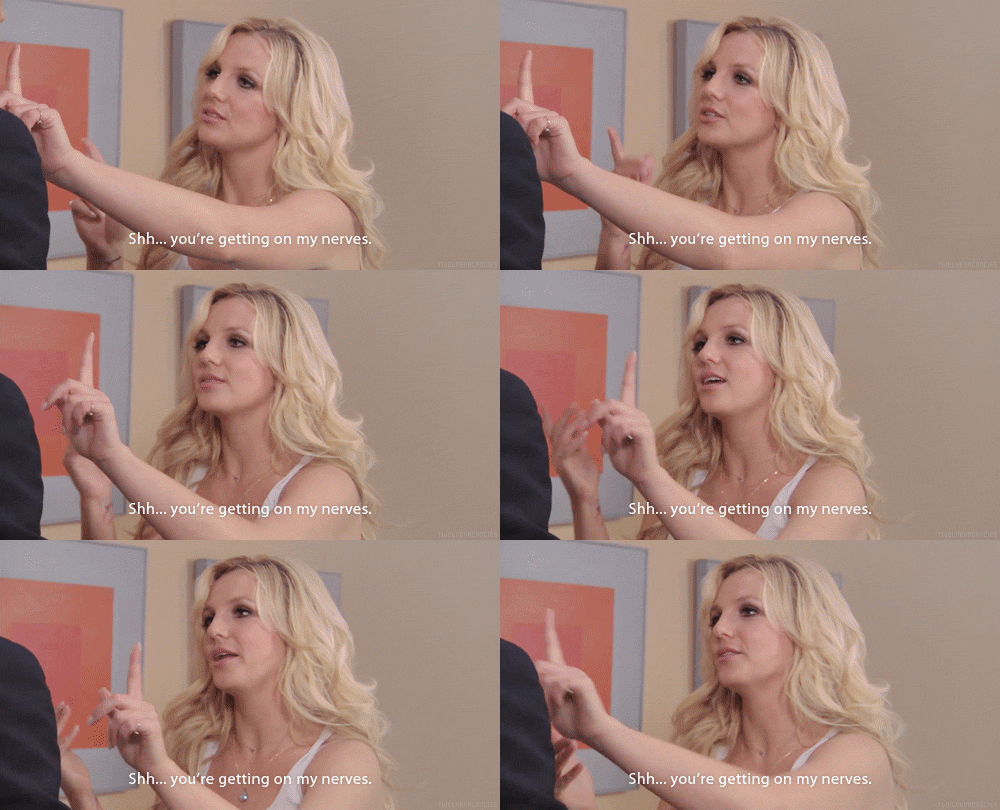
I wish I had a magical power where I could mediate a dispute between two sides and every time someone opened their mouth to distract, obfuscate, argue, or otherwise not say something helpful, I could raise my finger in the "shush" position AND THEY WOULD.  I would calmly tell them to try again, and they could start again, but if they just found another way to do the same thing, I could shush them again.  And they would all be forced to sit there until they learned how to properly discuss contentious topics.


It would help if *I* had that skill myself, so that I knew what "properly discuss" techniques were, but since this is a magical power, then I would magically know.

I had a partner once who I was attempting to teach about feelings, their importance, and how to identify and use them.  I remember one particular argument we had where I was trying to just get him to state his feelings.  That's it.

He said "I think they're wrong."  I said "that's not a feeling that you are having."  He said "well I FEEL that they're wrong."  I just could not get him to understand that the correct answer is "I feel frustrated and hurt and defensive."  He was just dead set on deflecting the conversation onto what OTHER PEOPLE were doing, not on what he was feeling.  In our entire relationship, I never got him to understand this.

I've seen other people who go into discussions where one person is trying to understand but the other person just keeps taking every attempt to understand as an attack and reacts defensively.  I want to make them put down their defensive positions and just talk.  Stop *arguing*, and start *revealing*.

Whenever I see an image of Impeachface McTinyhands, I have this same frustration.  Every time he opens his mouth, I want to bang a gavel at him to interrupt him until he learns how to fucking answer the goddamn question.  Spiceyspice too.

My head is filled with banging judges' gavels and Dr. Evil doing "shhh!" and Ruby Rod with his "zzzzzzZZZZzz!"


No.  Just stop it right there.


Try again.   Nope, that's still not it.


Nuh!  Try again.


Uh uh.  No.


Nope.  Stop. ...
joreth: (being wise)
*Sigh*  Normally I have no problem blocking people who are becoming a pain in the ass, but when it's a *friend* who says *several times* that he will back out of an argument and then refuses to do so, sometimes I have to hang up the phone for him.  But I'd rather not, and it hurts to do it.

I already know that when I lose my temper, I'll say things that I will later regret.  So when I back out of an argument, I back out.  I know that I can't be trusted to have a productive conversation when I'm too emotionally invested in my position to really hear the other side.   If you have the foresight to know that about yourself too, then seriously, back out when you say you're going to.  Because I guarantee, no matter what the person on the other side of the argument is like, you will only make things worse if you stay in an argument past the point that even you recognize that you need to take a break from it.

The other person could be the best, most calm and collected arguer ever, or they could be a total douchebag, and either way, if you're not in the right emotional space for the argument, anything you say is going to make things worse.  Which is why I back out when I'm getting pissed off.  Unfortunately, though, online spaces don't offer very good ways to "back out" and they rely on the other person's cooperation or nuking them.

I wish FB had an option to just, say, put someone in a time-out.  I mean, I know that you can unblock people later, but it's so ... final, so harsh.  Maybe I just want to stop someone from talking at me for a while.  It's like, if you're in an argument with someone in person, you can leave the room.  But if you're in an argument with someone at a *party*, then you have to either leave the party to prevent them from following you around the party to continue arguing or kick them out of the party.

Sometimes, neither is an acceptable option for the circumstances.  Sometimes, I just want someone to stop talking at me while I go into the "quiet room" at the party, or go talk with someone else on the other side of the room.  I can turn off FB for a while and let them rant and rave at an empty inbox, but then I can't wander around FB.  That's me leaving the party.  Besides, then they're still ranting and raving and those messages will be there when I get back.  Leaving might prevent *me* from saying something I don't want to say, but it doesn't make someone else take the space they need but won't take.  And obviously I can't kick *them* off FB (nor would I want to).

Unfriending & unfollowing aren't always the right options either.  When the problem is that someone I know posts shit that I don't want to see, then those are two reasonable options.  But when the problem is that someone keeps talking at me, unfriending and unfollowing don't prevent that.  I don't necessarily want to stop seeing *them*, nor do I necessarily want them to stop seeing *me*.  I want them to lose the ability to contact me for the moment, either DM or comments or tagging me.

And, maybe I don't *want* to actually unfriend someone.   I grew up understanding that friends and family argue sometimes, and it's not the end of the relationship.  Sometimes those arguments are some pretty ugly fights, even, and it still doesn't mean that the relationship *has* to end over it.

I've been reading some stuff (citations not at hand atm, but check out The Gottman Institute for more on that) that suggests that there is a point in an argument at which nothing productive is happening because the participants are "flooded", meaning too emotional, and taking a break at that point significantly increases the chances of a resolution post-break.  My family did this intuitively.  I think it's one of the reasons why I maintain such strong emotional ties to members of my family who have such different worldviews from me.

Sometimes I just don't want to be in *this* argument right *now* and the other person doesn't seem to have the self-control to stop arguing.  But, for whatever reason, I don't want to nuke the relationship.  It would be nice to have, like, a 24-hour Wall of Silence, where neither of us can message each other or comment on each other's posts, until we've both had some space and time to calm down.   But, y'know, you're still friends, and maybe you can even still see each other's posts and still interact in groups or mutual friends' comment threads.  You just can't PM them or talk *in their space*.

But as long as people can't seem to help themselves and continue talking at others past the point where even they recognize that they are not in the right frame of mind to be continuing the conversation, I have to resort to blocking.

And I don't like that.   There's not enough nuance in our online responses, and I think that hurts us individually and as communities.
joreth: (boxed in)
So far every single match online who was even a slight possibility has failed my second test (the first one being "can you even read?" with my bio having specific terminology).

As a "single" woman, a poly person, and someone who prefers kitchen table poly in particular, I prefer to meet people for the first time in social settings.   I like meeting at parties and public events.  The other person can even bring their friends with them.   I realize this isn't common, but it's what I prefer to do.

This does several things - it keeps me safer from danger because I'm in a familiar setting with other people, it gives us both an "out" if we don't click.   They have people they can talk to, I have people I can talk to, someone in the group is bound to be That Person who can keep even a limping conversation going, one of us can always leave early because we're not really "ditching" someone if they're there anyway for the event itself, if the other person sucks, we can use our friends as a buffer, etc.

And finally, it shows me just how comfortable they are with the idea of polyamory, or even just with someone being sociable and outgoing and having their own friends.  I don't have a lot of free time, so I tend to combine activities so I can see the most amount of people in the shortest amount of time.

I also prefer for my partners to get along with each other, at least socially, if not become friends.  So I want to see how well these prospectives handle meeting my friends.   How well they handle me sharing or splitting my attention.  I am not a beginner relationship.  I throw people in the deep in right away because I don't have time or energy to teach them how to swim.

And I want my friends' opinions on the new guy because I don't trust rose colored glasses.   I don't need my friends' "approval", but I want some independent verification.  Plus, the social event is usually an activity that means a lot to me.   How accommodating is he of the things I'm passionate about?  How interested is he in the things I'm interested in?

I know that not everyone likes large social events, but that's a compatibility issue in its own right with me.   If they really hate social events that much, we're not going to get along long-term.  I also know that it's hard to have a more personal connection in these kinds of settings, but that's not what I'm looking for when I arrange them. I would have had to develop some kind of connection before even inviting them out. Now is the time for me to see if there is any real-life chemistry in a safe, controlled way.

And only then, if I don't instantly hate them on sight (something that happened to me when a guy I met online from out of town planned a week-long trip to meet me, which really sucked for both of us), I'll plan something more personal and intimate to get to know each other better.

And so far every single person (but 1) who has made it past the first test has failed this one.  Every single person I agreed to meet from an online dating app has said they'd meet me at some public event and then failed to show up.

So, guys, when a woman you're interested in says that she is passionate about this thing, and she would like to meet you in this context, don't fuck that up.  She is inviting you into her world in a way that gives her a feeling of control and safety.  When a woman you know invites you to a thing she is really interested in, don't fuck that up.  She is inviting you into her world, to share something with her that sparks joy in her life.

These are Bids For Attention.  When Bids For Attention go unacknowledged, people pull away.   When it happens enough times in proportion to the investment already made into the relationship, this will kill the relationship.

And for something that hasn't started yet, it really only takes once or twice.  So now even guys I was actually interested in meeting are now off the table for me.  They totally lost their chance by refusing (not being "unable", but *refusing*) to meet me under the circumstances I proposed.

Because it's not like I'm a passive communicator or someone who drops hints.  I've said outright that this is how I prefer to meet people and why.   Quickest way to kill any interest I might have in you is for you to ignore my Bids For Attention, to overlook my safety concerns, and to dismiss the things that I'm passionate about.
joreth: (dance)
A few years ago I wrote about a dance situation where I was sliding into a depressive state but putting on my best pretend-happy face (https://joreth.dreamwidth.org/387838.html).   I went out dancing and met up with 2 friends that night - one dancer and one non-dancer.

The non-dancer and I had been having some incredibly intimate conversations recently and we were getting to know each other *really* well.  He saw the effect that the endorphins had on me and thought I looked happy.  I was smiling, outgoing, and having one of my best dance-skill nights where I was totally killing it on the floor.   The non-dancer saw all of that and remarked on how happy I looked.

The dancer friend and I had not had that same level of intimacy and we only knew each other marginally well.  But after one 3 minute song of full-body contact, he could see the depression behind the smile and the dance endorphins.

So now I want to give another example of how partner dancing gives people amazingly good non-verbal communication skills.

In 2019, I started a casual relationship with another dancer.   We were becoming pretty good friends, but we still had some barriers up in the emotional intimacy department.   We were having fun, but that's about it.  But he's a fantastic lead and can build very good partnerships with his follows on the floor.   I'll call him Michael.

We had not told anyone in our dance communities that we had been sleeping together.   First of all, we weren't *dating*, so it felt weird to be making announcements about a casual relationship, but second, we are both community leaders and we didn't want to make things weird with overlapping our private and public lives.

Plus, he's ultimately monogamous and available for a dating relationship, so eventually he would want to find a romantic partner (probably from within the dance community) and having everyone already know that he's hooking up with someone else tends to make potential monogamous dating partners keep their distance.   He would, of course, disclose to anyone to whom that information is relevant, but it didn't need to be public knowledge.  Ah, the complex, twisty rules of mono culture.

I have another friend, who I'll call Anne, who is also a dancer.   She and I have a similar level of platonic emotional intimacy - decent friends but still getting to know each other.   Anne and Michael have their own friendship with each other, and it's possibly a closer emotional relationship than I had with either of them.

So, on this particular Wednesday night, I went to my usual dance event, and I met a guy there who was interested in using the venue.   The manager wasn't there that night, so he wandered over to my event to make connections.  So we chatted and I let him in on how our event was arranged and stuff.  I'll call him Nick.  I was feeling some chemistry between us, but I wasn't sure how much of that was real and how much was just because I had really good sex earlier in the day and I was still all after-glowey.

I found out that, in addition to Nick being a promoter, he's also a Latin dancer.  So I invited him up to my DJ booth to pick whatever song he wanted and to dance with me.  So we did and he's a fucking amazing dancer - one of the best I've ever danced with.

Earlier, he had given me his business card, offering to help me with promotion of our event.   It felt like a pretty typical networking type of exchange.  Later, while bent over my laptop looking at music (he also gave me a ton of his own music, so we were talking and exchanging files), he suggested I call him to get together and do more music exchange when we had time and more drive space, and he gave me his personal number.

Now, this could have gone either way.  It could have been more networking, or it could have been a soft flirt to see if there was interest.  I enthusiastically accepted his number, y'know, to exchange music.  Then we danced.  He said several times that he was impressed, given that I'm not a Latin dancer, I'm a Ballroom Latin dancer (which is different) and a beginner at that.

So I put on a bachata, which I like better than salsa, and we danced again.   Then he mentioned another style of dance that I might like and when I asked him what it was like, we danced again.  I was definitely feeling the chemistry.  After the 3rd dance, the conversation lulled, and I excused myself to mingle with my other guests and friends.   Here's the relevant part...

As I was walking across the rather large dance floor, apparently I was smiling.   Anne and Michael were standing next to each other, both watching me (everyone had stopped what they were doing to watch me dance with Nick just a moment before).   Michael remarked to Anne that I looked happy.

Anne, knowing that I often get trapped by men in uncomfortable conversations because a) I'm a woman at a nightclub and b) I'm the event host who has to make the rounds and talk to everyone, suggested the possibility that it might have been a tense smile.   Keep in mind that I'm still a good 50-60 feet away and it's dark with flashing, disorienting lights.

Michael, without taking his eyes off me, said "no, that's a happy look".   Apparently Anne glanced sharply at Michael as she realized that he was able to tell the difference between my happy smile and my pasted, polite but tense smile.   She looked at him, looked back at me, back at him, back at me, and on the third glance back at him (all of which I could see as I walked towards them), she asked him if we were sleeping together.

Surprised, he looked at her, admitted it, and then asked how she knew.  She said that the first clue was his knowing the difference between my smiles, and what confirmed it was the expression on his face as he watched me walk over to them and his relaxed posture, as well as my own body language while I walked towards them.

All of this happened in the span of time it took me to walk across the dance floor.  When I arrived, I told them all about who the guy was and mentioned that I got his number.   Michael said "see? Happy smile!"

So, here is someone I have been dancing with for months able to tell at a glance from across a *dark* room the difference between genuinely being excited about something and being polite to a new person and my general enthusiasm for the activity.   Because he is getting to know me very intimately through dancing.  The sex helps, but that's relatively new compared to how long we've been dancing together, and also sex is very contextual.   Dancing expresses a lot of different emotions, and we can feel that with the music and the body contact.  And here is someone else who I have *not* been dancing with but who has general non-verbal communication skills, and who *has* been dancing with the other person in this scenario so she knows *his* body language almost as intimately as I do.

He can read me, she can read him, and through our mutual connection with him and our general skills, she can infer my mental state too.  Kind of like the dance version of metamours. 

I know that a lot of people don't like dancing or think they're bad at it.  But I can't stress enough just how valuable those skills can be in interpersonal relationships. I've known some people who are just naturally that intuitive, but I don't know of any other activity that people can practice that develops this level of intuitiveness and awareness of other people.  This is an activity that can *teach* and *improve* exactly this kind of non-verbal communication and intuitiveness regardless of one's starting point in intuiting non-verbal communication.

I would like to encourage more people to try partner dancing, or at least to learn lead / follow exercises, to add one more *incredibly* powerful tool to their relationship toolkit.
joreth: (sex)
I do not believe in "converting" people to polyamory, or any other relationship style or sexuality for that matter. I don't believe it can be done and I believe that attempting to do so is inherently coercive. I believe people have the right to choose whatever relationship style or sexual behaviour they want, no matter what it is or why they choose it, with the exception of anything that violates other people's agency (sorry, you don't have the right to choose to force young boys to give you blowjobs behind the alter just because you're their priest, you just don't).

You can *introduce* people to new things, but I don't think you can *convert* them to something they're not or don't have their own internal motivation to try and become. And I would rather not have these people being pushed into my communities because they flail around and smack up everyone who gets near them. If you don't want to try it, then don't. Please, don't. Stay out of my communities unless you actually want to be there.

www.quora.com/How-can-I-convince-my-husband-to-let-me-sleep-with-other-men-He-has-slept-with-many-women-before-our-marriage-and-I-am-jealous-that-I-did-not-have-that-experience/answer/Joreth-Innkeeper

Q. How can I convince my husband to let me sleep with other men? He has slept with many women before our marriage and I am jealous that I did not have that experience.

A.
You can't "convince" him. At worst, that would be coercion. You can lay out your desires and your reasons for them, and then you can A) accept his decision to not consent to an open marriage, B) accept his acceptance of an open marriage, C) cheat, or D) leave.

You have to decide, ultimately, what is more important to you - having other sexual experiences or remaining married. When you know what your answer to that question is, then you will know how to proceed with talking to your husband about deconstructing and reconstructing your marriage into an open one ("Opening Up" A Relationship Doesn't Work, Try This Method Instead - https://joreth.dreamwidth.org/375573.html)

If your marriage is more important, then be prepared for him to say that he does not want an open marriage and you will have to give up your fantasy. If the sexual encounters are more important, then be prepared for him to say that he does not want an open marriage and you will have to divorce him if you want to remain an ethical person.

You are allowed to have your desires. But he is also allowed to only consent to the kind of relationships that he wants to have. Once you know where the line in the sand is drawn, you can share that information with him so that he can make an informed decision about what kind of relationship he will engage in with you.

Just be careful not to make it an ultimatum (Can Polyamorous Hierarchies Be Ethical pt. 2 - Influence & Control - https://joreth.dreamwidth.org/349226.html). This shouldn't be a way to control the outcome of the discussion. You shouldn't go into it thinking "you better let me have other sexual partners or else I will divorce you!" That's punitive. If you are relying on the threat of divorce to get your way, that's coercion.

But if his "no" is an equally acceptable answer to his "yes", then saying "honey, I love you, but this is a thing I really need to do for myself, and if you don't want to share this journey with me, I'll understand, but I do have to travel this path one way or another and I hope I can share it with you" is not an act of coercion, it's an act of love and acceptance and of giving him the information he needs to make a decision. He might not feel that way in the moment, though. Sometimes it's hard to see the difference.

There are tons of books and forums and websites everywhere that can help people wrap their brains around open relationships. I'm sure others will share those resources in the comments. You can try giving him those resources and see if that helps. My favorite is the book More Than Two (www.MoreThanTwo.com).

But ultimately, you cannot "convince" someone to have an open relationship. Dragging a partner into any kind of relationship they don't want grudgingly makes things much worse. That goes in both directions, btw. You staying in a monogamous relationship grudgingly will make everything worse for you both too. Should you decide that your marriage is ultimately more important than having extramarital sexual relationships, make sure you own that choice. Make that choice *yours*, not something he forced you into. Don't frame it as "he won't let me have sex with other men", frame it as a choice you made to be with him. Otherwise, you might end up losing the marriage anyway.

First, look at all the worst case scenarios - you have other lovers and get divorced, you stay with him and feel resentful, you cheat and damage your integrity, his trust, and possibly get divorced anyway, etc. - and decide which worst case scenario is the one you are most willing to risk. Then come to your husband with that in mind. Lay it all out for him, including the consequences for what happens if he doesn't give his consent, so that he can make an informed decision.

And then live with your choices.
joreth: (sad)
www.quora.com/What-is-a-common-sign-that-a-marriage-relationship-is-heading-for-a-breakup-which-many-people-often-neglect-or-dont-know/answer/Joreth-Innkeeper

Q. What is a common sign that a marriage/relationship is heading for a breakup, which many people often neglect or don't know?

A.
Dr. John Gottman and his team of relationship researchers have identified what they call the Four Horsemen of the Relationship Apocalypse. When these 4 traits appear in a romantic relationship, Dr. Gottman can predict the demise of said relationship with a ridiculously high degree of accuracy (most reports are over 90% accuracy). So if your relationship has these 4 things, it's probably doomed.

The Four Horsemen: Criticism, Contempt, Defensiveness, and Stonewalling - https://www.gottman.com/blog/the-four-horsemen-recognizing-criticism-contempt-defensiveness-and-stonewalling/

2 things that most people don't know is that 1) just having conflict in a relationship or feeling anger is NOT, by itself, a sign that a relationship is heading for a breakup - people have arguments and conflict and feel anger and that's just the nature of interacting with other people in intimate settings, so just having arguments doesn't mean that the relationship is unhealthy or about to end, but that 2) there is a ratio of how *often* or how *much* conflict or unhappiness a relationship can withstand and it's much lower than most people think.

In a relationship, Gottman and other researchers also discovered that there should be a ratio of "negative interactions" to "positive interactions" overall in a relationship that is 1:5. That means that for every bit of ";negative interactions", there should be 5 bits of "positive interactions". Lots of people think that they should stay in relationships until the happiness ratio tips over to where you are unhappy more than half of the time. That's not true.

The Magic Relationship Ratio, According to Science - https://www.gottman.com/blog/the-magic-relationship-ratio-according-science/

So, the predictors of the ending of a romantic relationship are criticism, contempt, defensiveness, and stonewalling. Anger is not among the predictors. If you have these criteria in your relationship more often than 1:5 compared to positive interactions, the relationship is probably on its way out.
joreth: (being wise)
-But I'm just being honest!-  That's right.  You are JUST being honest.  You are not being compassionate, or considerate, or thoughtful, or loving, or polite, or even pleasant.  Just.  Honest.  There are times when someone has to deliver an unpleasant truth.  There may even be times when that person is the -just being honest- fanatic.  But so much more often, unvarnished honesty is unnecessary, unkind, and unwarranted, and a little thought put into the delivery of the message would go such a long way toward making it valuable and constructive feedback rather than a shattering blow.  Most people who insist on being -brutally honest- enjoy the brutality much more than the honesty.This is the problem I have with the Radical Truthers. Much like NVC, I tend to only see it being used by people who want to be assholes and pass off responsibility for how their behaviour affects other people's feelings.

You can be truthful AND kind.

But if you're going to be truthful without being kind, at least be honest *about that*. I am quite often not kind. But I'm not going to defend myself by blaming the other person's hurt feelings on "but I'm just being honest!" No, I am trying to make people feel consequences for their actions, so I will say things intended to be *felt* because that's my point.

But when it comes to interpersonal relationships - those connections that I value among people I want to keep in my life such as friends, partners, and family, there is no need to "just be honest". I can be both honest and kind.

That doesn't mean that it will never hurt, even if I'm trying to be kind. It means that I am delivering my honesty with compassion and understanding of the impact of my words and I'm not saying "truth" just to say the truth. I'm taking responsibility for the effect I'm having on the people around me.

Honesty is not a virtue. Courage is a virtue. "Just being honest" is not being courageous. Being compassionate, considerate, and thoughtful is being courageous. Take the Path of Greatest Courage and don't hide behind "just being honest". Honesty, by itself, is not enough.
joreth: (anger)
Everyone gets this shit wrong. Personality Type Systems are extremely limited and narrow in scope, but within their very limited range, can be very useful. People just keep wanting to widen their applicability, and that's when they turn to shit. These are not newspaper horoscopes, putting you in boxes and telling you how to run your life. They're merely a set of language that *you* decide which describes you, that can help you understand yourself and others *in narrow ranges* that you can use to better communicate with people who you want to understand and who you want to understand you.

ttps://www.quora.com/How-should-one-view-their-Myers-Briggs-type-Would-it-be-wise-to-base-your-relationships-and-employment-on-what-it-says/answer/Joreth-Innkeeper

Q. How should one view their Myers–Briggs type? Would it be wise to base your relationships and employment on what it says?
Joreth Innkeeper, teaches workshops on Type Systems like MBTI & 5LL

A. MBTI is, at best, a communication tool. It should not be used to make any kind of decisions for anything. It can be used to explain to another person how you work, so that they know what to expect from you, and to then offer you some shorthand to reference these points later.

For instance, I am an INTJ. One of the characteristics of this category is that I really like having my plans on the calendar and scheduled, and I get very uncomfortable and anxious when the plan is changed.

My former sweetie, who works with the actual institution that controls the MBTI (not one of these knock-offs that just make up online quizzes based on some workshop they once took on MBTI), introduced me to the “hit and run” method.

This is when we have plans, and suddenly something comes up that has to change the plans, like if we were going away for a weekend vacation and on Friday morning his boss tells him that he will have to stay late instead of leaving after lunch for our trip. So then he would have to call me and tell me that the plans have changed.

For someone of his type (ENTP) to be dating someone of my type, we often had scheduling challenges because I prefer more structure and he is very spontaneous and can more easily roll with change. So this might be mildly irksome to him to have his boss delay his vacation plans, but to me it would be a huge deal. I would have a lot of strong, negative emotions about it when he would be over it already.

So, he would call me up, say “sorry, sweetie, plans have changed, we have to leave tonight instead of this afternoon, oops, gotta go bye!” and let me stew by myself. Then my own processes would kick in and I would get back to planning a contingency and backup plans, which alleviates my anxiety about the change. By the time he would call me back in an hour or so, I would feel better because I “solved the problem” by creating a new plan. He would ask how I’m doing, and I could say “OK, here’s what we’re gonna do…” and lay out the new plan.

I would be happy because now I have a new plan, he would be happy because he doesn’t have to plan anything, and even though things wouldn’t be our ideal, we would have solved the issue.

If he had stayed on the phone with me, he would have had to listen to me get upset at the change in plans, and the anxiety of “what are we going to do now?” He would have wanted to try and reassure me or console me and try to tell me to relax, to just roll with it, everything will work itself out.

For someone with my type, telling me to just relax and not worry, to just let things work themselves out, would be the wrong thing to say. But to someone with his type, it would have made *him* feel better if the situation was reversed. So he would have been upset because I was upset, and then I would have gotten upset because he wasn’t helping me figure out a plan and he was making things worse by dismissing my concerns.

The “hit and run” worked a lot better for us. Once we realized that our conflict was a product of our personality types, we could come up with a solution. And then later, I had some terminology to explain to both him and to other people how to solve this problem with me in the future.

When I started dating other people, I could tell them “I am an INTJ, which means I feel this way about scheduling and change and plans and organizing.” They could tell me how they feel about those topics, and then if they happened to also be one of the categories that likes spontaneity, I could say “OK, then, if this situation comes up between us, the hit-and-run method is the best way to deal with me.”

Then, later, when I am faced with a plan change and I start freaking out about it, if the new person is just standing there looking lost at me, wondering what to do, I can remind them “I’m just being INTJ right now, remember how this goes?” and they can say “Oh, right, we talked about this - the hit-and-run, OK then, I’ll leave you to your planning and not take your freaking out about this as personal or as something that I need to fix for you”.

Knowing the processes going on behind the behaviour and the emotions helps two people communicate with each other and helps them to find solutions that work for their particular dynamic. MBTI is one system among many that offers language and a structure to facilitate that communication and solution-finding process.

But it is absolutely not meant to help you make decisions. MBTI is not a set of boxes that we all fit into. It’s more like a spectrum of handed-ness. If you were to draw 2 lines from left to right, one line on top of the other, and put 0 on one side and 100 on the other, and then place an x somewhere on the top line for how often you use your right hand, and another x on the bottom line for how often you use your left hand, you could use those two lines to determine if you were right handed or left handed.

Handedness is a category. People are either right or left handed (let’s leave out ambidextrousness for now). But that doesn’t mean that they don’t use both hands on occasion. And it doesn’t even mean that there is a spectrum with left handed use on one side and right handed use on the other. You have an individual spectrum for each hand. The one that gets used the most is your dominant hand, but if you added up the amount you use each hand, you would get more than 100% because the amount you use each hand overlaps.

Same thing with types. You are not in an either/or box. You are on a spectrum of each individual trait where you use some more than others, or where some come more easily to you than others. You will still use the others a little bit, and you can learn to use the others the way you can learn to use your off-hand if you want to.

In addition to that, our experiences throughout life teach us skills in those traits that are not our dominant traits. Many of those experiences come very early in life, so it can be difficult to tell if your skill with those traits are “natural” or “learned”. Scheduling, for example - our society encourages good scheduling skills from our very early days in primary or elementary school.

Many people learn how to schedule well, whether it’s “natural” for them or not. That same partner I was talking about above has diabetes, so as a young child, he learned how to schedule his day around his eating needs, to prevent any diabetic complications. Yet scheduling is not “natural” to him and not something that he likes doing. But he’s very good at it … when he wants to be.

So you can’t make decisions based on your category because there are too many things that can influence individual people - life experiences, deliberate training, where on the spectrums they fall, etc.

DO NOT use MBTI to make decisions about who to date or what kind of job to take. I can’t stress this enough.

DO NOT MAKE DECISIONS BASED ON MBTI.

Use MBTI for its intended use - as a communication tool to better understand yourself and the people you are relating to such as partners, family, coworkers, etc.

joreth: (being wise)
www.quora.com/What-is-the-most-ridiculous-thing-you-and-your-spouse-fight-about/answer/Joreth-Innkeeper

Q. What is the most ridiculous thing you and your spouse fight about?

A.
Franklin and I once got into an argument at a kink convention.  We were waiting in line for registration and someone walked past us with some kind of bright, unnatural hair color.  I don’t remember what color it was, but it caught our attention.  Franklin called the color by one name, I called it by another name.  And I don’t mean he called it “carnation pink” while I called it “rose pink”, I mean we called it by actual different color names.  We were both adamant that it was the name we called it.  We were both shocked that the other apparently saw a totally different color.

For some reason, this debate felt personal and I had to insist we drop the subject.  It got all wrapped up in my feelings of being dismissed by a partner, of having my judgement questioned, of being ‘splained at (because I’m a photographer and a lighting technician - I literally get paid to create color with light), of a whole bunch of other things.

I couldn’t understand why he was disagreeing with me, or why he saw the color so differently.  Unlike the stereotype, Franklin is also a photographer and used to work in printwork, like, magazine layouts and stuff.  He actually has a really good, nuanced eye for color.  But we saw this color so very differently.

Later, we had a totally different conversation that clarified things for me.  It’s not that we saw different colors, it’s that we both saw the exact same color and we just arrived at it from different perspectives.

You see, I work with light.  Color in lighting is an additive process.  You add colors together to get different colors.  Franklin works with ink, which is a subtractive process (https://www.xrite.com/blog/additive-subtractive-color-models).  You take colors out to get other colors.  When you add all the colors of light together, you get white.  When you add all the colors of paint and ink together, you get a dark, murky brownish, greyish black.

I see the world in terms of how light waves interact with each other.  Franklin sees the world in terms of pigment.  I see the world in RBG and he sees it in CMYK

Once we got to the root of the problem, the argument no longer upset me.  It was simply a matter of coming to the same conclusion from two different perspectives - neither of us was wrong, but in different contexts, we each had different perspectives.

It’s my experience that “serious” arguments over “silly” things are really symptoms of deeper things like worldviews or perspectives.  We could have just let this argument go and dismissed it as being “silly” because the name of that person’s hair color was completely irrelevant to anything important in our lives (or we could have asked him the manufacturer’s label for that color and solved the debate).  And, honestly, we did both let it go.

But when an opportunity came up to look deeper into the conflict, I took it, and discovered something more important at stake - it wasn’t really about the name of the color, it was about respecting each other’s different experiences and knowledge bases and perspectives.  We had the opportunity to learn more about each other as individuals, and through that learning came more understanding, which came greater respect.

So, while certainly plenty of “silly” arguments exist that have no real deeper meaning, I’ve learned that if an argument about “silly” things feels serious, it’s worth looking into why.  This was a “silly” argument.  But had we just let it go at that, without taking the opportunity that the subsequent discussion afforded us by making a connection to that “silly” argument, we wouldn’t have reached this better understanding of each other, and we quite possibly might have had an actual, real serious argument later where we were unable to find common ground because we hadn’t had this experience of seeing each other’s perspectives.

Not all perspectives are “valid” in that they’re not all equally correct.  Sometimes someone really is just wrong about something.  But, in this case, approaching a color from an additive perspective vs. approaching it from a subtractive perspective are both valid, in that they’re both legitimate approaches to arrive at a color.  We got to see that about each other, and we can take that respect for our different backgrounds and experiences into our future conflicts, which have helped us to find common ground at times when it feels like we are seeing two totally different colors.

And now we play-disagree ironically about which is better - RGB or CMYK.
joreth: (::headdesk::)
Dudes - show even the barest minimal effort in who she is as a person. Trust me, it will totally make you stand out from the crowd.

Right now, I am open to both LTRs and casual relationships. I can totally have casual sex without an emotional connection to people. I am capable of having a purely physical chemistry with someone without it being related to how I feel about them as a person. And I'm non-monogamous. If I express interest in a guy, it's *almost* a sure thing under these conditions.

So I'm on Tinder, which is all about the quick, physical attraction version of matching. I see a guy that I find attractive. I'd consider hooking up with him. Only problem is that I don't want to get blindsided, yet again, by someone who expresses interest and then suddenly pulls back because of a problem with who I am as a person.

If we don't match, then we don't match, and that's fine. Just don't lead me on thinking that we do and I start to get attached and then pull the rug out from under me because of an integral part of who I am.

So, I "like" a bunch of profiles, and I make the first contact email, because I have no problem being a woman who does that. But I squeezed a whole bunch of controversial labels into my character-limited profile to get all that shit out up front. Then, I send everyone some version of the following message:
Me: Since we matched, you had to have found me interesting in some way. Did you read my bio? What parts interested you? Does any of it suggest we might not be compatible?
So far, without exception, everyone has responded to my message with a variation on this:
Him: think we would get along just fine, and it doesn’t hurt that you are crazy beautiful😉
Me: OK, but that didn't answer my questions
Dudes.  My profile is one fucking paragraph long.   All you'd have to say is "hey, you're an atheist? Me too!" or "actually, I don't know what solo poly means" or "honestly, I swiped because of your pictures, but now that I see your profile, I don't think I'd get along with a feminist, but thanks for messaging me!"

THIS IS NOT HARD.  I'm totally setting you up for a win here, or at least an easy out.  Put forth ANY effort.  ANY.  AT.  ALL.

**Edit**

To be fair, I was finally able to drag out of about 2 or 3 people a response to my initial questions.  So far about half of the people I had to say "but that didn't answer my questions" eventually answered them, sort of.

Most of them I ended up unmatching with because, as I said to one of them, it shouldn't be this much work to get a guy to pay attention to who I am when that guy *says* he's interested in me.

There are a couple-three guys who I didn't send that particular question to because they actually had info in their own profile that I was able to respond to.  So I opened my conversation with something specific to their bio - "hey, it says you like dancing, what kind of dancing do you do?", "you're a camera operator? Me too!", "you just came back from Korea? What was that like?"

Again, Tinder bios are one paragraph long.  It's really not that difficult to read and comment on something in the profile (assuming there is anything specific in the profile to comment on, besides "I like food, music, and hanging out").  The bio even pops up over the second picture when you're swiping through their pictures.  Just pick one thing in the bio and comment on it.

And when I message you first and *ask you to pick one thing in my bio and comment on it*, then fucking do that.
joreth: (boxed in)
How Not To Break Up With Someone:
  • "I totally can't do this polyamory thing. What if you find someone better than me?!"
     
  • "Nvrmd, I totes can! I'm definitely ready to try polyamory! Let's do this!"
     
  • "JK! I'm getting back together with my ex and she won't allow me to be poly, so I'm blocking you now."
How Not To Break Up With Someone:
  • Spend a solid week convincing them to give you a chance over their concerns that you don't have enough relationship experience for them.
     
  • Make a date with them explicitly to discuss whether or not you can date each other.
     
  • Stand them up for that date.
     
  • Block their methods of contact so you aren't tempted to respond and they don't know that you're not getting their attempts to reach out.
     
  • Leave them a message on Facebook to read when they get home after spending all night wondering where you are, saying how much you learned from them about ethics and personal growth, but sorry, you can't ever talk to them again in any capacity.
     
#ThisIsWhyINeverAssumeAnyoneIsLyingInADitchSomewhere #TheyAreAlwaysAtHomePlayingXboxJustAvoidingMe #GhostingSucks #BreakingUp #HowNotToBreakUp #EthicalBreakups #YallHaveShittyBreakupSkills
joreth: (sex)
https://www.quora.com/Some-women-say-they-dont-want-a-guy-to-ask-for-permission-to-kiss-them-They-say-Just-do-it-But-the-MeToo-movement-and-current-culture-seem-to-make-it-risky-for-a-man-to-take-any-actions-without-getting-consent-How/answer/Franklin-Veaux

Consent is so difficult for some people to grasp!

So, I have a non-consent fetish. I really like rough, violent sex. I like it when it feels like my partner is so overcome with lust for me that he just takes me without regard to my feelings on the matter. My interest in violent sex waxes and wanes depending on other variables in my life. Sometimes I really don't want any violence at all and I'm totally into the whole sappy romance-with-candlelight-and-soft-focus-filter thing. But when I'm in a depressive state, my interest in violent sex is particularly strong.

I happen to be in one of those depressive states right now, while simultaneously actively looking for new partners. Which means that dating is particularly frustrating for me, because I really want that whole swept-away, passionate, lustful experience but men are just awful and I can't stand them right now because politics and depression. When some of the people on the dating apps that I'm using start right out with the kind of aggressiveness that I could have been into, I get pissed off at them. So, things are complicated for me right now.

But if I was out with someone, and there was some chemistry between us, and he did this to me ... I'd probably drop trou right there. Aggression, control, and still consent.
"lean in and whisper in someone’s ear, “You’re very attractive and I would love to kiss you, but I’m not going to unless you tell me you want it.”"
What if something like that happened at each stage?
  • "I want so bad to touch you right now, but I will not unless you tell me you want it."
  • "Tell me how much you want to stroke me, and then do it."
  • "I want to feel your heat, your wetness, I can tell you want me to, but you have to ask me for it first."
  • "You smell so good, I want to taste you. As soon as you tell me you want me to."
  • "I'm right here, about to penetrate you, but I'm not going to, unless you tell me you want it."
joreth: (feminism)
I'm listening to the song Hole In The Bucket. The way I've always heard the song performed, it seems to imply that the guy is basically lazy and expects his wife to troubleshoot everything for him.

It's like, guys who can't find their keys or socks or something, and take one glance around the room and then shout to their wife in the other room "where is it?" and the wife, who is up to her elbows in soap suds with screaming kids running around her ankles and food burning on the stove has to also mentally remember the details of every room in the house and all her husband's activities since he came home the night before to find whatever it is he lost because he can't be arsed to actually look for the thing.

The song is always sung with irritation at the guy who can't manage very simple domestic tasks and expects his wife to tell him each step along the way.

But today, I had a different perception.

If the genders were reversed, and I was playing "Henry", this song now sounds to me like being mansplained at.

Henry isn't doing a thing. Liza tells him to do a thing. Henry gives a reason for why he's not doing a thing, so Liza tells him to fix it. Every step Liza suggests, Henry asks Liza how he's supposed to accomplish that step, until we come right back to the beginning where he can't do the first step because of the original problem he mentioned at the beginning.

This reminds me of the argument I got into with my parents' friend about why I don't have health insurance. "Just save money!" How am I supposed to do that if my bills are higher than my income? "Get a better job!" How do I do that if the economy is in a recession and there aren't enough jobs? "Go to school for a better education!" How do I afford school if I don't have any money? "Save better!" With what income?

And 'round and 'round it goes.

It felt, to me, this time listening to this song, that Henry already knew there was a problem, but Liza thought she knew better, and Henry had to walk her through it, step by step, to reach the conclusion he had already reached. And, as a woman, I find this "well how would you suggest I solve this problem then?" questioning method to be very familiar, as a lot of men really don't like it when I simply make statements.

"OK, that sounds reasonable. Oh, wait a minute, but then how would I do this part if this thing is happening?" Constantly catering to the person offering "advice" and doing emotional labor to manage their own feelings so that they don't get "hurt" that their advice isn't warranted. Spending all this time walking them through the decision tree until they finally get to the conclusion I have already reached and doing so gently so they don't get their feelings hurt when I was the one who was dismissed, as though I couldn't have figured all this out on my own.

Up until the very last verse of the song, where we come to the first verse again, with the genders as-is, this song is still very much a "women are the Household Managers and have to do all the Domestic Labor even when the men 'help out'" situation.

But when we come full circle, then I suddenly switch to the other side and hear the lines as not Domestic Labor Management but as Unhelpful Fixer Offering Not Applicable Suggestions.

So that was an interesting perspective shift.


joreth: (being wise)
https://www.quora.com/How-does-an-open-relationship-differ-from-a-polyamorous-one/answers/114146576

Q. How can you tell if the person you are with us in an open relationship or a polyamorous one?

A. Ask them.

Ask them “what kind of relationship are you in?”

Ask them “how would you describe your relationship?”

Ask them “what label do you use for your relationship and how would you define that label?”

Ask them “would you tell me more about how your relationship works?”

Ask them.

#SeriouslyItIsNotThatComplicated #JustFuckingTalkToEachOther #IMightBeALittleBitSnarkyTonight #LowValueQuestions
 

Tags

August 2024

S M T W T F S
    123
45678910
11121314 151617
18192021222324
25262728293031

Syndicate

RSS Atom

Banners